
Summary
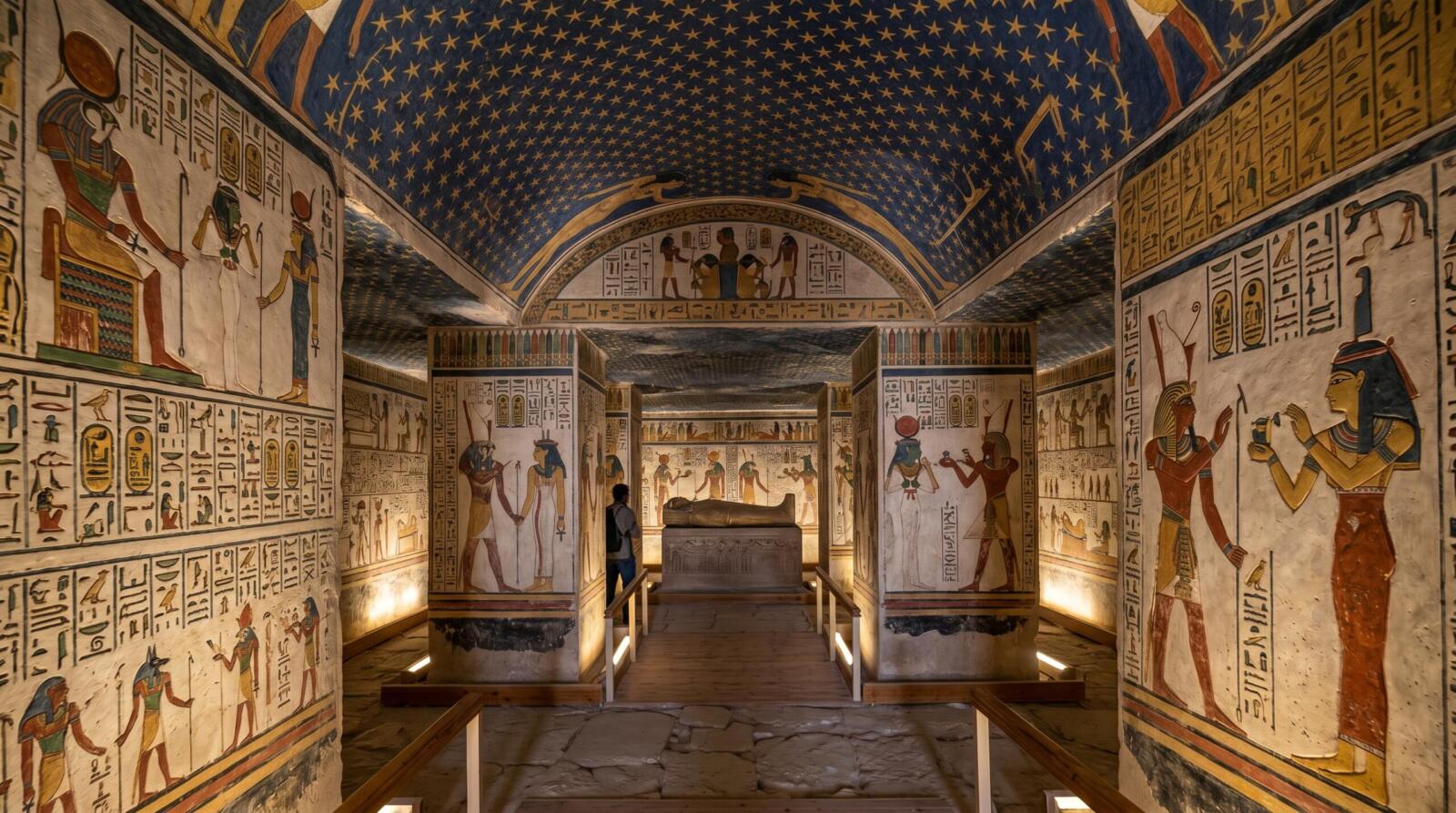
Ancient Egyptian art was made to last forever and to work: a statue could house a spirit, a painted meal could feed the dead, and a carved king could keep order in the world. That is why it followed strict rules for 3,000 years, with figures shown side-on, a fixed set of proportions and colours chosen for their meaning. Most of it was never meant to be seen by the public: it was made for tombs and the inner rooms of temples.
Why Egyptian Figures Look the Way They Do
Egyptian artists did not draw what the eye sees from one point. They combined the most typical view of each part of the body:
- the head in profile, but the eye drawn as if seen from the front;
- the shoulders and chest from the front;
- the waist, legs and feet from the side, often with two left or two right feet.
The aim was a complete, readable figure that would “exist” fully in the afterlife. Size showed importance: kings and gods are drawn larger than their servants, and a wife may be shown tiny beside her husband’s legs.
The Grid and the Rules
Artists laid out each figure on a grid of squares. In the Old and Middle Kingdoms a standing figure measured 18 squares from the soles of the feet to the hairline; later artists used a grid of 21 squares. The grid kept proportions identical across centuries and let teams of craftsmen work on one wall. Scenes were arranged in horizontal bands called registers, read like a comic strip, often with hieroglyphs as captions.
The Meaning of Colours
| Colour | Made from | Meaning |
|---|---|---|
| Black | Carbon (soot) | Fertile Nile mud, rebirth, the god Osiris |
| Green | Malachite | Growth, health, new life |
| Red | Red ochre | Energy, power, but also danger and the desert |
| Blue | Egyptian blue, the first synthetic pigment | The sky, the Nile, the hair of the gods |
| Yellow and gold | Yellow ochre, real gold leaf | The sun and the eternal flesh of the gods |
| White | Gypsum or chalk | Purity and holiness |
Men were usually painted with reddish-brown skin and women with lighter yellow skin, a convention rather than a portrait.
Sculpture and Relief
Statues were carved in limestone, sandstone, granite, diorite and wood, and painted. A ka statue in a tomb was a home for the spirit, so it had to be durable and recognisable. Typical poses are the striding man with the left foot forward, the seated figure, and the compact “block statue” of an official squatting with his knees drawn up.
Walls were carved in two kinds of relief: raised relief, where the background is cut away, used indoors; and sunk relief, where the figures are cut into the surface, used on outer walls because it casts sharp shadows in strong sunlight. Look for both at Karnak.
8-Day Cairo, Siwa and White & Black Desert Adventure
Planning the trip itself? Start here.
View This TripThe Amarna Revolution
For a few decades in the 14th century BC the rules broke. Under Akhenaten, artists showed the king with a long face, full hips and thin limbs, and the royal family in relaxed, affectionate scenes, kissing their children under the rays of the sun disc. The workshop of the sculptor Thutmose at Amarna produced the famous bust of Nefertiti. After Akhenaten’s death, art returned to the traditional style, though with a new softness that can be seen in the treasures of Tutankhamun.
Famous Works of Egyptian Art
- The Narmer Palette (about 3100 BC): the first great royal image, showing Narmer uniting Egypt. Egyptian Museum, Cairo.
- The statue of Khafre: the king enthroned, protected by the falcon Horus, carved in hard stone. Egyptian Museum.
- The Meidum Geese: a painted frieze of geese from an Old Kingdom tomb, among the oldest surviving paintings. Egyptian Museum.
- Rahotep and Nofret: a painted limestone couple with inlaid eyes that still look alive. Egyptian Museum.
- Tutankhamun’s gold mask: gold, lapis lazuli and coloured glass. Grand Egyptian Museum.
- The tomb of Nefertari: some of the finest painting in Egypt, in the Valley of the Queens.
Where to See Egyptian Art in Egypt
- Cairo and Giza: the Egyptian Museum and the Grand Egyptian Museum.
- Luxor: the Luxor Museum, the painted royal tombs of the Valley of the Kings, and the lively everyday scenes in the Tombs of the Nobles, where farmers, musicians and banquets fill the walls.
- Abydos: the delicate painted reliefs of the Temple of Seti I, often called the finest in Egypt.
See the art in context with the gods it shows in ancient Egyptian gods, the symbols in ancient Egyptian symbols, and the jewellery in clothing, makeup and jewellery.
Ancient Egyptian Art: FAQ
Why are Egyptian figures drawn sideways?
Artists combined the clearest view of each body part, head in profile, eye and shoulders from the front, legs from the side, to make a complete figure for eternity.
What was the purpose of Egyptian art?
Mostly religious and magical: to provide for the dead, honour the gods and show the king keeping order, rather than to decorate.
What colours did the Egyptians use?
Black, green, red, blue, yellow and white, made from minerals; Egyptian blue was the first artificial pigment in history.
Who were the artists of ancient Egypt?
Mostly anonymous craftsmen working in teams in royal and temple workshops; a few names survive, like the sculptor Thutmose of Amarna.
Where can I see ancient Egyptian art?
In the Egyptian Museum and Grand Egyptian Museum in Cairo, the Luxor Museum, and the painted tombs and temples of Luxor and Abydos.



























