
Testimonials
Our Clients Reviews
See what our happy travelers say about us

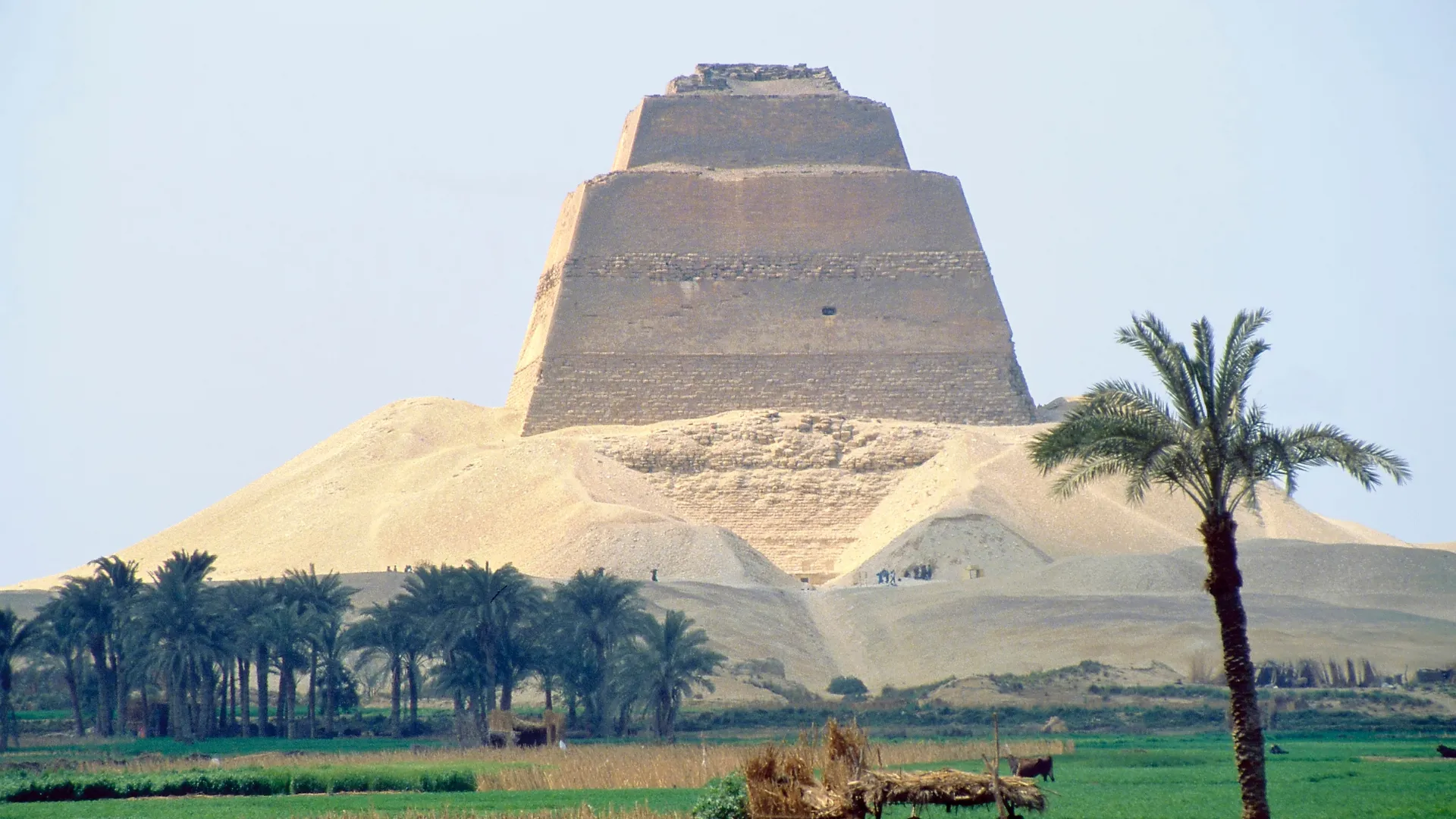
The Meidum Pyramid is one of the oldest and most unusual-looking monuments in Egypt. Located approximately 100 km south of Cairo near the entrance to the Fayoum depression, it does not resemble a conventional pyramid at all: the outer casing and fill material collapsed in antiquity, leaving a steep three-stepped tower rising from a sloping mound of limestone rubble. This distinctive appearance has led to its modern Arabic nickname Haram el-Kaddab — ‘the false pyramid’ or ‘the collapsed pyramid.’
The pyramid was begun by Pharaoh Huni, the last ruler of the 3rd Dynasty, and completed or significantly modified by Sneferu, the first pharaoh of the 4th Dynasty. It represents the earliest experiment in converting a stepped pyramid into a smooth-sided true pyramid by filling in the steps with casing stones. Whether the collapse occurred during or after construction remains debated among archaeologists.
Despite its ruined state, Meidum is a significant site for understanding the technical development of pyramid construction. The mortuary temple attached to the pyramid’s eastern face is the earliest known example of this architectural form and directly influenced the design of all subsequent pyramid complexes. Adjacent mastaba tombs belonging to senior officials of Sneferu’s court — including the tomb of Rahotep and Nofret — yielded some of the finest painted sculptures now in the Egyptian Museum.
The Meidum Pyramid was begun under Huni (c. 2637–2613 BCE) as a standard seven-step pyramid and was modified by Sneferu, who filled in the steps and added an outer smooth casing to create the first true pyramid. This modification may have contributed to its collapse: the additional weight placed on fill material that was not properly bonded to the core is the leading structural explanation for the failure.
The adjacent mastaba cemeteries contain tombs belonging to princes and senior officials of Sneferu’s reign. The tomb of Prince Rahotep and his wife Nofret, excavated by Auguste Mariette in 1871, contained two extraordinarily well-preserved painted limestone statues — now in the Egyptian Museum — with intact inlaid eyes that continue to captivate visitors. Papyrus records from the reign of Sneferu found at the site describe labor rosters and food rations for the pyramid workforce.
Ancient visitors left graffiti on the pyramid walls dating to the New Kingdom (c. 1550–1070 BCE), recording pilgrimages to what was already considered an ancient and revered monument — indicating that Egyptians of later dynasties recognized Meidum as one of the foundational monuments of their civilization.
The collapsed casing has left a unique three-stepped tower rising from a debris slope — visually unlike any other pyramid and an unintended record of construction failure.
A descending corridor leads to the burial chamber, constructed with the corbelled ceiling technique that Sneferu's engineers would refine at Dahshur and Giza.
The earliest surviving pyramid mortuary temple, with two uninscribed stelae still standing in their original positions flanking the offering altar.
A cluster of large mastaba tombs south of the pyramid belong to Sneferu's princes and officials; the tomb of Nefermaat contains the earliest known painted floor in any Egyptian tomb.

See what our happy travelers say about us



