
Summary
Tutankhamun, often called King Tut, became pharaoh at about nine years old around 1332 BC and died at about nineteen. His short reign undid his father Akhenaten’s religious revolution, but history barely remembered him until 4 November 1922, when Howard Carter found his tomb in the Valley of the Kings almost intact. Its more than 5,000 objects, from the solid gold mask to golden shrines, chariots and a dagger of meteoric iron, made him the most famous pharaoh in the world. Today his treasures fill their own galleries in the Grand Egyptian Museum, and his mummy still lies in his tomb.
Who Was Tutankhamun?
He was born around 1341 BC as Tutankhaten, “living image of the Aten”, almost certainly the son of the pharaoh Akhenaten; DNA studies published in 2010 point to Akhenaten’s sister as his mother. He grew up at Amarna, the new capital of the sun god, and was married to Ankhesenpaaten, a daughter of Akhenaten and Nefertiti.
He came to the throne as a child of about nine, around 1332 BC, guided by two powerful men: the elderly official Ay and the army commander Horemheb. Both later became pharaohs themselves.
Undoing a Revolution
Within a few years the young king changed his name to Tutankhamun, “living image of Amun”, and his queen became Ankhesenamun. The court left Amarna and returned to Memphis and Thebes. A great stela he set up at Karnak, the Restoration Stela, describes a land in chaos, its temples abandoned and its gods turned away, and announces that he has rebuilt their shrines and restored their priests. He also added statues and reliefs at Luxor Temple, where his figures were later taken over by Horemheb.
How Did King Tut Die?
Tutankhamun died around 1323 BC, aged about 19, with no surviving heir: two tiny mummified daughters, stillborn, were buried with him. How he died is still debated:
- A broken leg and malaria: CT scans show a fracture above his left knee that had not healed, and the 2010 DNA study found the parasite of the most severe form of malaria. Many scientists think the two together killed him.
- A bone disorder: the same study found a condition in his left foot, and more than 130 walking sticks were placed in his tomb.
- A chariot accident has been suggested to explain the fracture.
- Murder, once popular because of a damaged area of his skull, is now largely ruled out: the damage happened during embalming or the 1925 examination.
After his death, Ay became king and was shown in the tomb performing Tutankhamun’s funeral rites.
The Discovery of the Tomb
By the early 20th century, most experts believed the Valley of the Kings had nothing left to give. The British archaeologist Howard Carter, funded by Lord Carnarvon, kept searching for Tutankhamun, whose name had turned up on small objects in the valley.
- 4 November 1922: Carter’s workers uncovered a step cut into the rock, beneath the huts of workmen who had built the tomb of Ramesses VI above it, which is why robbers had missed it for 3,000 years.
- 26 November 1922: Carter made a hole in the sealed doorway, held up a candle, and was asked if he could see anything. His famous answer: “Yes, wonderful things.”
- February 1923: the sealed burial chamber was opened, almost filled by a huge gilded shrine.
- 1925: the innermost coffin was opened and the gold mask revealed.
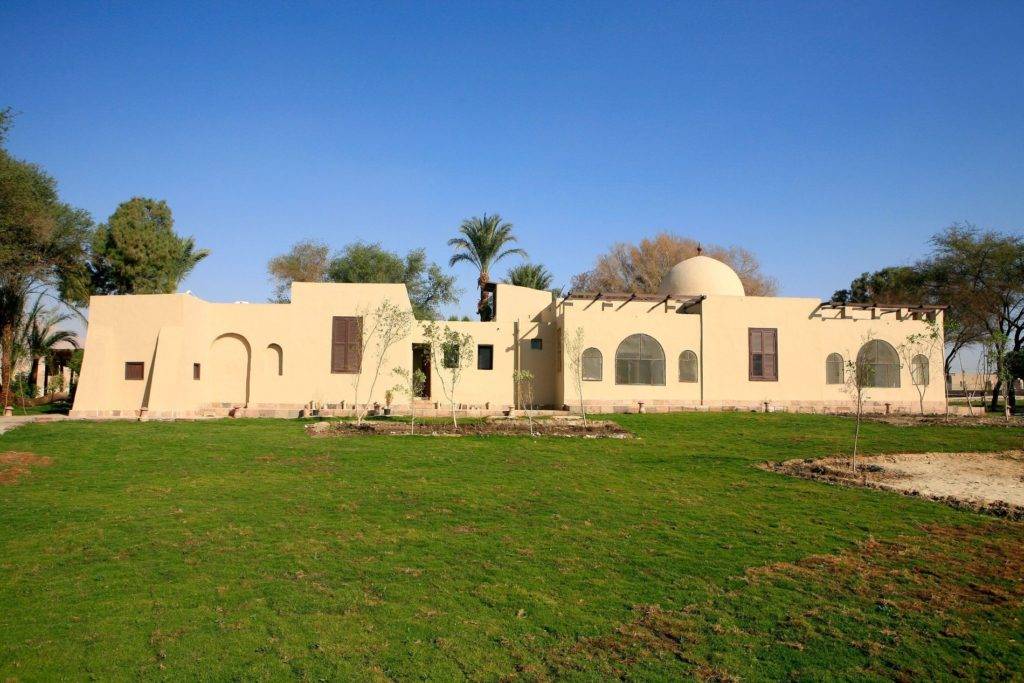
It took Carter about ten years to record and remove everything. Lord Carnarvon died in Cairo in April 1923, from an infected mosquito bite, which gave newspapers the legend of the “curse of the pharaoh”. Carter himself lived until 1939. Carter’s house still stands on Luxor’s west bank.
8-Day Cairo, Siwa and White & Black Desert Adventure
Planning the trip itself? Start here.
View This TripThe Treasures of Tutankhamun
The tomb held more than 5,000 objects, crowded into four small rooms. Among the most famous:
- The gold mask: about 10 kg of solid gold inlaid with glass and semi-precious stones; read its story in ancient Egyptian masks.
- Three nested coffins, the innermost of solid gold weighing about 110 kg, inside a quartzite sarcophagus.
- Four gilded shrines, nested inside each other around the sarcophagus, filling the burial chamber almost wall to wall.
- The Golden Throne, showing the king and his queen in the relaxed Amarna style, still with the name of the Aten on it.
- Six chariots, bows, arrows, shields and a dagger whose blade, scientists confirmed in 2016, was made from meteoric iron.
- The canopic shrine, guarded by four golden goddesses, holding his organs in miniature gold coffins.
- Two trumpets, board games, clothes, jewellery, beds, food and wine: everything a king needed for eternity.
Read how the dead were prepared for the afterlife in Egyptian mummies and sarcophagi, and what the symbols on the treasures meant in ancient Egyptian symbols.
The Tomb of Tutankhamun Today (KV62)
Tutankhamun’s tomb is small for a king, probably because he died young and a tomb prepared for someone else was used in a hurry. Only the burial chamber is painted: the funeral procession, Ay performing the Opening of the Mouth ceremony, the king with the gods, and twelve baboons representing the hours of the night. The king’s mummy rests there in a glass case, kept at a controlled temperature, the only royal mummy still lying in the Valley of the Kings.
The tomb needs a separate ticket on top of the general Valley of the Kings ticket; see current prices and which other tombs to choose on that page.
Where to See Tutankhamun in Egypt
| Where | What to see |
|---|---|
| Grand Egyptian Museum, Giza | The complete treasure for the first time in one place: the gold mask, the coffins, the shrines, the throne and the chariots |
| Valley of the Kings, Luxor | His tomb, KV62, and his mummy (extra ticket) |
| Luxor Museum | Statues from his reign |
| Karnak and Luxor Temple | The Restoration Stela and his statues and reliefs |
See the treasures with an Egyptologist on our Giza Pyramids and Grand Egyptian Museum tour, and his tomb on our Valley of the Kings tour. Meet his family in Amenhotep III and Akhenaten.
King Tut: FAQ
Who was King Tut?
Tutankhamun, a pharaoh of the 18th Dynasty who ruled from about 1332 to 1323 BC, becoming king at about nine and dying at about nineteen.
Why is King Tut so famous?
Because his tomb, found by Howard Carter in 1922, was the only royal tomb in the Valley of the Kings discovered almost intact, with more than 5,000 objects, including the gold mask.
How did King Tut die?
No one knows for sure. The leading theory is a badly broken leg combined with severe malaria; murder is now largely ruled out.
Where is King Tut’s mask now?
In the Tutankhamun galleries of the Grand Egyptian Museum in Giza.
Is King Tut’s mummy still in his tomb?
Yes. His mummy lies in a climate-controlled glass case in his tomb, KV62, in the Valley of the Kings.
Was there really a curse of Tutankhamun?
No. Lord Carnarvon died of an infection in 1923, and newspapers turned it into a legend; Howard Carter lived another 16 years.


























