




 Day Tour
 Day Tour
 Nile Cruise
 Nile Cruise
Testimonials
Our Clients Reviews
See what our happy travelers say about us


Karnak Temple is the largest religious complex ever built, covering approximately 200 acres on the east bank of the Nile at Luxor. It was the primary cult center of the god Amun-Ra and the religious and economic capital of Egypt during the New Kingdom (c. 1550–1070 BCE). The complex is not a single temple but a collection of sanctuaries, pylons, obelisks, sacred lakes, and auxiliary temples constructed by some 30 different pharaohs over more than 2,000 years.
The most celebrated single space is the Great Hypostyle Hall, completed under Ramesses II. It covers 5,000 square meters and contains 134 massive sandstone columns in 16 rows. The central columns stand 21 meters tall; traces of the original painted decoration — red, blue, yellow, and green — survive on the upper sections. Karnak also controlled hundreds of thousands of acres of agricultural land and employed tens of thousands of priests, craftsmen, and servants at its peak.
The complex is connected to Luxor Temple 2.7 km to the south by the Avenue of Sphinxes, reopened in 2021 after 70 years of excavation and restoration.
The earliest structures at Karnak date to the Middle Kingdom reign of Senusret I (c. 1971–1926 BCE). The complex reached its architectural and political peak during the New Kingdom, when successive pharaohs competed to leave the grandest additions: Thutmose I erected the first two surviving pylons and obelisks; Hatshepsut added two obelisks (one still standing at 29.5 meters, the tallest in Egypt); Amenhotep III built the third pylon; and Ramesses II completed the Hypostyle Hall.
During the Amarna Period, Akhenaten built a series of temples to the Aten at Karnak. After his death, Horemheb demolished these and used the talatat blocks as fill in his own pylons — inadvertently preserving 36,000 blocks from which scholars have partially reconstructed the Amarna-era facades.
Karnak was in use continuously from the Middle Kingdom until the Christian era — a span of roughly 2,000 years.
134 sandstone columns up to 21 meters tall, with surviving traces of original polychrome painted decoration — the most imposing ancient Egyptian interior space.
Hatshepsut's standing obelisk at 29.5 meters is the tallest in Egypt — one of four ancient obelisks visible within the complex.
A large rectangular artificial lake used for priestly purification rituals, bordered by stone quays; its surrounding walkway is used for the Sound and Light Show at night.
Reassembled chapels and structures from dismantled monuments including the White Chapel of Senusret I — one of the finest pieces of Middle Kingdom relief carving.
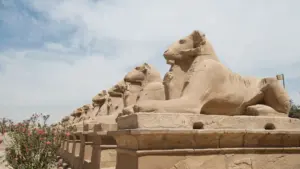
A ceremonial avenue of criosphinxes leads from the main entrance to the first pylon — each sphinx cradling a small figure of Ramesses II between its paws.
These packages visit this site as part of the itinerary.

Start From


Start From


Start From

See what our happy travelers say about us



