
Summary
Egyptian hieroglyphs are the picture-signs the ancient Egyptians used to write their language for more than 3,500 years, from about 3200 BC to AD 394. The name is Greek for “sacred carvings”; the Egyptians called them medu netjer, “the words of the god”. Despite looking like pictures, hieroglyphs were a full writing system: most signs stood for sounds, others for whole words or ideas. They were forgotten for some 1,400 years until the Rosetta Stone helped Jean-François Champollion decipher them in 1822.
How Hieroglyphs Work
Classical Egyptian writing used around 700 to 1,000 common signs, falling into three groups:
- Sound signs (phonograms): most signs stand for one, two or three consonants. A mouth is r, a house plan is pr, a scarab beetle is ḫpr.
- Word signs (logograms): a picture standing for the thing itself, usually followed by a short stroke: a sun with a stroke means “sun” (ra).
- Determinatives: silent signs at the end of a word that show its category, such as a seated man for male names or walking legs for verbs of movement.
Egyptian writing showed no vowels, which is why scholars write nfr (“good, beautiful”) and why names have several spellings, such as Ramesses, Ramses and Rameses.
The Hieroglyphic Alphabet
Twenty-four signs each stood for a single consonant. They were never used as a true alphabet by the Egyptians, but they are the place every beginner starts, and the signs used to write your name on a souvenir cartouche:
| Sign (what it shows) | Scholars write | Sounds roughly like |
|---|---|---|
| Egyptian vulture | ꜣ | a (glottal “ah”) |
| Flowering reed | i | i / y |
| Forearm | ꜥ | a (deep “ayin”) |
| Quail chick | w | w / u |
| Foot | b | b |
| Stool | p | p |
| Horned viper | f | f |
| Owl | m | m |
| Water | n | n |
| Mouth | r | r (later also l) |
| Reed shelter | h | h |
| Twisted flax | ḥ | h (emphatic) |
| Placenta (sieve) | ḫ | kh as in Scottish “loch” |
| Animal belly | ẖ | a softer kh |
| Door bolt | z | s / z |
| Folded cloth | s | s |
| Pool | š | sh |
| Hill slope | q | q (k at the back of the throat) |
| Basket with handle | k | k |
| Jar stand | g | g (hard) |
| Bread loaf | t | t |
| Tethering rope | ṯ | ch / tj |
| Hand | d | d |
| Cobra | ḏ | j / dj |
Which Way Do You Read Hieroglyphs?
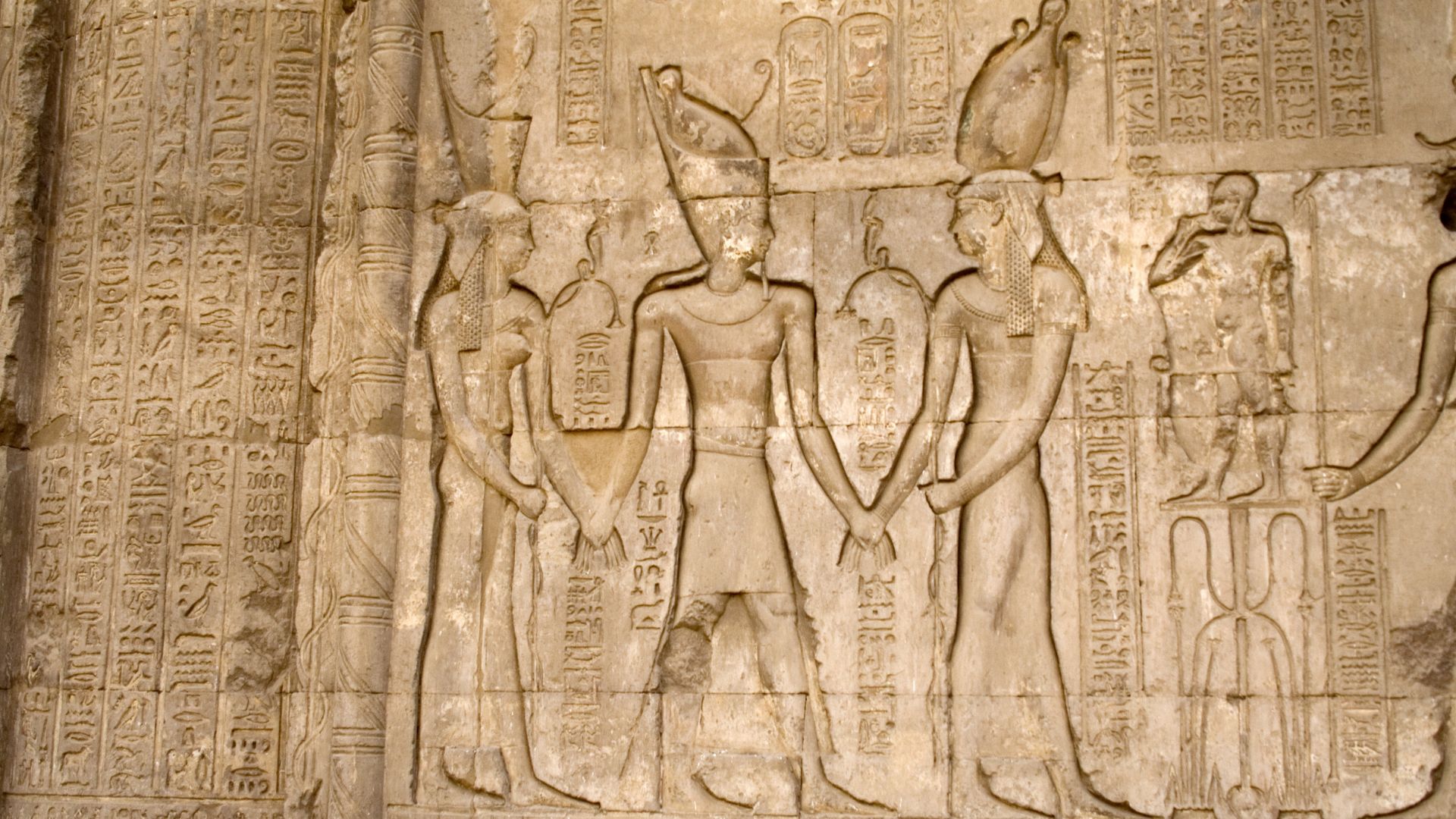
Hieroglyphs can run from right to left, from left to right, or in columns from top to bottom. The rule is simple: read towards the faces. People, birds and animals all look towards the beginning of the line, so if they face left, you start on the left. Scribes often turned the direction to suit the wall, so the figures in a text faced the god or king it was written for.
Cartouches: Names of the Kings

A cartouche is the oval ring drawn around a royal name, from the French word for a cartridge. It represents a loop of rope, a sign of eternity and of the king ruling “all that the sun encircles”. Kings had five names; the two most important, the throne name and the birth name, were written in cartouches. Spotting cartouches is the easiest way to know whose temple you are standing in. Ramesses II carved his everywhere; see Ramesses II.
8-Day Cairo, Siwa and White & Black Desert Adventure
Planning the trip itself? Start here.
View This TripHieratic, Demotic and Coptic
Hieroglyphs were slow to carve and paint, so scribes also wrote faster, joined-up scripts:
- Hieratic: a cursive form of hieroglyphs written in ink on papyrus, used for letters, accounts and religious texts from the earliest times.
- Demotic: an even quicker script, in use from about 650 BC for everyday documents.
- Coptic: the last stage of the Egyptian language, written with the Greek alphabet plus a few signs taken from demotic. It survives today in the liturgy of the Coptic Church.
The last dated hieroglyphic inscription was carved at Philae Temple on 24 August AD 394.
The Rosetta Stone and Champollion
In 1799 French soldiers rebuilding a fort near Rashid (Rosetta), in the Nile Delta, found a broken slab of dark granodiorite carved with the same decree, issued in 196 BC for King Ptolemy V, in three scripts: hieroglyphic, demotic and Greek. Because scholars could read the Greek, the stone offered a key to the other two. It passed to the British in 1801 and has been in the British Museum since 1802.
The English scholar Thomas Young made the first progress with the royal names. Then Jean-François Champollion, who also knew Coptic, showed that hieroglyphs mixed sound signs with word signs, and announced his decipherment in Paris in September 1822. Modern Egyptology begins with his letter.
Where to See Hieroglyphs in Egypt
- Saqqara: the Pyramid Texts inside the pyramid of King Unas, carved around 2350 BC, the oldest religious texts in the world. See Saqqara and the Step Pyramid.
- Luxor: the columns of Karnak Temple and the painted royal tombs of the Valley of the Kings.
- Between Luxor and Aswan: the late temples of Esna, Edfu, Kom Ombo and Dendera, whose walls are covered with thousands of signs.
- Cairo: the Egyptian Museum and the Grand Egyptian Museum, full of inscribed statues, stelae and coffins.
A good Egyptologist guide will teach you to pick out names and common words in minutes. Learn the most common signs in ancient Egyptian symbols, the ankh and the Eye of Horus.
Egyptian Hieroglyphs: FAQ
What are hieroglyphs?
The picture-based writing system of ancient Egypt, used from about 3200 BC to AD 394 for monuments, tombs and religious texts.
How many hieroglyphs are there?
About 700 to 1,000 were in regular use in classical times; by the Greek and Roman period priests used several thousand.
Is there a hieroglyphic alphabet?
There are 24 signs that each stand for one consonant, often called the hieroglyphic alphabet, but Egyptians always mixed them with other signs.
Which way do you read hieroglyphs?
Towards the faces of the people and animals in the text: if they look left, start reading from the left.
Who deciphered hieroglyphs?
Jean-François Champollion in 1822, using the Rosetta Stone and his knowledge of Coptic.
Where is the Rosetta Stone?
In the British Museum in London, where it has been since 1802.
Can I get my name written in hieroglyphs in Egypt?
Yes. Jewellers in Khan el-Khalili, Luxor and Aswan make gold and silver cartouches with your name spelled in the hieroglyphic alphabet.



























