
Summary
Ancient Egyptian symbols were never just decoration: each one was a word, a prayer and a source of power. The ankh meant life, the Eye of Horus protection and healing, the scarab rebirth, and the djed stability. They were written in hieroglyphs, worn as amulets, carved on temple walls and placed with the dead. This guide explains 16 of the most important symbols, what they meant to the Egyptians, and where you can still see them in Egypt today.
Why Symbols Mattered in Ancient Egypt
For the Egyptians, an image could make something real. Writing a word for “life” or “protection” on a wall, a coffin or an amulet was believed to bring that quality into being, and to keep it working for eternity. That is why the same few symbols appear everywhere: in the hands of gods on temple walls, in jewellery, on furniture, and wrapped among the bandages of mummies.
Most of the symbols below are also hieroglyphs, signs in the writing system used for more than 3,000 years. The ankh, for example, is the hieroglyph for the word ankh, “life”. Knowing a handful of them turns a temple wall from a pattern into a message.
The Ankh: The Key of Life
The ankh, a cross with a loop at the top, is the best-known Egyptian symbol and stands for life, both in this world and the next. Gods are shown holding it by the loop, or offering it to the king’s nose, giving him the “breath of life”.
- What it may show: no one knows for certain. The most common theories are a sandal strap or a knotted band of cloth.
- How it was used: as an amulet, on mirrors (ankh-shaped mirror cases were common), in the names of kings such as Tutankhamun, “living image of Amun”, and in the phrase “given life”, carved after royal names.
- Later life: Egyptian Christians, the Copts, adopted it as the crux ansata, the looped cross.
Where to see it: everywhere, but especially in the hands of the gods at Karnak and in the painted tombs of the Valley of the Kings.
The Eye of Horus (Wedjat)
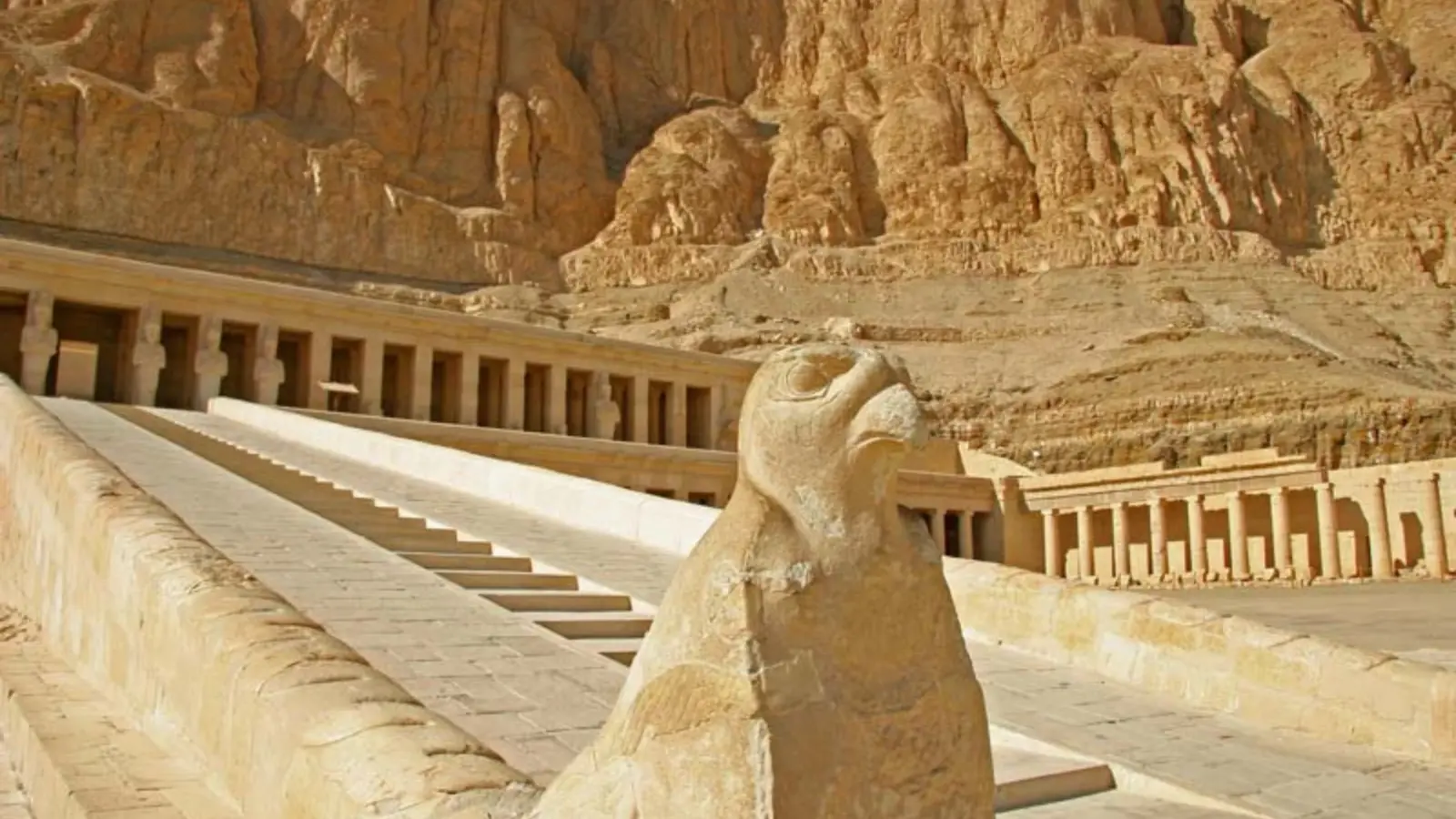
The Eye of Horus, or wedjat, “the sound one”, is a human eye with the markings of a falcon’s cheek beneath it. It stands for protection, healing and wholeness.
It comes from the myth of Horus and his uncle Seth. In their fight for the throne of Egypt, Seth tore out Horus’s eye; the god Thoth healed it. The restored eye became a symbol of everything made whole again, and it was one of the most popular amulets in Egypt, worn by the living and placed on the bodies of the dead.
Egyptologists once linked its six parts to fractions of a measure of grain, the so-called “Horus-eye fractions”. That idea is now debated, but it is still often repeated.
Where to see it: on amulets in the Grand Egyptian Museum, and at Edfu, the temple of Horus, where the whole battle with Seth is carved on the walls.
The Eye of Ra
Often confused with the Eye of Horus, the Eye of Ra is the sun god’s eye, and it is fierce rather than healing. In myth it acts on its own as a dangerous goddess, sometimes Sekhmet the lioness, sometimes Hathor, sent out to punish enemies. In art it is often shown as the sun disk circled by a rearing cobra. The simplest way to tell them apart: the Eye of Horus is usually a left eye, and the Eye of Ra a right eye, though artists did not always keep the rule.
The Scarab: Rebirth and the Rising Sun
The scarab is the dung beetle, which rolls a ball of dung across the ground and lays its eggs inside it. The Egyptians saw in it the god Khepri rolling the sun into the sky each morning, and the young beetles that crawled out of the ball seemed to be born from nothing. The scarab therefore meant creation, renewal and rebirth.
- Scarab amulets and seals were made in their millions, often with a name or a short prayer carved on the flat base.
- Heart scarabs were placed over the heart of a mummy, inscribed with a spell asking the heart not to speak against its owner at the final judgement.
Where to see it: the giant granite scarab beside the Sacred Lake at Karnak, which visitors walk around for luck.
The Djed Pillar: Stability
The djed is a pillar with four horizontal bars at the top. It means stability and endurance, and it became linked with the god Osiris, often read as his backbone. Each year the king took part in a ceremony of “raising the djed”, which symbolised Osiris rising again and the order of the country being restored. Djed amulets were placed on mummies so that the dead would stand firm in the afterlife.
Where to see it: at Abydos, the cult centre of Osiris, where the Temple of Seti I has some of the finest painted reliefs in Egypt.
The Was Sceptre: Power
The was is a long staff with a forked base and an animal head at the top. Held by gods and kings, it stands for power and dominion. It is often shown together with the ankh and the djed, in the phrase “all life, stability and power”, which sums up what every king hoped to receive from the gods.
The Tyet: The Knot of Isis
The tyet looks like an ankh with its arms folded down, and is sometimes called the knot of Isis or the “blood of Isis”. It was linked with the goddess and stood for her protection. Tyet amulets, often made of red stone such as carnelian or red jasper, were placed on the neck of the mummy.
Where to see it: at Philae, the island temple of Isis near Aswan.
8-Day Cairo, Siwa and White & Black Desert Adventure
Planning the trip itself? Start here.
View This TripThe Lotus, the Papyrus and the Union of the Two Lands
Egypt was always “the Two Lands”: Upper Egypt in the south and Lower Egypt in the Nile Delta. Each had its own plant.
- The lotus (in fact the blue water lily) was the plant of Upper Egypt. Because it closes at night and opens again in the morning, it also stood for the sun and rebirth. In one creation myth, the sun god was born from a lotus.
- The papyrus was the plant of Lower Egypt, a sign of growth and life.
- The sema-tawy, “union of the two lands”, shows the two plants tied around a windpipe-shaped sign by two gods. It is carved on the sides of royal thrones as a statement that the king ruled all of Egypt.
Where to see it: the papyrus-bundle columns of the Hypostyle Hall at Karnak, and the throne bases of royal statues at the Egyptian Museum.
The Cartouche and the Shen Ring
The shen is a loop of rope tied at the bottom, a circle with no end, meaning eternity and protection. Stretched into a long oval, it becomes the cartouche, the frame drawn around the names of kings and queens. Writing the name inside it was believed to protect the ruler for ever.
The cartouche was also the key to reading hieroglyphs: in 1822, Jean-François Champollion used the royal names in cartouches on the Rosetta Stone and other monuments to decipher the script. A gold cartouche with your name in hieroglyphs is still one of the most popular souvenirs in Egypt.
Royal Symbols: Crook, Flail, Crowns and the Uraeus
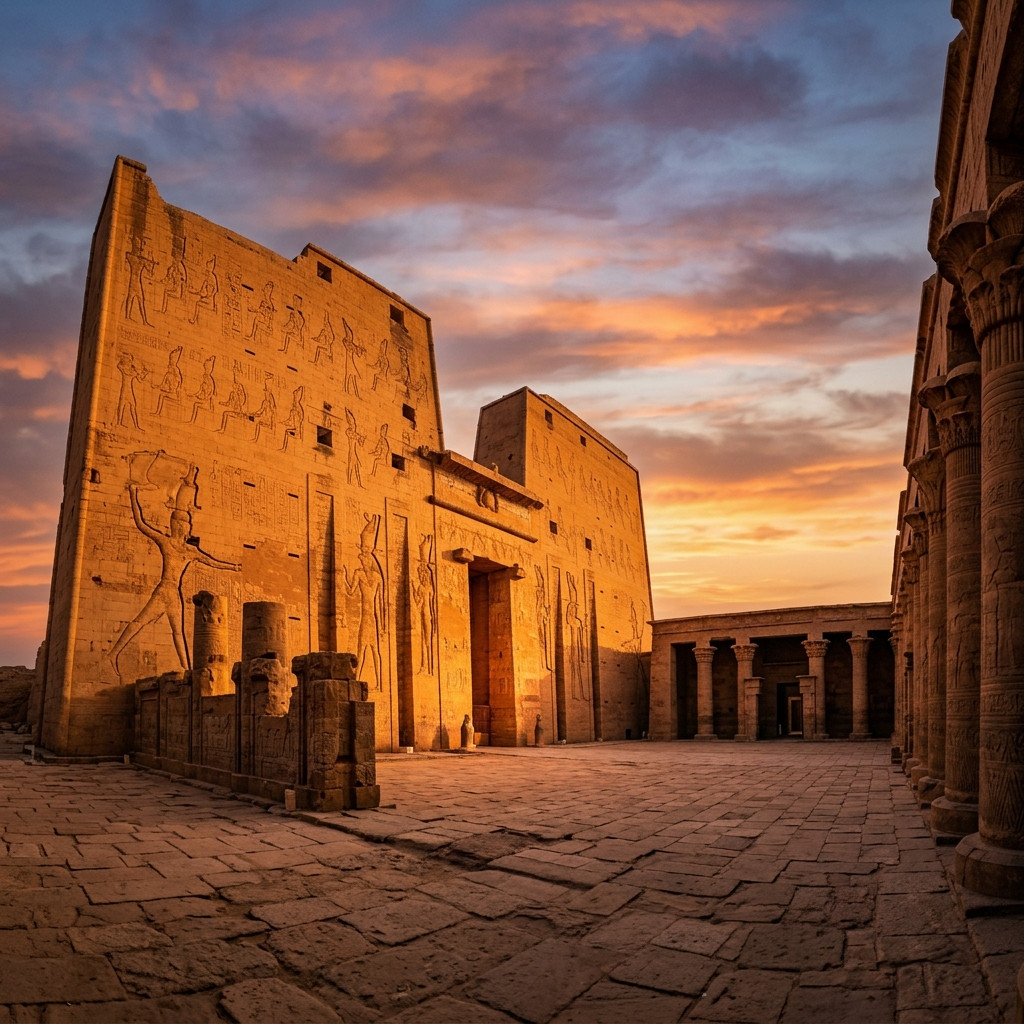
- The crook and flail, held crossed over the chest, were the king’s badges of office. The crook, a shepherd’s staff, meant care for the people; the flail meant authority and perhaps the power to provide food. Both belonged first to Osiris.
- The crowns: the White Crown of Upper Egypt, the Red Crown of Lower Egypt, and the Double Crown, or pschent, which combined the two. The blue crown, or khepresh, is often worn by kings in battle scenes.
- The uraeus, the rearing cobra on the king’s brow, stood for the goddess Wadjet, ready to spit fire at the king’s enemies.
- The nemes, the striped headcloth, best known from the gold mask of Tutankhamun and the Great Sphinx.
Where to see them: the gold mask in the Grand Egyptian Museum, and the colossal statues of Ramesses II at Abu Simbel.
Symbols of the Gods and the Soul
- The winged sun disk: the sun with outstretched falcon wings, the emblem of Horus of Edfu, carved over almost every temple doorway to guard the entrance.
- The feather of Maat: a single ostrich feather, the symbol of truth, justice and cosmic order. In the judgement of the dead, the heart was weighed against it.
- The ba: a bird with a human head, one part of the soul, free to fly out of the tomb by day and return at night.
- The sistrum: a sacred rattle shaken in the worship of Hathor, goddess of music, love and joy.
Read more about the gods behind these symbols in our guide to ancient Egyptian gods.
Egyptian Symbols at a Glance
| Symbol | Meaning | Linked with | Where to see it |
|---|---|---|---|
| Ankh | Life | All gods | Karnak, Valley of the Kings |
| Eye of Horus | Protection, healing | Horus | Edfu, museum amulets |
| Eye of Ra | The sun’s fierce power | Ra, Sekhmet, Hathor | Temple reliefs |
| Scarab | Rebirth, renewal | Khepri | Karnak (giant scarab) |
| Djed | Stability | Osiris | Abydos |
| Was sceptre | Power | Gods and kings | Temple reliefs |
| Tyet | Protection | Isis | Philae |
| Lotus | Upper Egypt, rebirth | The sun | Column capitals |
| Papyrus | Lower Egypt, growth | The Delta | Karnak Hypostyle Hall |
| Sema-tawy | Unity of Egypt | The king | Throne bases |
| Shen and cartouche | Eternity, protection of the name | Kings and queens | Everywhere |
| Crook and flail | Kingship | Osiris, the king | Tutankhamun’s mask |
| Uraeus | Royal protection | Wadjet | Royal statues |
| Winged sun disk | Protection of the temple | Horus of Edfu | Temple doorways |
| Feather of Maat | Truth, order | Maat | Tomb paintings |
| Ba bird | The soul | The dead | Tomb paintings |
See the Symbols for Yourself
The best way to learn these signs is to find them on the walls with an Egyptologist beside you. On our Valley of the Kings tour, in the temples of a Nile cruise and in the galleries of the Grand Egyptian Museum, your guide will show you how to read them. See our guide to Egyptian temples for where to start.
Ancient Egyptian Symbols: FAQ
What is the most important ancient Egyptian symbol?
The ankh, the sign of life. It appears in the hands of almost every god and in the names of kings, and it was used for more than 3,000 years.
What is the difference between the Eye of Horus and the Eye of Ra?
The Eye of Horus stands for protection and healing, from the myth of Horus’s eye restored after his fight with Seth. The Eye of Ra is the fierce power of the sun god, often shown as a goddess or a cobra around the sun disk.
What does the scarab mean in ancient Egypt?
Rebirth and renewal. The beetle was linked with Khepri, the god who rolled the sun into the sky each morning.
What does the djed pillar symbolise?
Stability and endurance. It was linked with Osiris and often read as his backbone.
Did the ancient Egyptians use symbols as amulets?
Yes. The ankh, the Eye of Horus, the scarab, the djed and the tyet were all worn as protective amulets by the living and placed with the dead.


























