
Summary
King Narmer ruled around 3100 BC and is usually credited with uniting Upper and Lower Egypt into a single kingdom, making him, for most historians, the first pharaoh of Egypt. He is best known from the Narmer Palette, a carved slate showing him wearing the crowns of both lands and striking down his enemies. Many scholars think he is the same king later remembered as Menes, the founder of Memphis. He was buried at Abydos, and his successors ruled Egypt for the next 3,000 years.
Who Was King Narmer?
Before about 3100 BC, the Nile valley was divided into rival kingdoms. Upper Egypt, the long valley in the south, and Lower Egypt, the wide Nile Delta in the north, had their own rulers, gods and crowns. Narmer, a king from the south whose power base was around Hierakonpolis and Abydos, is the ruler most closely linked with bringing them together.
He stands at the boundary between prehistory and history: some Egyptologists place him at the end of “Dynasty 0”, others as the first king of the 1st Dynasty. Either way, after him Egypt was ruled as one country by one king, the system that lasted until the Romans.
The Meaning of His Name
Narmer’s name was written with two hieroglyphs inside a serekh, a rectangle showing a palace front topped by the falcon of Horus: a catfish (n’r) and a chisel (mr). It is often translated as “striking catfish” or “fierce catfish”, a fitting name for a warrior king. His name has been found on pottery and seals from the Delta to southern Canaan, showing how far his authority and trade reached.
The Narmer Palette
The Narmer Palette is one of the most important objects in the history of Egypt, and perhaps the first historical document in the world. It is a shield-shaped slab of dark siltstone, about 64 cm high, found in 1897–98 by the British archaeologists James Quibell and Frederick Green in the temple at Hierakonpolis. Palettes like this were originally used to grind eye make-up; this one was a ceremonial offering to the gods.
- The front: Narmer, wearing the tall White Crown of Upper Egypt, raises a mace to strike a kneeling enemy, while the falcon god Horus holds a captive representing the conquered northern land.
- The back: Narmer, now in the Red Crown of Lower Egypt, walks in procession to view rows of beheaded enemies. Below, two mythical beasts with long, intertwined necks are tamed by attendants, often read as a symbol of the two lands joined together.
- At the top of both sides: the faces of a cow goddess, probably Bat or Hathor, framing the king’s name.
It is the earliest object to show a king in both crowns, and its style, with the king shown larger than everyone else in a striding pose, set the rules for Egyptian royal art for 3,000 years. The palette is on display at the Egyptian Museum in Tahrir, Cairo.
Was Narmer the Same as Menes?
Later Egyptian king lists and Greek historians name the first king of Egypt as Menes. According to the Greek historian Herodotus, Menes founded the city of Memphis, near modern Cairo, at the meeting point of Upper and Lower Egypt, and the 3rd-century BC priest Manetho wrote that he reigned for decades and was killed by a hippopotamus.
The name Menes does not appear on monuments of the period, so historians have long debated who he was. The two main theories are:
- Menes was Narmer, the king of the unification. A seal impression from Abydos listing the early kings starts with Narmer, which supports this view.
- Menes was Hor-Aha, Narmer’s successor, who may have founded Memphis.
Most scholars today lean towards Narmer, but the question is still open. It is also likely that unification was a long process over several generations, which later tradition credited to one heroic founder.
8-Day Cairo, Siwa and White & Black Desert Adventure
Planning the trip itself? Start here.
View This TripNarmer's Tomb at Abydos
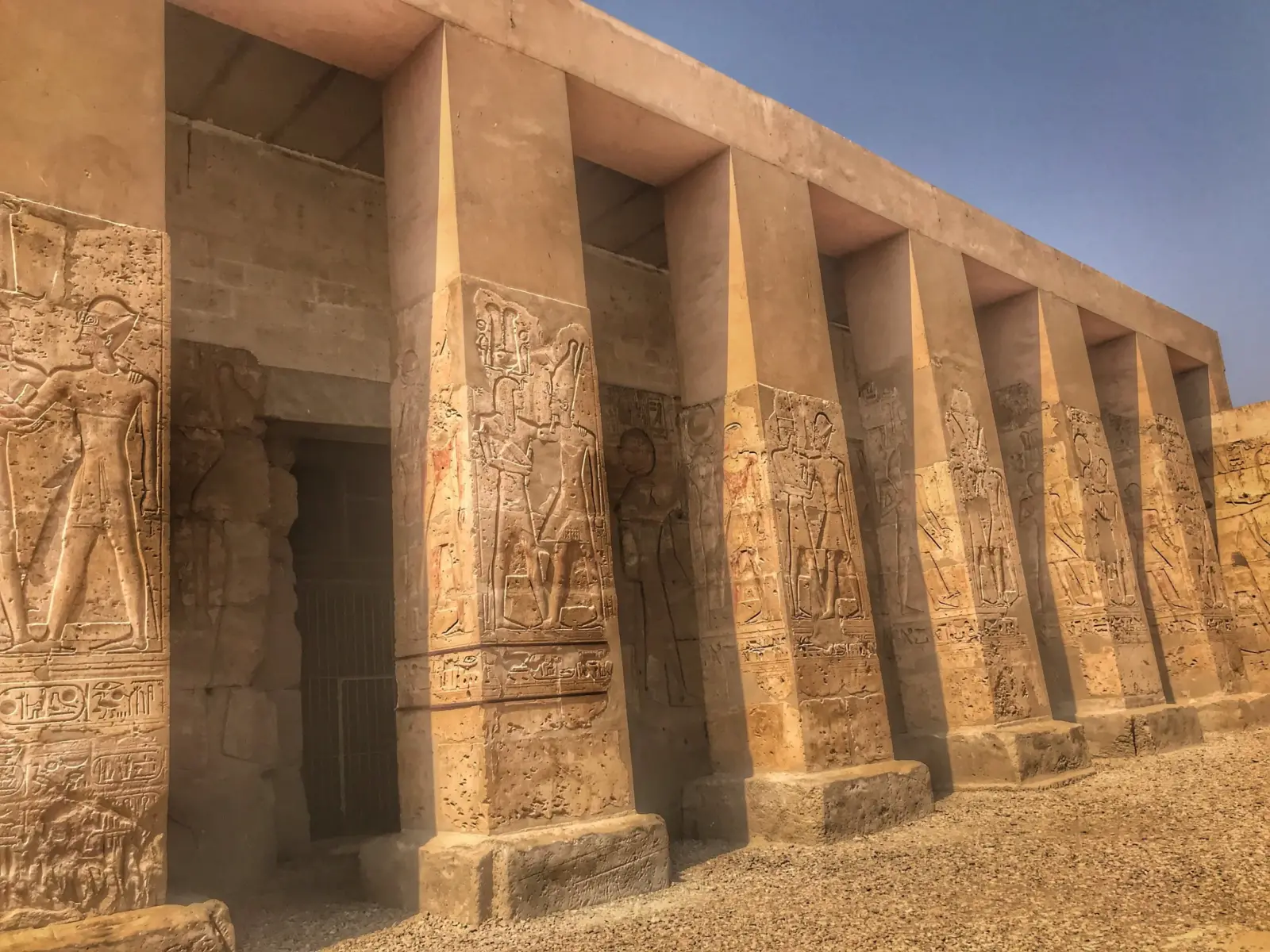
Narmer was buried at Umm el-Qa’ab, the royal cemetery of the earliest kings at Abydos in Upper Egypt. His tomb is a pair of brick-lined chambers dug into the desert, simple compared with the pyramids that came 400 years later. Abydos became Egypt’s holiest place, the cult centre of Osiris, god of the dead, and later kings built their temples there. Today, visitors to Abydos come mainly for the magnificent Temple of Seti I, whose walls carry the famous Abydos King List, naming the pharaohs from Menes to Seti I. You can visit it on our Dendera and Abydos day tour from Luxor.
Narmer's Legacy
Narmer’s reign set the pattern for everything that followed:
- One king for two lands: every later pharaoh carried the title “King of Upper and Lower Egypt” and wore the Double Crown.
- The king as Horus: his name in a serekh topped by the falcon became the standard royal name.
- The smiting pose: the image of the king striking an enemy appears on temple pylons for the next 3,000 years, from Karnak to Edfu.
- A capital at Memphis: whoever founded it, Memphis remained one of Egypt’s great cities. Its remains, with the colossal statue of Ramesses II, can be seen at the Memphis open-air museum.
Discover the kings who came after him in our guides to Egyptian pharaohs, the Old Kingdom and Ramesses II.
King Narmer: FAQ
Who was the first pharaoh of Egypt?
Most historians name King Narmer, who united Upper and Lower Egypt around 3100 BC. Ancient tradition called the first king Menes, who may be the same person.
What is the Narmer Palette?
A carved siltstone slab about 64 cm high, from around 3100 BC, showing Narmer wearing the crowns of Upper and Lower Egypt and defeating his enemies. It is in the Egyptian Museum in Cairo.
Where is King Narmer buried?
At Umm el-Qa’ab, the cemetery of the earliest kings at Abydos in Upper Egypt.
What does the name Narmer mean?
It is written with the signs for a catfish and a chisel and is usually translated as “striking catfish” or “fierce catfish”.
Who came after Narmer?
His successor was Hor-Aha, probably his son, followed by the other kings of the 1st Dynasty.



























