
Summary
Akhenaten ruled Egypt for about 17 years, around 1353–1336 BC, and turned its religion upside down. Born Amenhotep IV, son of Amenhotep III and Queen Tiye, he set aside Egypt’s many gods in favour of one, the Aten, the disk of the sun, and built a new capital in the desert at Amarna. With his queen, Nefertiti, he inspired a new, strikingly natural style of art. After his death his revolution collapsed: his city was abandoned, his name was erased, and his son Tutankhamun restored the old gods.
Who Was Akhenaten?
Akhenaten came to the throne as Amenhotep IV, the son of the magnificent Amenhotep III and his powerful queen, Tiye. Egypt was at the height of its wealth, and the temple of Amun at Karnak was the richest institution in the land.
In the first years of his reign he built temples to the sun disk at Karnak itself. Then, around his fifth year, he changed his name to Akhenaten, “effective for the Aten”, and announced a new capital, a city that would belong to the Aten alone.
The Aten: One God of Light
The Aten was the visible disk of the sun, shown in art as a circle whose rays end in small human hands, holding the ankh, the sign of life, to the noses of the king and queen. Akhenaten taught that the Aten was the source of all life, and that he himself was its only son and the only one who truly knew it.
- The old gods were set aside: the temples of Amun were closed, and workmen were sent across Egypt to chisel his name, and sometimes the word “gods” in the plural, off monuments.
- Worship moved into the open: Aten temples had no roofs, so offerings were made directly under the sun.
- The Great Hymn to the Aten, carved in a tomb at Amarna, praises the sun for creating every land and creature. It is one of the finest poems of the ancient world.
Whether this was true monotheism, the worship of a single god, is still debated. It was certainly the most radical religious change in Egyptian history. Read about the gods he replaced in ancient Egyptian gods.
Amarna: A City for the Sun
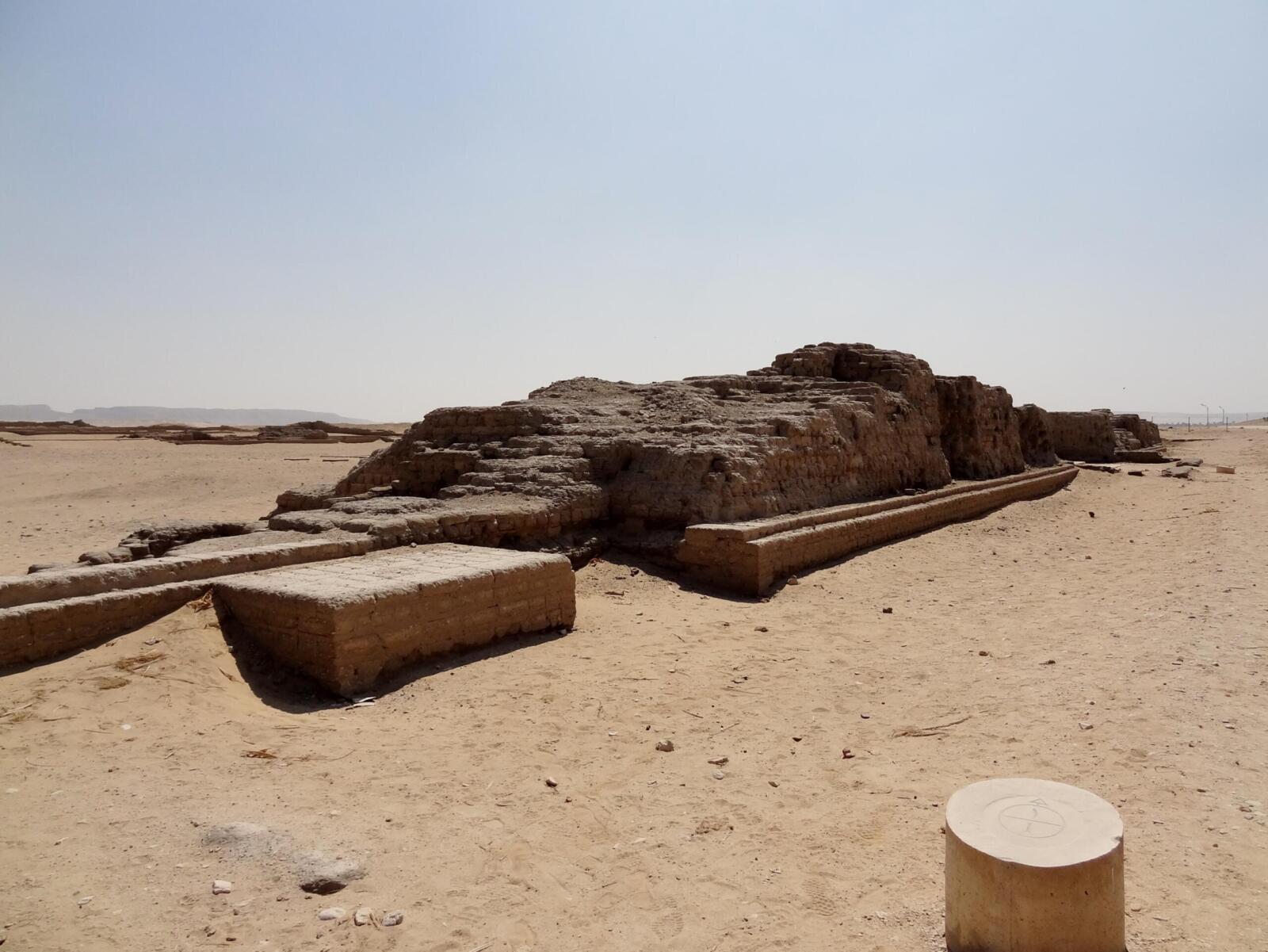
Akhenaten founded his capital, Akhetaten, “Horizon of the Aten”, on an empty stretch of the east bank of the Nile in Middle Egypt, today known as Tell el-Amarna. Boundary stelae carved in the cliffs marked its limits. Within a few years it held palaces, open-air temples, government offices, workshops and homes for perhaps 30,000 people.
It was here, in 1887, that a local woman found the Amarna Letters, the clay tablets of the king’s diplomatic correspondence with Babylon, Mitanni and the Hittites. Because the city was abandoned after his death and never built over, archaeologists can study it as a snapshot of one moment in Egyptian history.
Nefertiti and the Royal Family
Akhenaten’s chief queen, Nefertiti, “the beautiful one has come”, appears beside him in almost every scene, sometimes in poses usually reserved for kings, such as smiting enemies. The couple had six daughters, and Amarna art shows them in rare scenes of family life: the king kissing his children, the daughters on their parents’ laps.
Nefertiti’s painted limestone bust, found in a sculptor’s workshop at Amarna in 1912, is now in Berlin and is one of the most famous portraits in the world. What became of her is still debated: some scholars think she ruled briefly after Akhenaten under another name.
Amarna Art
The art of Akhenaten’s reign broke with a thousand years of tradition. The king was shown with a long face, a narrow chin, full lips, a swelling belly and broad hips, very different from the idealised, athletic pharaohs before him. Scenes became more natural and full of movement: plants, birds and animals, the royal family at home. The reasons are still argued over, but the style influenced Egyptian art long after his reign. See it in the Amarna rooms of the Egyptian Museum in Tahrir. Read more in ancient Egyptian symbols.
8-Day Cairo, Siwa and White & Black Desert Adventure
Planning the trip itself? Start here.
View This TripThe End of the Revolution
Akhenaten died around 1336 BC. After one or two short reigns, the throne passed to a boy named Tutankhaten, almost certainly his son. Within a few years the young king changed his name to Tutankhamun, honouring Amun again, the court left Amarna, and the old temples reopened.
Later kings treated Akhenaten as a criminal. His name was left out of king lists, such as the one in the Temple of Seti I at Abydos, and he was referred to only as “that enemy”. Horemheb and the Ramesside kings pulled down his temples and reused tens of thousands of their small stone blocks, called talatat, as filling inside the pylons of Karnak and elsewhere, which is how many of his reliefs survived.
Tomb and Mummy
Akhenaten prepared a royal tomb in a valley behind Amarna, where fragments of his granite sarcophagus were found. His body was probably moved to Thebes when the city was abandoned. A damaged mummy found in 1907 in tomb KV55 in the Valley of the Kings is thought by many scholars to be his: DNA studies published in 2010 identified the KV55 man as the father of Tutankhamun, though his identity is still debated. Read more in Egyptian mummies and sarcophagi.
Where to See Akhenaten Today
| Where | What to see |
|---|---|
| Tell el-Amarna, near Minya | The remains of his city, the boundary stelae and the rock-cut tombs of his officials |
| Egyptian Museum, Tahrir | The Amarna rooms: colossal statues of the king from Karnak and the art of his reign |
| Luxor Museum | A reconstructed wall of talatat blocks from his Karnak temples |
| Grand Egyptian Museum | The treasures of his son Tutankhamun |
Meet his family in our guides to Amenhotep III, Tutankhamun’s mask and Egyptian pharaohs.
Akhenaten: FAQ
Who was Akhenaten?
A pharaoh of the 18th Dynasty, ruling about 1353–1336 BC, who replaced the worship of Egypt’s many gods with the worship of the Aten, the sun disk, and built a new capital at Amarna.
Why is Akhenaten called the heretic pharaoh?
Because he abandoned Egypt’s traditional gods, closed the temples of Amun and had their names erased. Later kings treated him as an enemy and removed him from the records.
Was Nefertiti Akhenaten’s wife?
Yes. Nefertiti was his chief queen, and they had six daughters.
Was Akhenaten the father of Tutankhamun?
Almost certainly. DNA studies of royal mummies point to the man from tomb KV55, thought by many to be Akhenaten, as Tutankhamun’s father.
What happened to Amarna?
It was abandoned within a few years of Akhenaten’s death, when the court returned to Thebes and Memphis, and was never built over again.




























