
Summary
Seti I was the second king of Egypt’s 19th Dynasty, ruling around 1290–1279 BC, and the father of Ramesses II. He restored Egypt’s power after the upheaval of the Amarna period, fought successful wars in Syria and Libya, and commissioned some of the most beautiful art ever made in Egypt: his temple at Abydos, the reliefs of the Great Hypostyle Hall at Karnak, and his tomb, KV17, the longest and finest in the Valley of the Kings. His mummy, one of the best preserved of any pharaoh, is in Cairo today.
Who Was Seti I?
Seti was the son of Ramesses I, an army officer and vizier who became king when Horemheb died without an heir. Ramesses I reigned for less than two years, and Seti, already an experienced general, took the throne around 1290 BC. His name means “man of Seth”, after the god of storms and the desert; his throne name was Menmaatre, “eternal is the justice of Ra”.
He came to power at a turning point. A generation earlier, the religious revolution of Akhenaten had shaken the country, closed temples and weakened Egypt’s empire. Seti saw himself as the king who would bring back the old order, and on his monuments he called his reign a “repeating of births”, a renaissance.
Seti I at War
In the first years of his reign Seti led campaigns to rebuild Egypt’s empire in the Levant: against the Bedouin of Sinai, the cities of Canaan, the Libyans in the west, and finally the Hittites in Syria, where he briefly took the city of Kadesh. His wars are carved in great detail on the outer north wall of the Hypostyle Hall at Karnak, with the king charging in his chariot. The rivalry with the Hittites came to a head under his son Ramesses II at the Battle of Kadesh.
The Temple of Seti I at Abydos
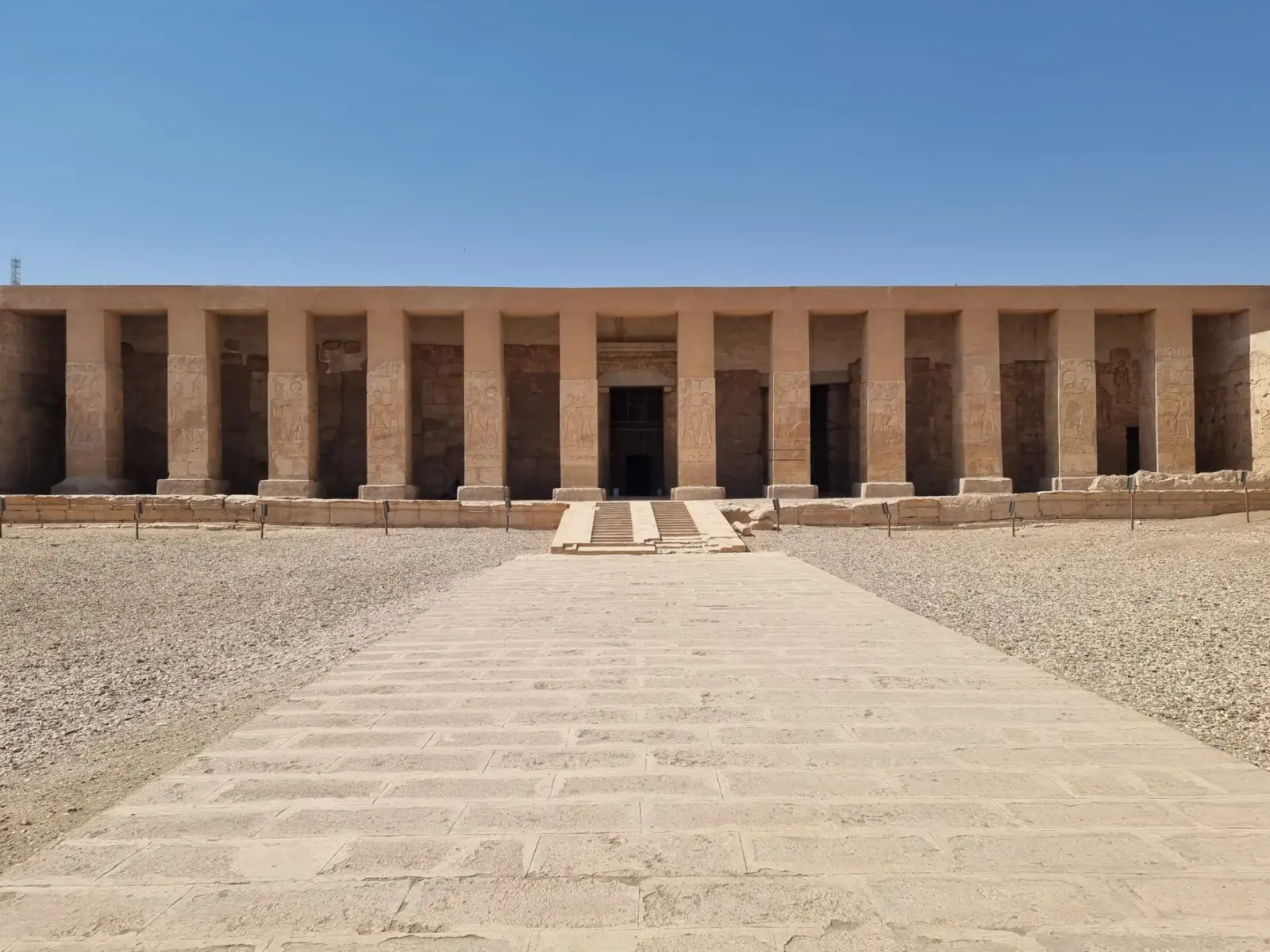
Seti’s greatest monument is his temple at Abydos, the holy city of Osiris. Unusually, it has seven chapels side by side, for Osiris, Isis and Horus, the state gods Amun-Ra, Ra-Horakhty and Ptah, and the deified Seti himself. Its painted reliefs, in fine raised relief with much of their colour intact, are considered among the most beautiful in Egypt.
- The Abydos King List: in a corridor, Seti and the young Ramesses make offerings to 76 earlier kings, named in cartouches from Menes onwards. It is one of the most important sources for the order of the pharaohs, although it leaves out rulers Seti considered illegitimate, such as Hatshepsut and Akhenaten.
- The Osireion: behind the temple lies a mysterious, half-flooded building of massive granite pillars, built as a symbolic tomb of Osiris.
See it on our Dendera and Abydos day tour from Luxor, and read more on the Temple of Seti I page.
Builder of Karnak and Luxor
Seti began many of the projects that his son finished. At Karnak, he and Ramesses II decorated the Great Hypostyle Hall, with its 134 giant columns; the finer raised reliefs in the northern half are Seti’s, the deeper sunk reliefs in the southern half are mostly his son’s. On Luxor’s west bank he built a mortuary temple at Qurna, and he opened new quarries and gold mines to pay for his projects. He also built a small temple at Abydos for his father, Ramesses I.
The Tomb of Seti I (KV17)
Seti’s tomb in the Valley of the Kings is the longest and most completely decorated tomb in the valley, running about 137 metres into the hillside. Every wall and ceiling is carved and painted, with the full texts of the books of the afterlife and an astronomical ceiling in the burial chamber.
It was discovered in 1817 by the Italian adventurer Giovanni Belzoni, who found the king’s beautiful translucent alabaster sarcophagus, now in Sir John Soane’s Museum in London. The tomb was closed for many years for conservation; today it can be visited with a special extra ticket, one of the most expensive in Egypt, but for many visitors the highlight of the whole valley. See ticket details on our Valley of the Kings page.
8-Day Cairo, Siwa and White & Black Desert Adventure
Planning the trip itself? Start here.
View This TripThe Mummy of Seti I
Seti’s mummy was not in his tomb. Around 1000 BC, priests moved it, with many other royal mummies, to a secret cache at Deir el-Bahari, where it was found in 1881. It is one of the best-preserved royal mummies, with a calm, recognisable face. In April 2021 it was carried with 21 other kings and queens in the Pharaohs’ Golden Parade to the National Museum of Egyptian Civilization in Cairo, where it can be seen in the Royal Mummies Hall. Read more in Egyptian mummies and sarcophagi.
Seti I and Ramesses II
Seti made his son Ramesses co-ruler while still young and took him on campaigns, preparing him carefully for the throne. On the walls at Abydos, the two appear together, the boy reading out the names of the ancestors. Ramesses went on to reign for 66 years and became the most famous pharaoh of all, but much of his early success rested on the strong, stable Egypt his father had rebuilt. Meet more of the great rulers in our guide to Egyptian pharaohs.
Where to See Seti I in Egypt
| Where | What to see |
|---|---|
| Temple of Seti I, Abydos | The finest painted reliefs, the King List, the Osireion |
| Valley of the Kings | His tomb, KV17 (extra ticket) |
| Karnak Temple | The Hypostyle Hall and his battle reliefs |
| NMEC, Cairo | His mummy in the Royal Mummies Hall |
King Seti I: FAQ
Who was Seti I?
The second king of the 19th Dynasty, who ruled Egypt around 1290–1279 BC. He was the son of Ramesses I and the father of Ramesses II.
Where is Seti I buried?
His tomb is KV17 in the Valley of the Kings, the longest and most decorated tomb there. His mummy is now in the National Museum of Egyptian Civilization in Cairo.
What is Seti I famous for?
Restoring Egypt’s power after the Amarna period, his wars in Syria, and his superb monuments: the Temple of Seti I at Abydos, the Hypostyle Hall at Karnak and his tomb.
What is the Abydos King List?
A list of 76 earlier kings carved in Seti I’s temple at Abydos, showing Seti and his son Ramesses honouring their ancestors.
Can you visit the tomb of Seti I?
Yes, with a special extra ticket on top of the general Valley of the Kings ticket.


























