Summary
Ancient Egyptian masks were made for the dead, not for disguise. Placed over the face of a mummy, a funerary mask gave the dead person a perfect, everlasting face, so the soul could recognise its body and live for ever. Most were made of cartonnage, layers of linen and plaster that were painted or gilded; kings had masks of solid gold. The most famous of all, the gold mask of Tutankhamun, is now in the Grand Egyptian Museum. This guide explains why masks mattered, how they were made, the greatest examples, and where to see them in Egypt.
Why Did the Egyptians Make Masks?
The Egyptians believed that after death the ba, the part of the soul shown as a bird with a human head, left the body each day and had to find its way back at night. A mummy wrapped in linen had no recognisable face, so a mask gave it one: an idealised portrait, always young and calm, that would never decay.
The mask also made the dead person divine. Gold was thought to be the flesh of the gods, and blue lapis lazuli their hair, so a gold mask with blue stripes showed the dead as a god reborn. Spells written on or near the mask, from the Book of the Dead, protected the head and gave the dead the power to see, breathe and speak in the afterlife. Read more about the whole process in Egyptian mummies and sarcophagi.
How Were Egyptian Masks Made?
- Cartonnage: the most common material. Layers of linen or old papyrus were soaked in glue and plaster, shaped over a mould, then smoothed, painted and sometimes gilded. It was light, cheap and easy to decorate.
- Wood: carved and painted, often for the faces of coffins.
- Plaster: in the Old Kingdom, some mummies had plaster modelled directly over the wrappings of the face.
- Gold and silver: only for kings and the very highest elite, hammered from sheet metal and inlaid with glass and semi-precious stones.
The face was not a true likeness but an ideal one, following strict artistic rules. Wigs, collars and jewellery painted or inlaid on the mask showed rank and status.
The Gold Mask of Tutankhamun
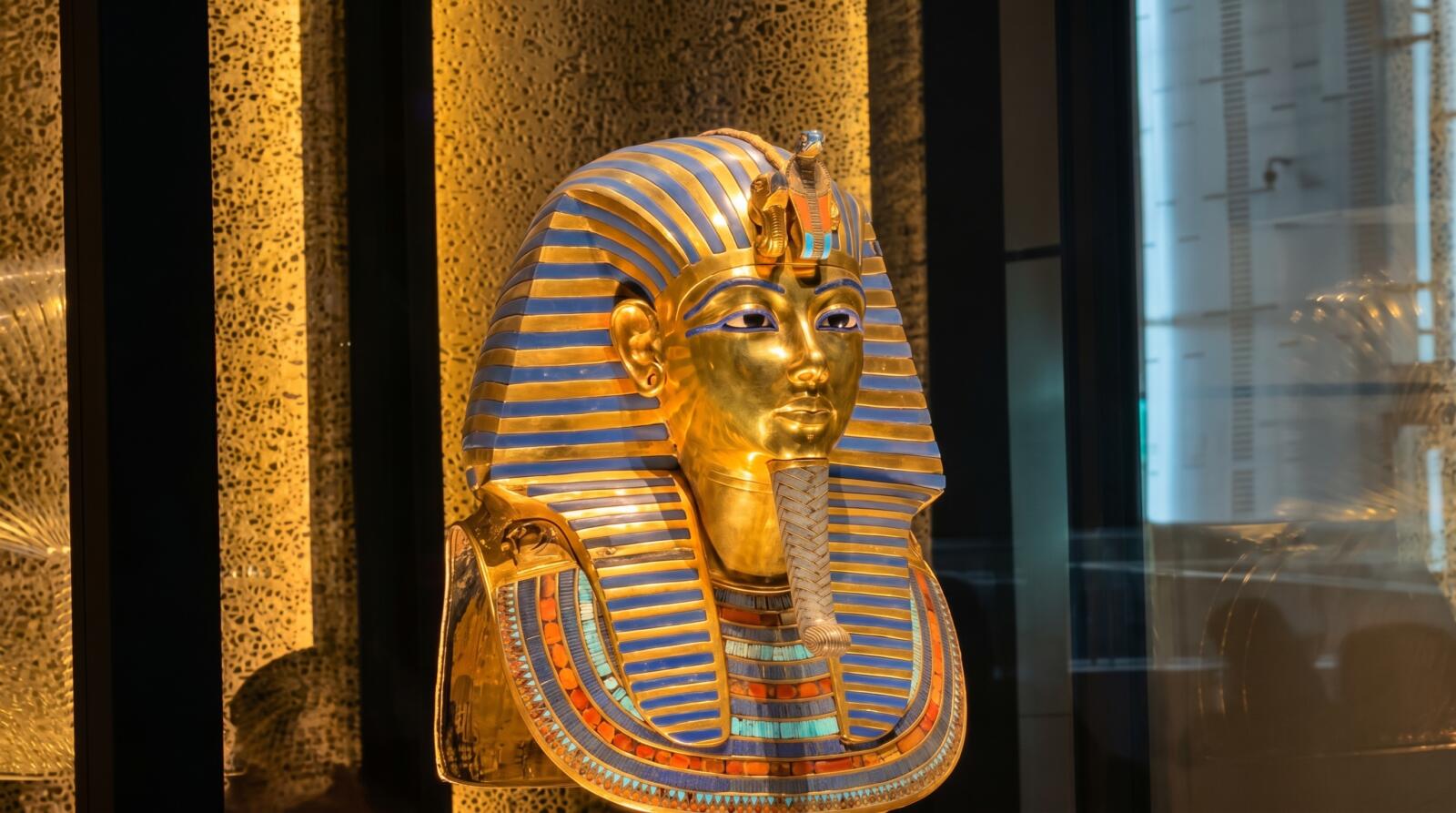
The most famous object from ancient Egypt was found in 1925, when Howard Carter’s team opened the innermost coffin of Tutankhamun, three years after discovering his tomb in the Valley of the Kings.
- Size and weight: about 54 cm high and some 10 kg of solid gold.
- Decoration: the striped nemes headcloth is inlaid with blue glass; the eyes are of quartz and obsidian; the broad collar is set with lapis lazuli, carnelian, turquoise and glass.
- Royal symbols: on the brow are the vulture of the goddess Nekhbet and the cobra of Wadjet, protectors of Upper and Lower Egypt; the plaited beard marks the king as a god.
- Spell on the back: a text from the Book of the Dead protects each part of the face and links it to a god.
In 2014 the beard was knocked off during cleaning and glued back badly; a German-Egyptian team removed the glue and restored it properly in 2015. After nearly a century in the Egyptian Museum, the mask now stands in the Tutankhamun galleries of the Grand Egyptian Museum, beside the king’s gold coffin.
The Gold Masks of Tanis
Tutankhamun’s is not the only royal gold mask. In 1939 and 1940, the French archaeologist Pierre Montet found intact royal burials of the 21st and 22nd Dynasties at Tanis in the Nile Delta. They included the gold mask of King Psusennes I, with his silver coffin, and the gold masks of King Amenemope and King Shoshenq II. Because the discovery was overshadowed by the Second World War, these treasures are far less famous than Tutankhamun’s, but they are just as rich. They are shown at the Egyptian Museum in Tahrir.
Masks of Nobles and Ordinary People
Most Egyptians who could afford mummification had a cartonnage mask, painted with a gilded or yellow face (the colour of divine gold), a wig and a colourful collar. Among the finest are the gilded masks of Yuya and Tjuyu, the great-grandparents of Tutankhamun, whose almost intact tomb was found in the Valley of the Kings in 1905. Women’s masks often have long wigs and flower headbands; later masks have inlaid glass eyes that still seem to look back at visitors.
8-Day Cairo, Siwa and White & Black Desert Adventure
Planning the trip itself? Start here.
View This TripFayum Portraits and the Golden Mummies
Under Greek and Roman rule, masks changed. From the 1st century AD, many families in the Fayum and elsewhere replaced the mask with a portrait painted on a wooden panel in hot wax or tempera and wrapped into the mummy over the face. These “Fayum portraits” show real individual faces, men, women and children with Roman hairstyles and jewellery, and are among the earliest realistic portraits in art.
In 1996, in the Bahariya Oasis in the Western Desert, archaeologists began excavating the Valley of the Golden Mummies, a Greco-Roman cemetery where many mummies wore gilded cartonnage masks. Some are shown in the small museum at Bawiti, the oasis town, on the way to the White Desert.
Ritual Masks: Anubis and Bes
A few masks were made for the living. Priests may have worn a mask of Anubis, the jackal-headed god of embalming, while preparing the dead; a rare pottery jackal mask with eye holes survives in a German museum. A cartonnage mask of the god Bes, protector of the home and of childbirth, found at the town of Lahun, may have been worn by a performer in rituals or festivals. These are rare: in ancient Egypt, masks were overwhelmingly for the dead.
Where to See Egyptian Masks Today
| Where | What to see |
|---|---|
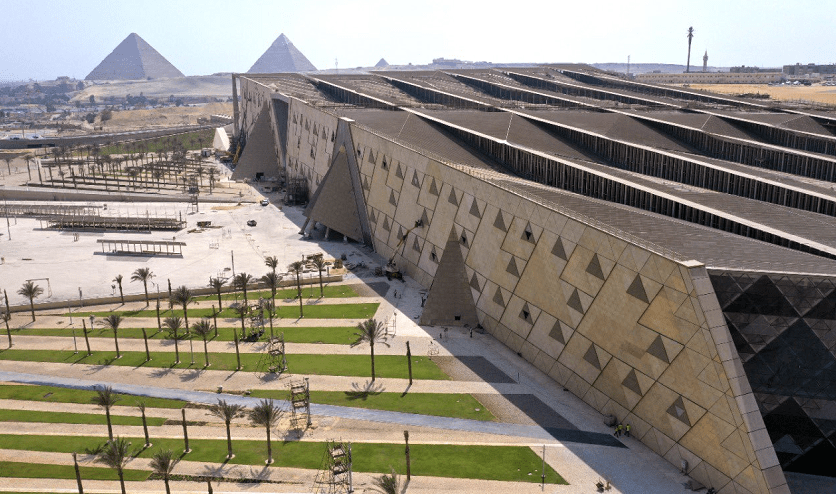
| Grand Egyptian Museum, Giza | The gold mask of Tutankhamun and his coffins |
| Egyptian Museum, Tahrir | The gold masks of Tanis, including Psusennes I; the masks of Yuya and Tjuyu; Fayum portraits |
| Bawiti, Bahariya Oasis | Gilded masks from the Valley of the Golden Mummies |
| Mummification Museum, Luxor | Coffins, cartonnage and the tools of embalming |
See Tutankhamun’s mask with an Egyptologist on our Giza Pyramids and Grand Egyptian Museum tour, and read about the symbols on the masks in ancient Egyptian symbols.
Ancient Egyptian Masks: FAQ
What was the purpose of an Egyptian funerary mask?
To give the mummy a perfect, everlasting face so the soul could recognise its body, and to show the dead person as a god reborn.
What is Tutankhamun’s mask made of?
Solid gold, about 10 kg, inlaid with blue glass, lapis lazuli, carnelian, turquoise, quartz and obsidian.
Where is Tutankhamun’s mask now?
In the Grand Egyptian Museum in Giza, after nearly a century in the Egyptian Museum in Tahrir.
What were most Egyptian masks made of?
Cartonnage: layers of linen or papyrus stiffened with glue and plaster, then painted and sometimes gilded.
Did the ancient Egyptians wear masks while alive?
Rarely. A few ritual masks of gods such as Anubis and Bes survive, but almost all Egyptian masks were made for the dead.