



 Day Tour
 Nile Cruise
 Nile Cruise
 Nile Cruise
 Nile Cruise
Testimonials
Our Clients Reviews
See what our happy travelers say about us


The Temple of Horus at Edfu is the best-preserved ancient temple in Egypt and the second largest after Karnak. Built during the Ptolemaic period between 237 and 57 BCE, it was constructed entirely on top of an earlier New Kingdom temple site in a deliberate effort to maintain continuity with pharaonic traditions, even as the ruling dynasty was Macedonian-Greek. The result is a monument of extraordinary completeness: pylon towers, outer court, hypostyle halls, offering hall, and sanctuary all survive largely intact.
The temple is dedicated to Horus the Elder, identified at Edfu specifically as Horus of Behdet — the falcon god in his most martial aspect. The outer walls are covered in enormous relief carvings depicting the Triumph of Horus, a mythological drama in which Horus defeats Set and his armies of hippopotami and crocodiles. The annual re-enactment of this drama was one of the most important festivals in the Ptolemaic religious calendar.
At 137 meters long and with pylon towers rising 36 meters, Edfu gives the clearest available impression of how great pharaonic temples looked in their prime. The interior darkens progressively toward the sanctuary, following the canonical Egyptian sacred architecture of increasing restriction from entrance to inner shrine.
The foundation of the current temple was laid by Ptolemy III Euergetes on 23 August 237 BCE — a date recorded precisely in inscriptions on the walls. Construction continued for 95 years and the temple was finally dedicated in 142 BCE. Decoration of the outer areas was complete around 57 BCE under Ptolemy XII — the entire project spanning 180 years and six Ptolemaic reigns.
The temple’s inscribed texts are among the most complete surviving sources for Ptolemaic religious practice, including the ‘Sacred Drama of Horus’ performed annually, a liturgical calendar, lists of temple personnel, and building accounts.
The temple was converted to a church in the Christian era and subsequently buried under accumulated sand and Nile silt to roof level — a fortunate accident that preserved it from stone-robbing. Auguste Mariette began systematic excavation in 1860, uncovering the temple largely intact.
Two 36-meter towers flanking the entrance carry carved reliefs of Ptolemy XII smiting enemies — the tallest intact ancient pylon in existence.
The outer ambulatory walls depict the full mythological drama of Horus defeating Set in battle, told in a sequence of carved and painted scenes.
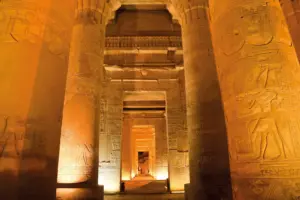
Two hypostyle halls with forest-like columns lead progressively deeper into the temple; the outer hall ceiling retains traces of astronomical decoration.
The sanctuary contains a monolithic black granite shrine — the largest naos in Egypt — placed here before the Ptolemaic temple was built, indicating cult continuity at this site.
In the outer court stands a granite falcon statue wearing the double crown, representing Horus of Behdet; one of the best-known images of any Egyptian temple.
These packages visit this site as part of the itinerary.

Start From


Start From


Start From

See what our happy travelers say about us



