






 Day Tour
 Nile Cruise
Testimonials
Our Clients Reviews
See what our happy travelers say about us


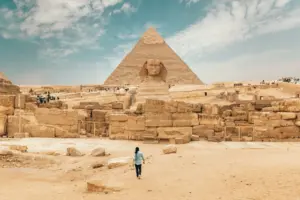
The Great Sphinx of Giza is the largest monolithic statue in the world, carved directly from the natural limestone bedrock of the Giza plateau. It depicts a reclining lion with a human head, facing due east toward the rising sun. The body stretches 73 meters from paw to tail and stands 20 meters tall. The head, believed to bear the face of Pharaoh Khafre, was carved from a harder limestone layer than the body, which accounts for the differential weathering visible today.
The Sphinx is positioned at the eastern end of Khafre’s complex and functioned as a guardian of the plateau’s causeways and temples. Between its paws stands the Dream Stela, a granite tablet erected by Pharaoh Thutmose IV (c. 1400 BCE) recording a legend in which the Sphinx appeared to him in a dream and promised him the throne if he cleared the sand burying its body — an early record of the Sphinx being partially obscured by desert encroachment.
Depending on the season, the Sphinx’s nose casts a shadow that functions as a solar marker at certain times of day, and at the spring and autumn equinoxes the sun sets directly over the shoulder of Khafre’s pyramid as seen from the Sphinx’s perspective — a deliberate celestial alignment that is widely accepted by archaeoastronomers.
The Great Sphinx was carved from a knoll of limestone left in place after quarrying operations on the Giza plateau, most likely during the reign of Khafre (c. 2558–2532 BCE), though some scholars propose an earlier date during the reign of Khufu. No definitive inscription names the builder, but the stylistic resemblance of the face to known statues of Khafre, and its physical position within Khafre’s complex, supports the attribution.
Ancient Egyptians called the Sphinx Hor-em-Akhet (‘Horus on the Horizon’) and later identified it with the god Ra-Horakhty. During the New Kingdom it was a major cult site, and a small chapel was built between its paws by Amenhotep II. The Dream Stela erected by Thutmose IV records the earliest known literary reference to the Sphinx.
Over millennia the Sphinx has required repeated restoration: first by New Kingdom pharaohs, then by Roman engineers, and extensively during the 20th century. Major consolidation work in the 1980s and again in the 1990s addressed severe chemical weathering from humidity and salt crystallization. The Sphinx’s missing nose — lost sometime between the 3rd and 14th centuries CE — is documented in medieval Arab texts but the exact circumstances remain unclear.
The viewing terrace in front of the Sphinx provides the standard face-on viewpoint; the erosion channels in the limestone body are visible at close range from here.
The granite tablet erected by Thutmose IV stands between the Sphinx's paws, recording one of the oldest known legends of the monument.
Immediately south of the Sphinx, this massive granite temple — partially open to visitors — is one of the best-preserved Old Kingdom structures on the plateau.
At the spring and autumn equinoxes, the sun sets directly over Khafre's pyramid as viewed from the Sphinx's position — a deliberate astronomic orientation.
These packages visit this site as part of the itinerary.


Start From


Start From

See what our happy travelers say about us



