Summary
The Nile is one of the longest rivers in the world, about 6,650 km from its farthest sources in East Africa to the Mediterranean, and it is the reason Egypt exists. It flows north through eleven countries. In Egypt, almost the whole population lives in its narrow green valley and delta, surrounded by desert. Its yearly flood fed the civilisation of the pharaohs for 5,000 years, until the Aswan High Dam tamed it in 1970. Today a Nile cruise between Luxor and Aswan is the classic way to see Egypt.
Nile River Facts at a Glance
| Fact | Detail |
|---|---|
| Length | About 6,650 km, usually counted with the Amazon as one of the two longest rivers on Earth |
| Direction | South to north, into the Mediterranean |
| Main branches | The White Nile (from the Lake Victoria region) and the Blue Nile (from Lake Tana in Ethiopia), meeting at Khartoum in Sudan |
| Countries in its basin | Eleven, from Burundi and Rwanda to Egypt |
| In Egypt | From Lake Nasser in the south to the Delta on the Mediterranean |
| Mouths | Two branches in the Delta, at Rosetta and Damietta |
| Cataracts | Six stretches of rapids in Sudan and Egypt; the First Cataract is at Aswan |
Where Does the Nile Begin?
The Nile has two great sources:
- The White Nile flows from Lake Victoria, the largest lake in Africa, shared by Uganda, Kenya and Tanzania; its farthest headwaters are rivers in Rwanda and Burundi that feed the lake. It flows steadily all year.
- The Blue Nile rises at Lake Tana in the highlands of Ethiopia. Swollen every summer by monsoon rains, it brings most of the Nile’s water and almost all of its rich silt.
The two meet at Khartoum, the capital of Sudan, and the river then crosses the Sahara for some 3,000 km to the sea, joined by only one more major tributary, the Atbara, north of Khartoum.
Why Does the Nile Flow North?
Rivers flow downhill, not to any point of the compass. The Nile’s sources lie in the high plateaus of East Africa, and the land slopes gradually down towards the Mediterranean, so the river runs north. This is why, in Egypt, the south is called Upper Egypt (upstream) and the north Lower Egypt (downstream), and why Luxor and Aswan are in “Upper” Egypt even though they are lower on a map.
The Nile and Ancient Egypt
The Greek historian Herodotus called Egypt “the gift of the Nile”. Almost no rain falls in Egypt, but every summer the Ethiopian monsoon swelled the river, which flooded the valley and left a fresh layer of black silt. The Egyptians called their country Kemet, “the black land”, after it.
- Farming: the flood decided the three seasons of the year; see farmers in ancient Egypt.
- Taxes: officials measured the flood on Nilometers, such as those at Kom Ombo and Elephantine Island, to set the year’s taxes.
- Transport: boats sailed south with the north wind and drifted north with the current, carrying stone for the pyramids and grain for the state. See economy and trade in ancient Egypt.
- Religion: the flood was the god Hapi, and the river’s cycle of death and rebirth was linked with Osiris and the crocodile god Sobek.
Even today about 95% of Egyptians live on the roughly 5% of the country that the Nile waters.
8-Day Cairo, Siwa and White & Black Desert Adventure
Planning the trip itself? Start here.
View This TripThe Aswan High Dam and Lake Nasser
Completed in 1970, the Aswan High Dam ended the yearly flood for the first time in history. It protects Egypt from droughts and floods, provides electricity and allows two or three harvests a year, but it also stopped the silt that once fertilised the fields. Behind it lies Lake Nasser, one of the largest artificial lakes in the world, about 500 km long. Its rising waters forced an international rescue of the Nubian monuments, including Abu Simbel and Philae, which were moved to higher ground.
How to Travel the Nile Today
| How | Time | Best for |
|---|---|---|
| Nile cruise, Luxor to Aswan | 3 to 7 nights | The classic: temples by day, sunsets on deck, with stops at Edfu and Kom Ombo |
| Dahabiya | 4 to 7 nights | A small sailing boat for a few guests, mooring at quiet islands |
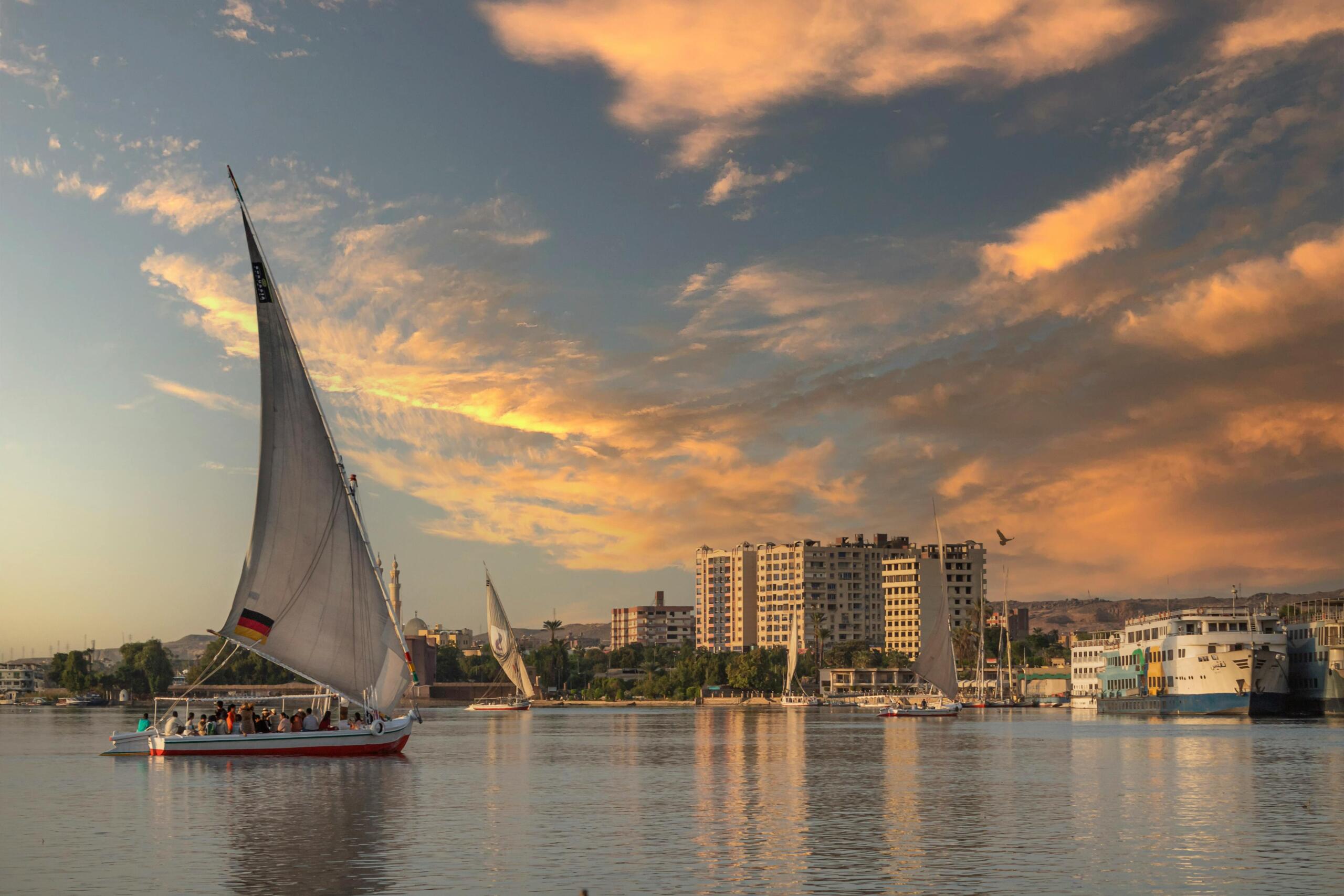
| Felucca | 1 to 2 hours | A sunset sail in Aswan or Luxor on a traditional wooden boat |
| Lake Nasser cruise | 3 to 4 nights | Remote Nubian temples and Abu Simbel from the water |
| Cairo Tower and the Corniche | An evening | The Nile at the heart of Cairo |
October to April is the most comfortable time for a cruise; see the best time to visit Egypt.
The Nile River: FAQ
How long is the Nile River?
About 6,650 km from its farthest sources to the Mediterranean, one of the two longest rivers in the world with the Amazon.
Where does the Nile River start?
Its two main branches start at Lake Victoria (the White Nile) and Lake Tana in Ethiopia (the Blue Nile). They meet at Khartoum in Sudan.
Which direction does the Nile flow?
North, from the highlands of East Africa down to the Mediterranean Sea.
Why was the Nile so important to ancient Egypt?
In a land with almost no rain, its yearly flood watered and fertilised the fields, and the river was the country’s main highway.
What is the best way to see the Nile?
A Nile cruise between Luxor and Aswan, which combines the river with the great temples of Upper Egypt.