
Summary
Hatshepsut ruled Egypt as pharaoh for about 21 years, around 1479–1458 BC, one of the very few women to hold the title. A king’s daughter and a king’s widow, she first governed for her young stepson Thutmose III, then had herself crowned as king. Her reign was peaceful and prosperous: she sent a famous trading expedition to the land of Punt and built some of Egypt’s most beautiful monuments, above all her terraced temple at Deir el-Bahari in Luxor. Twenty years after her death her images were attacked, and she was almost forgotten until the 19th century.
Who Was Hatshepsut?
Hatshepsut, whose name means “foremost of noble women”, was the daughter of King Thutmose I and his principal wife, Queen Ahmose, in the 18th Dynasty. As was common in the royal family, she married her half-brother, who became Thutmose II. They had a daughter, Neferure, but no son.
When Thutmose II died young, around 1479 BC, the heir was a small boy, Thutmose III, his son by a minor wife named Iset. Hatshepsut, as the senior queen, ruled on his behalf as regent.
From Queen to King
Within about seven years, Hatshepsut took a step almost no woman had taken before: she was crowned as king, with the full royal titles and the throne name Maatkare, “Truth is the soul of Ra”. Thutmose III was not removed; he remained co-ruler, but in second place.
Egyptian kingship was a male office, so her official images gradually show her as a male king, with a kilt, a bare chest, the royal headcloth and the false beard. Inscriptions still often use feminine grammar for her. To justify her rule, she had the story of her divine birth carved in her temple, showing the god Amun visiting her mother in the form of Thutmose I, making Hatshepsut the god’s own daughter. Read more about the women of Egypt in the ancient Egyptian social pyramid.
Senenmut, Her Right-Hand Man
Hatshepsut’s most trusted official was Senenmut, a man of modest birth who rose to become steward of the queen’s estates, tutor of her daughter Neferure and, probably, the architect of her great temple. More statues of him survive than of almost any other non-royal Egyptian, many showing him holding the little princess. His closeness to the queen has fuelled endless speculation, but the evidence tells us only that he was extraordinarily trusted.
The Expedition to Punt
In about the ninth year of her reign, Hatshepsut sent a fleet down the Red Sea to Punt, a land famed for incense, probably on the coast of modern Eritrea or Sudan. The ships came back with myrrh trees in baskets to plant at her temple, ebony, ivory, gold, baboons and leopard skins. The whole voyage is carved on the walls of her temple at Deir el-Bahari, including the Queen of Punt and her village of houses on stilts. Read how Egypt traded with the world in the economy and trade of ancient Egypt.
Her Temple at Deir el-Bahari
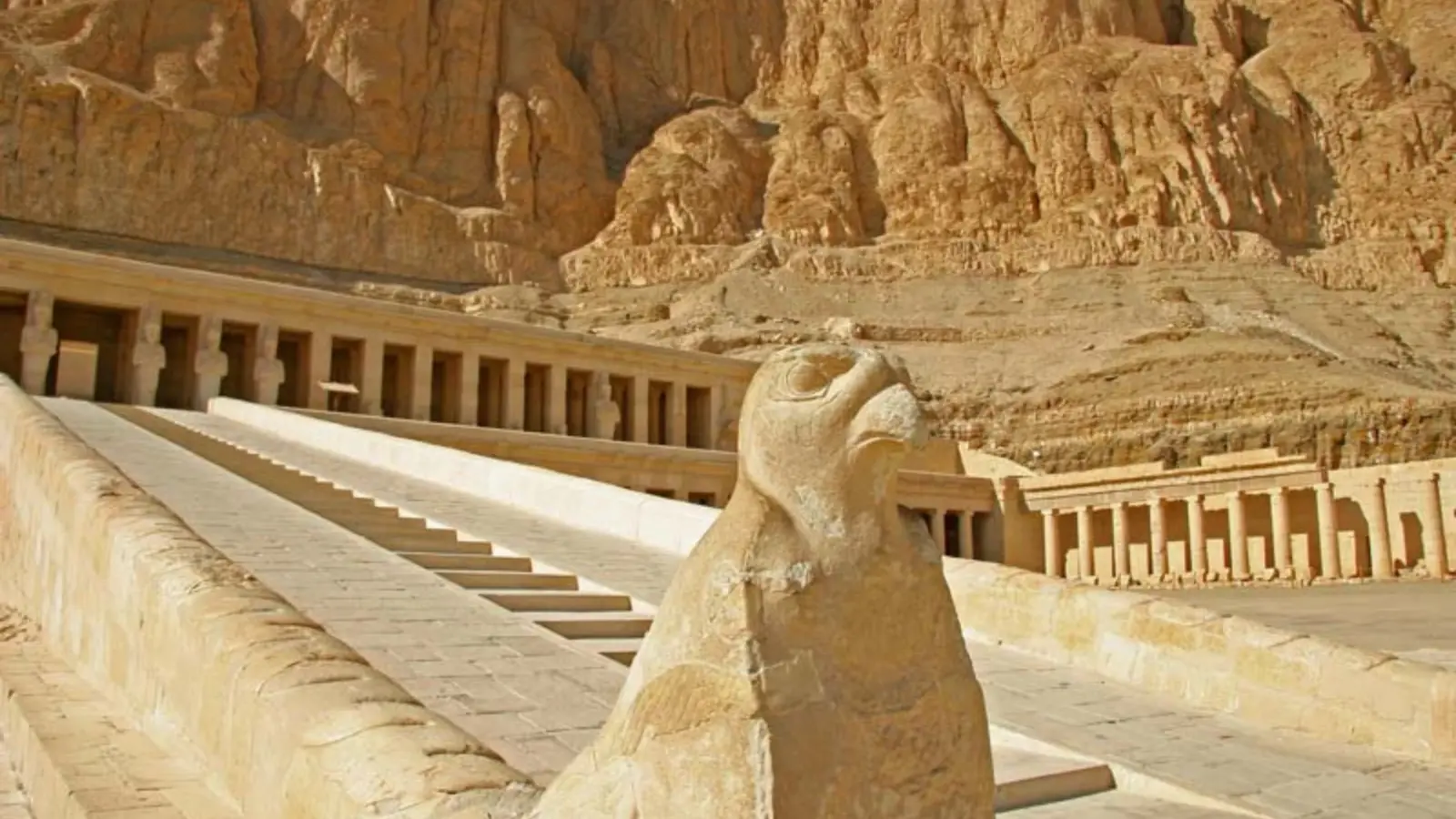
Hatshepsut’s mortuary temple, Djeser-Djeseru, “Holy of Holies”, rises in three great terraces against the cliffs on Luxor’s west bank, beside the older temple of Mentuhotep II that inspired it. Linked by long ramps and lined with colonnades, it is one of the most striking buildings of the ancient world. Highlights include the Punt reliefs, the divine-birth colonnade, the chapels of Hathor and Anubis with their original colour, and the statues of the queen as Osiris on the upper terrace.
See tickets, hours and what to see on our Temple of Hatshepsut page, and visit it with an Egyptologist on our Luxor west bank tour, together with the Valley of the Kings.
8-Day Cairo, Siwa and White & Black Desert Adventure
Planning the trip itself? Start here.
View This TripObelisks and Other Monuments
- Karnak: for her jubilee she raised a pair of red granite obelisks at Karnak. One still stands, nearly 30 metres high, the tallest standing obelisk in Egypt. She also built the Red Chapel, a shrine for the sacred boat of Amun, rebuilt today in Karnak’s Open Air Museum.
- Aswan: the giant Unfinished Obelisk in the granite quarries is generally dated to her reign. It cracked during carving and was abandoned in the rock.
- Speos Artemidos: a rock-cut temple near Beni Hassan in Middle Egypt, where she claimed to have restored temples damaged in the time of the Hyksos.
Why Were Her Images Erased?
Hatshepsut died around 1458 BC, and Thutmose III went on to rule alone for over 30 years as one of Egypt’s greatest warrior kings. Late in his reign, about 20 years after her death, her images and names as king were chiselled out of many monuments, her statues smashed and thrown into pits, and her obelisks at Karnak walled in.
It was once thought this was the revenge of a stepson who hated her. Because it happened so long after her death, most Egyptologists now see a political motive: a female king did not fit the traditional order, and Thutmose III may have wanted to secure the throne for his own son, Amenhotep II, by removing a rival royal line from the record. Her images as queen were often left untouched.
The Tomb and Mummy of Hatshepsut
Hatshepsut prepared a tomb in the Valley of the Kings (KV20), where her quartzite sarcophagus was found empty. Her mummy was lost for more than a century. In 2007, Egyptian archaeologists announced that an unidentified female mummy from a small tomb in the valley (KV60) was Hatshepsut: a tooth found in a box inscribed with her name fitted a gap in the mummy’s jaw. Since the Pharaohs’ Golden Parade of 2021 she has rested in the Royal Mummies Hall of the National Museum of Egyptian Civilization. Read more in Egyptian mummies and sarcophagi.
Where to See Hatshepsut Today
| Where | What to see |
|---|---|
| Temple of Hatshepsut, Luxor | Her terraced temple, the Punt and divine-birth reliefs |
| Karnak | Her standing obelisk and the Red Chapel |
| Unfinished Obelisk, Aswan | The cracked giant from her reign |
| NMEC, Cairo | Her mummy |
Meet the other great rulers in our guides to Egyptian pharaohs, Amenhotep III and Queen Nefertari.
Hatshepsut: FAQ
Who was Hatshepsut?
A queen of the 18th Dynasty who ruled Egypt as pharaoh for about 21 years, around 1479–1458 BC.
Was Hatshepsut the first female pharaoh?
Not quite: a few women, such as Sobekneferu in the 12th Dynasty, ruled before her. But Hatshepsut was the most successful and long-reigning woman to hold the title.
Why did Hatshepsut dress as a man?
Kingship was a male role, so her official images followed the traditional picture of a king, with a kilt and false beard, to show that she held the office in full.
Where is Hatshepsut’s mummy?
In the Royal Mummies Hall of the National Museum of Egyptian Civilization in Cairo, identified in 2007.
What is Hatshepsut famous for?
Ruling as a female pharaoh, her temple at Deir el-Bahari, the trading expedition to Punt and her obelisks at Karnak.


























