




 Day Tour
Testimonials
Our Clients Reviews
See what our happy travelers say about us
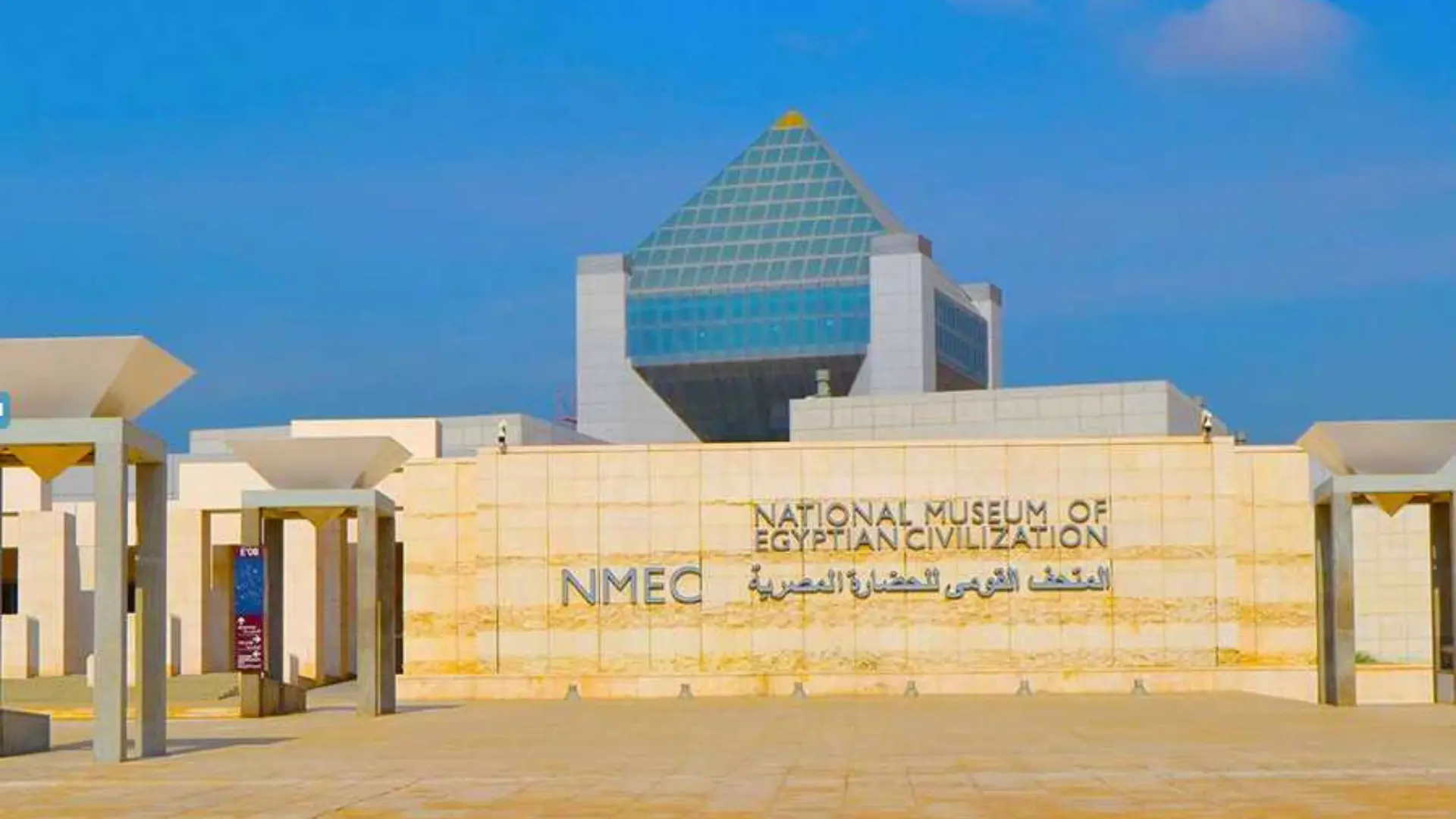

The National Museum of Egyptian Civilization (NMEC) in Fustat, Old Cairo, is Egypt’s newest major national museum, opened in phases from 2017 with its full program inaugurated in April 2021 during a ceremony that included the ceremonial transfer of 22 royal mummies from the Egyptian Museum in Tahrir Square. The museum presents the entirety of Egyptian civilization from prehistoric times to the modern era, across an architecture of reflecting pools, galleries, and an outdoor theater on the edge of the historic Ain el-Sira lake — the same lake from which pharaonic-era water rights disputes are recorded in ancient papyri.
The museum’s approach is deliberately civilizational rather than narrowly pharaonic. Its galleries trace Egyptian history through thematic lenses — the Nile, social organization, belief systems, arts and crafts, trade — and continue through the Greco-Roman, Coptic, Islamic, and modern periods in a narrative that treats Egypt’s 7,000 years of recorded history as a continuous story rather than one dominated by a single ancient chapter. This makes NMEC the most comprehensive museum of Egyptian history anywhere in the world.
The museum’s most celebrated feature is the Royal Mummies Hall — a specially designed, climate-controlled gallery displaying 22 royal mummies including Ramesses II, Seti I, Ramesses III, Thutmose III, Hatshepsut, and Ahmose I in individual glass cases with sophisticated atmospheric controls that maintain the precise temperature and humidity required for long-term preservation. The display is presented with exceptional dignity, with each mummy given substantial space and detailed biographical context.
The NMEC project was conceived in the 1980s as part of UNESCO’s ‘Campaign for the Safeguarding of the Cultural and Natural Heritage of Cairo’ and planned from the outset as Egypt’s flagship national museum. The site at Fustat — adjacent to Old Cairo, the first Islamic capital of Egypt, and near the Coptic quarter — was chosen deliberately to locate the museum in an area that embodied multiple layers of Egyptian history.
The museum building was designed to reference the three classical forms of Egyptian monumental architecture: the pyramid (the sloping museum roof), the pylon (the entrance gateway), and the obelisk (the central tower). The Ain el-Sira lake, which the museum fronts, was restored as part of the museum development — the lake had been significantly reduced in size and polluted by modern urban development, and its restoration created a public waterfront amenity alongside the museum.
The April 2021 Royal Mummy Parade — in which the 22 mummies were transferred from the Egyptian Museum in Tahrir Square to NMEC in golden carriages in a televised ceremony — was watched by an estimated 220 million viewers globally and created international recognition for the museum before it had been fully open for a year.
22 royal mummies including Ramesses II, Seti I, Hatshepsut, and Thutmose III displayed in individual climate-controlled cases with biographical context — the most important mummy display in any museum.
Thematic galleries presenting Egyptian history from prehistoric to modern times through the Nile, social organization, belief, craft, and trade — the most comprehensive continuous Egyptian history display anywhere.
Material from Egypt's earliest periods including Neolithic tools, Predynastic pottery, and the earliest evidence of Nile Valley settlement — rarely displayed in depth at other Egyptian museums.
Dedicated galleries covering post-pharaonic Egyptian civilization through the Coptic Christian and Islamic periods — treating these as integral chapters of Egyptian history rather than appendices.
The museum's outdoor terrace and waterfront on the restored historic lake provide a distinctive setting for the building and a public amenity in one of Cairo's oldest districts.
These packages visit this site as part of the itinerary.


Start From


Start From


Start From

See what our happy travelers say about us



