
Summary
Thutmose III ruled Egypt for 54 years, around 1479–1425 BC, and is often called the greatest warrior king in its history. For his first two decades he shared the throne with his stepmother, Hatshepsut. Ruling alone, he led at least 17 campaigns into the Near East, won the Battle of Megiddo, crossed the Euphrates, and made Egypt the leading power of its age. He was also a great builder at Karnak, and his obelisks now stand in Rome, Istanbul, London and New York.
Who Was Thutmose III?
Thutmose III was the son of King Thutmose II and a minor wife named Iset. When his father died around 1479 BC, he was a small child. His stepmother and aunt, Hatshepsut, ruled on his behalf and, within a few years, was crowned king herself. For about 22 years the two reigned together, with Hatshepsut as the senior king.
The young Thutmose was not kept from power: he trained with the army and may already have led campaigns. When Hatshepsut died around 1458 BC, he became sole king, with the throne name Menkheperre, “Lasting is the manifestation of Ra”. His reign is counted from his father’s death, so it lasted 54 years in all, one of the longest in Egyptian history.
The Battle of Megiddo
Within months of ruling alone, Thutmose faced a coalition of Canaanite and Syrian princes, led by the king of Kadesh, gathered at the city of Megiddo in northern Canaan. His generals advised a safe route; the king chose instead the narrow Aruna pass, where the army had to march in single file, and surprised the enemy by appearing where they least expected.
The Egyptians routed the coalition in the field, though the soldiers stopped to plunder the camp and the survivors escaped into the city, which then held out for seven months. When Megiddo fell, Thutmose won control of Canaan. It is the first battle in history recorded in detail, by an army scribe whose account was carved on the walls of Karnak. The place name later gave us the word “Armageddon”, from Har Megiddo, “the hill of Megiddo”.
Seventeen Campaigns and an Empire
Over the next 20 years Thutmose led at least 17 campaigns, recorded year by year in his Annals at Karnak. In his greatest expedition, around his 33rd year, he had boats built in Lebanon and carried overland on carts to the Euphrates, crossed the river into the kingdom of Mitanni, and set up a victory stela beside one left by his grandfather, Thutmose I.
His policy was clever as well as forceful: the sons of defeated princes were taken to Egypt, raised at court, and sent home as loyal rulers. Tribute flowed into Egypt from Nubia to Syria, and the wealth paid for a new age of building. The American Egyptologist James Henry Breasted later called him “the Napoleon of Egypt”. See how this wealth worked in the economy and trade of ancient Egypt.
Building at Karnak
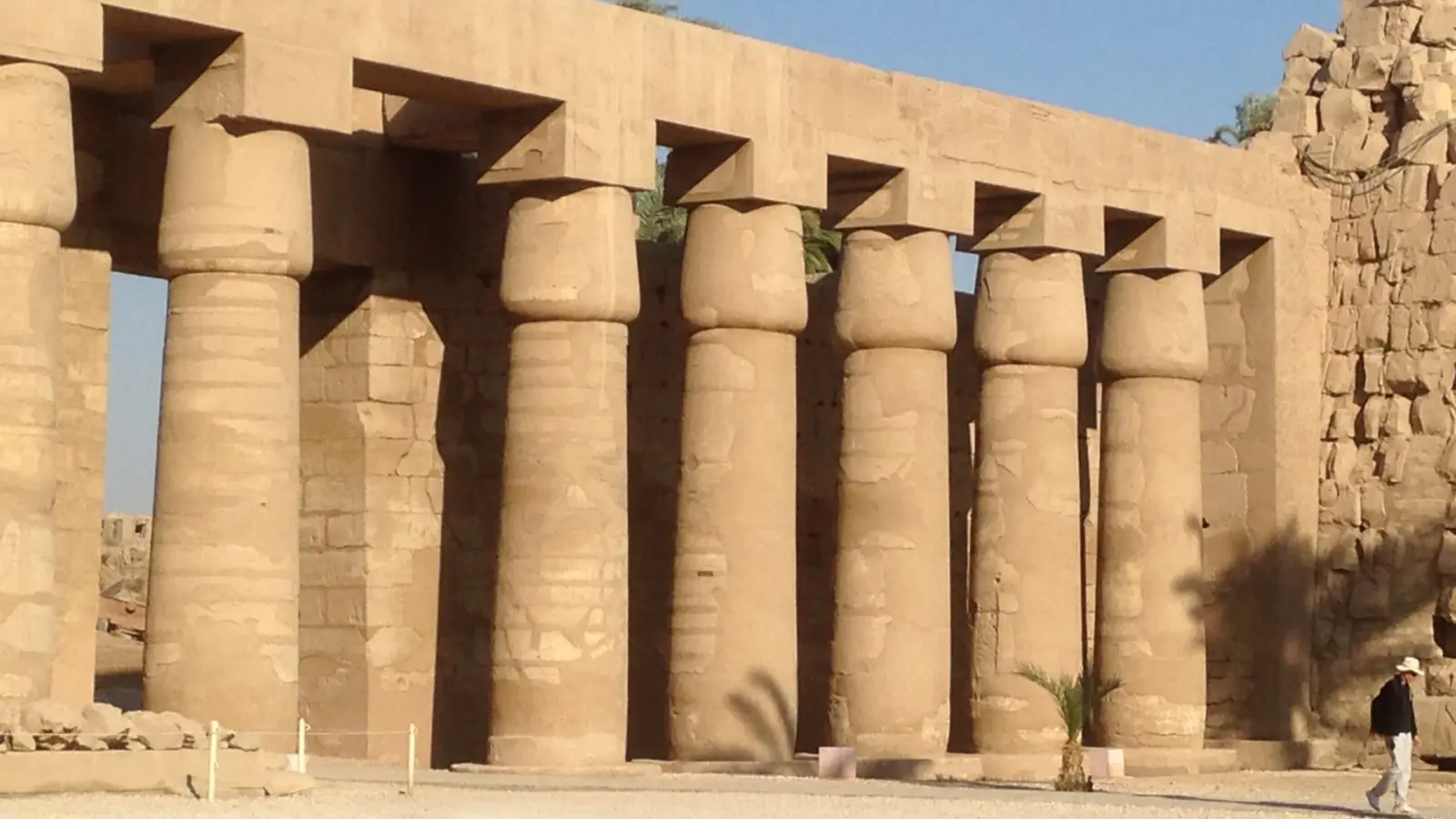
- The Festival Hall (Akh-menu) at the back of Karnak, with columns carved to look like tent poles.
- The “Botanical Garden”, a chamber whose walls show the foreign plants, birds and animals the king saw on campaign in Syria, the first record of its kind.
- The Hall of Annals, where the story of his campaigns is carved, and the Seventh Pylon, showing the king smiting his enemies.
- Temples across Egypt and Nubia, from Deir el-Bahari to the fortress temples near the Second Cataract.
His Obelisks Around the World
Thutmose III raised many obelisks, and several were taken abroad in later ages. Together they make him the pharaoh with the most monuments standing outside Egypt:
- Rome: the Lateran Obelisk, the tallest ancient obelisk in the world, begun by Thutmose III and erected by his grandson Thutmose IV at Karnak, then shipped to Rome in the 4th century AD.
- Istanbul: the Obelisk of Theodosius in the old Hippodrome, the top part of one of his Karnak obelisks.
- London and New York: the two “Cleopatra’s Needles”, which have nothing to do with Cleopatra. Thutmose III raised them at Heliopolis; they were moved to Alexandria under the Romans and to London and New York in the 1870s and 1880s.
8-Day Cairo, Siwa and White & Black Desert Adventure
Planning the trip itself? Start here.
View This TripThutmose III and Hatshepsut
Late in his reign, about 20 years after Hatshepsut’s death, her images as king were chiselled away and her statues broken. It was long told as the revenge of a resentful stepson, but the timing points to politics: removing a female king from the record, and securing the throne for his own son, Amenhotep II, who succeeded him around 1425 BC. Read the full story in our guide to Hatshepsut.
Tomb and Mummy
Thutmose III was buried in tomb KV34 in the Valley of the Kings, hidden high in a cleft in the cliffs and reached by a steep staircase. Its oval burial chamber is decorated with the complete Amduat, the “Book of What Is in the Underworld”, drawn in a simple stick-figure style that looks like an unrolled papyrus. It is on the general Valley of the Kings ticket when open.
His mummy was found in 1881 in the royal cache at Deir el-Bahari, damaged by ancient robbers. It is now in the Royal Mummies Hall of the National Museum of Egyptian Civilization in Cairo. Read more in Egyptian mummies and sarcophagi.
Where to See Thutmose III Today
| Where | What to see |
|---|---|
| Karnak Temple, Luxor | The Festival Hall, the Botanical Garden, the Annals and the Seventh Pylon |
| Valley of the Kings | His tomb, KV34 |
| Luxor Museum | Statues of the king |
| NMEC, Cairo | His mummy |
See Karnak and the Valley of the Kings in one day on our full-day Luxor tour, and meet the other great rulers in our guide to Egyptian pharaohs.
Thutmose III: FAQ
Who was Thutmose III?
A pharaoh of the 18th Dynasty who ruled about 1479–1425 BC, first beside Hatshepsut and then alone, and led Egypt to its greatest power through at least 17 military campaigns.
Why is Thutmose III called the Napoleon of Egypt?
Because of his military genius and his many successful campaigns; the name was coined by the Egyptologist James Henry Breasted.
What was the Battle of Megiddo?
Thutmose III’s victory over a Canaanite and Syrian coalition around 1457 BC, the first battle in history recorded in detail.
Where is Thutmose III buried?
In tomb KV34 in the Valley of the Kings. His mummy is in the National Museum of Egyptian Civilization in Cairo.
Did Thutmose III erase Hatshepsut?
Her images as king were removed late in his reign, about 20 years after her death, probably for political reasons connected with the succession.



























