
Summary
Ptah was the ancient Egyptian creator god of Memphis, the old capital of Egypt, and the patron of craftsmen, sculptors and builders. He is shown as a man wrapped like a mummy, with a close-fitting cap and a straight beard, holding a sceptre that joins three symbols of power and life. His priests taught that Ptah created the world simply by thinking it in his heart and speaking it with his tongue. Even the name “Egypt” goes back to his temple.
Who Was Ptah?
Ptah was the chief god of Memphis, the capital founded at the start of Egyptian history, just south of modern Cairo. Because Memphis was the royal city of the Old Kingdom, Ptah was one of the most important gods of the whole country for some three thousand years.
He was the god of craftsmen: stonemasons, sculptors, metalworkers and the architects who built the pyramids and temples. His high priest at Memphis carried the title “Greatest of the Directors of Craftsmanship”. Read about the other gods of Egypt in ancient Egyptian gods.
How Ptah Is Shown
Ptah is almost always shown in the same way, which makes him easy to recognise on temple walls:
- a man standing wrapped like a mummy, with only his hands free;
- a close-fitting skullcap and a straight beard, unlike the curled beard of other gods;
- often with green or blue skin, the colours of new life;
- holding a sceptre that combines the was (power), the ankh (life) and the djed pillar (stability).
Learn what these signs mean in ancient Egyptian symbols.
Creation by Thought and Word
Each great temple city had its own story of creation. At Memphis, the priests of Ptah taught that he was the first of all gods and that he created the world through his heart (where Egyptians believed thought lived) and his tongue: he conceived each thing, then spoke its name, and it came into being.
This idea survives on the Shabaka Stone, a black stone slab now in the British Museum. Around 710 BC King Shabaka had an old, worm-eaten text copied onto it so that it would be preserved; scholars call it the “Memphite Theology”.
Ptah, Sekhmet and the Apis Bull
At Memphis Ptah was worshipped with his wife, the lioness goddess Sekhmet, and their son Nefertem, god of the lotus flower. The sacred Apis bull, kept in a stall beside Ptah’s temple, was believed to be the living herald of the god. When an Apis bull died it was mummified and buried in the huge underground galleries of the Serapeum at Saqqara.
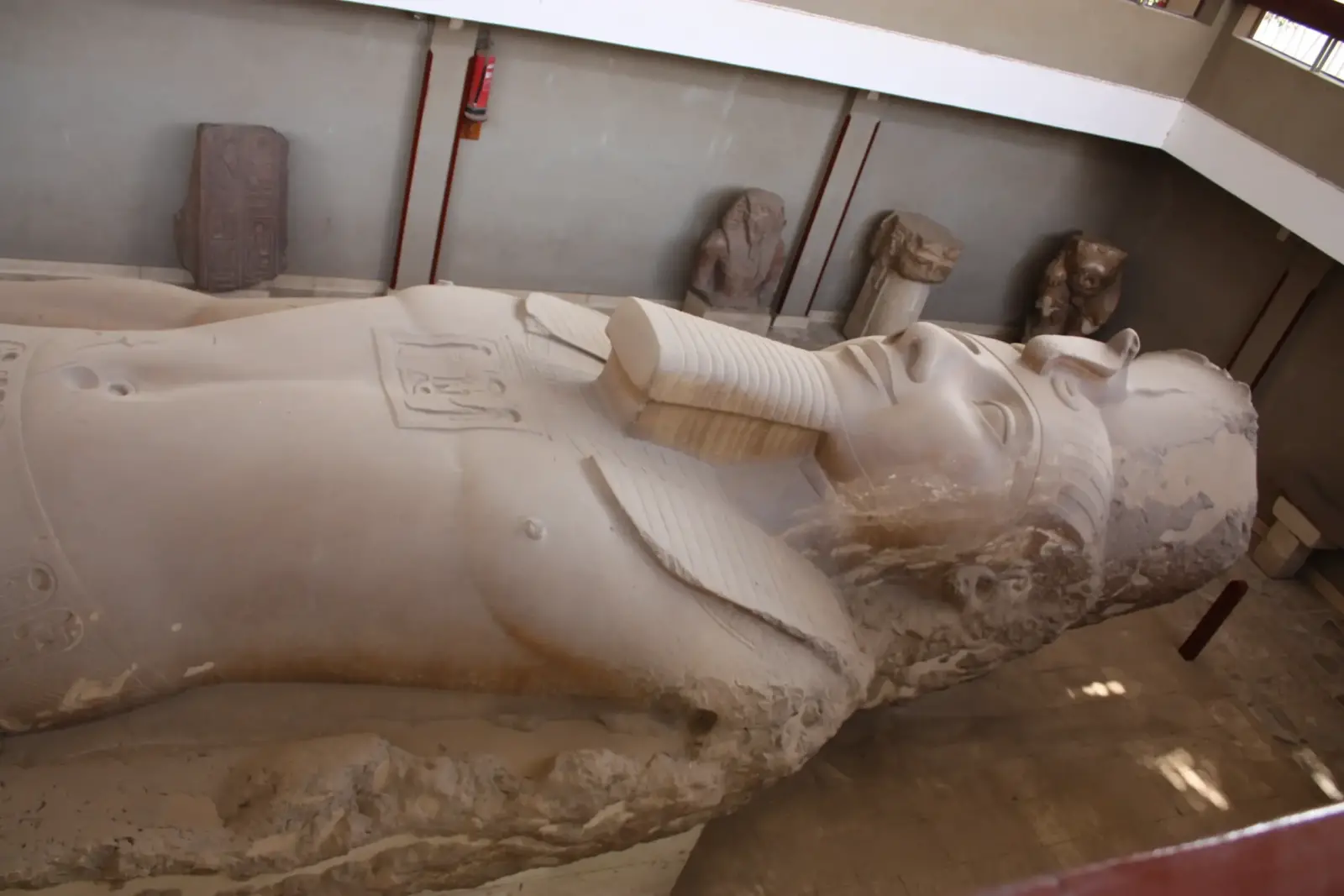
Little of Ptah’s great temple at Memphis survives above ground, but the site, now the Memphis open-air museum, displays the fallen colossus of Ramesses II and an alabaster sphinx that once stood at the temple.
8-Day Cairo, Siwa and White & Black Desert Adventure
Planning the trip itself? Start here.
View This TripThe God Who Named Egypt
The temple of Ptah at Memphis was called Hut-ka-Ptah, “the house of the spirit (ka) of Ptah”. The Greeks heard this name as Aigyptos and used it first for the city and then for the whole country. From the Greek came the Latin Aegyptus and our word Egypt.
In later times the architect Imhotep, builder of the Step Pyramid, was honoured as a son of Ptah, and Ptah was joined with other gods of Memphis as Ptah-Sokar-Osiris, a god of the dead.
Where to See Ptah in Egypt
- Abu Simbel: in the sanctuary of the Great Temple sit four statues: Ptah, Amun-Ra, Ra-Horakhty and Ramesses II. On the two days a year when the rising sun reaches the sanctuary, Ptah, a god linked with the underworld, is the one statue that stays in shadow. See Abu Simbel temples.
- Karnak: a small temple of Ptah stands inside the precinct of Amun at Karnak Temple, with a statue of Sekhmet in one of its chapels.
- Memphis: the open-air museum on the site of his city, usually visited with Saqqara.
Ptah: FAQ
What is Ptah the god of?
Creation and craftsmanship: he was the creator god of Memphis and the patron of sculptors, builders and artisans.
How did Ptah create the world?
According to his priests at Memphis, by thinking of each thing in his heart and speaking its name with his tongue.
Who was Ptah’s wife?
The lioness goddess Sekhmet; their son was Nefertem, god of the lotus.
Why is Ptah shown like a mummy?
His wrapped, motionless form was very ancient and linked him with the dead and with rebirth; his hands are free to hold his sceptre.
Is the word Egypt named after Ptah?
Yes, indirectly: it comes through Greek from Hut-ka-Ptah, the name of his temple at Memphis.



























