
 Day Tour
 Package
 Package
 Package
 Package
 Package
 Attraction
 Attraction
 Attraction
 Attraction
 Attraction
 Attraction
Testimonials
Our Clients Reviews
See what our happy travelers say about us


It is a modern cultural complex on the Alexandria waterfront, opened in 2002 as a revival of the spirit — if not the direct physical successor — of the ancient Library of Alexandria, which was one of the largest and most significant libraries of the ancient world. Designed by the Norwegian architecture firm Snøhetta following an international competition, the building is architecturally extraordinary: a massive tilted disc of gray Aswan granite inscribed with characters from 120 different world scripts, rising from a circular basin at the edge of the Mediterranean, with the main reading room descending in terraced levels under a roof of triangular glass panels that flood the interior with diffused natural light.
The library complex houses over 8 million books and documents across multiple specialized libraries, a planetarium, four museums, four art galleries, fifteen permanent exhibitions, a manuscript restoration laboratory, and several research centers. The main reading room — the largest in the world, with a capacity of approximately 2,000 readers simultaneously — is architecturally the building’s primary interior space, its stepped terraces descending toward the Mediterranean visible through the glass facade.
The Bibliotheca Alexandrina has established itself as the leading cultural institution in the Arab world and the primary international research center for Mediterranean studies, hosting conferences, concerts, film screenings, and academic events throughout the year. For visitors to Alexandria, it offers a compelling combination of architectural spectacle, museum content, and the cultural resonance of a modern attempt to reimagine one of antiquity’s great intellectual institutions.
The original Library of Alexandria was founded under Ptolemy I Soter around 300 BCE as part of the Mouseion (the institution that gave us the word ‘museum’) — a research institution modeled on Aristotle’s Lyceum and designed to collect all the world’s knowledge in one place. At its height the library reportedly held 700,000 scrolls — an enormous collection for antiquity. Its scholars included Euclid, Archimedes, Eratosthenes (who calculated the Earth’s circumference), and Hypatia.
The library’s destruction is one of history’s most debated mysteries — various sources attribute damage to Julius Caesar’s fire of 48 BCE, the Emperor Aurelian’s 270 CE assault, the Caliph Omar’s conquest of 641 CE, and the Christian bishop Theophilus’s destruction of the Serapeum in 391 CE. The most likely scenario is gradual decline through multiple events over several centuries rather than a single catastrophic destruction.
The modern Bibliotheca Alexandrina project was initiated by UNESCO in 1987 and supported by international funding from over 100 countries. The building was inaugurated in October 2002 and has operated continuously since, with a mission explicitly linking it to the spirit of ancient universalism in knowledge collection and dissemination.
The terraced interior descending under a triangular glass roof — the world's largest library reading room, flooded with diffused Mediterranean light and one of the most architecturally impressive interior spaces in Egypt.
The massive tilted granite disc exterior inscribed with 120 world scripts — the building's iconic image, visible from the Corniche and reflecting the library's mission of universal knowledge.
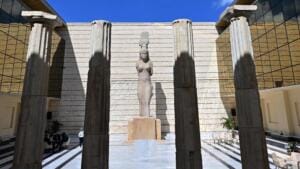
A significant collection of artifacts from the Greco-Roman and Islamic periods of Alexandria — complementing the Alexandria National Museum with objects relevant to the library's history and context.
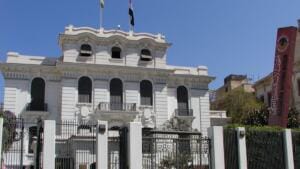
A museum dedicated to manuscript culture across multiple traditions — Arabic, Coptic, Greek, and Hebrew manuscripts displayed alongside restoration laboratory techniques.
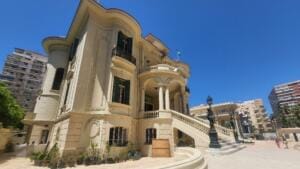
A state-of-the-art digital planetarium — appropriate to Alexandria's ancient astronomical tradition, where Eratosthenes calculated the Earth's circumference and Ptolemy wrote the Almagest.
Tickets are sold at the entrance; the main library and the museums inside have their own tickets. Entrance is included in our Alexandria tours.
The Bibliotheca Alexandrina opened in 2002 near the site of the great library of the ancient world. Its main reading room sits under a huge tilted disc facing the sea, and its outer granite wall is carved with letters and signs from scripts around the world. Inside there are several museums, including an antiquities museum and a manuscripts museum, as well as a planetarium. Read the story of the original in our guide to the ancient city.
The library is open during the day on most days of the week; check the library's own website for the hours on your date.
The library is on the Corniche of Alexandria's Eastern Harbour, a short drive from Qaitbay Citadel. Allow one to two hours.
| How | Best for |
|---|---|
| Alexandria day tour from Cairo | The library, Qaitbay Citadel and the catacombs in one day. |
No. It is a modern library, opened in 2002, built to remember the ancient one, which was lost in antiquity.
One to two hours for the reading room and one of the museums.
Yes, for the architecture and the museums; it fits easily into a day in Alexandria.
These packages visit this site as part of the itinerary.

Start From

Start From

Start From


Start From



Start From

See what our happy travelers say about us


