



Testimonials
Our Clients Reviews
See what our happy travelers say about us

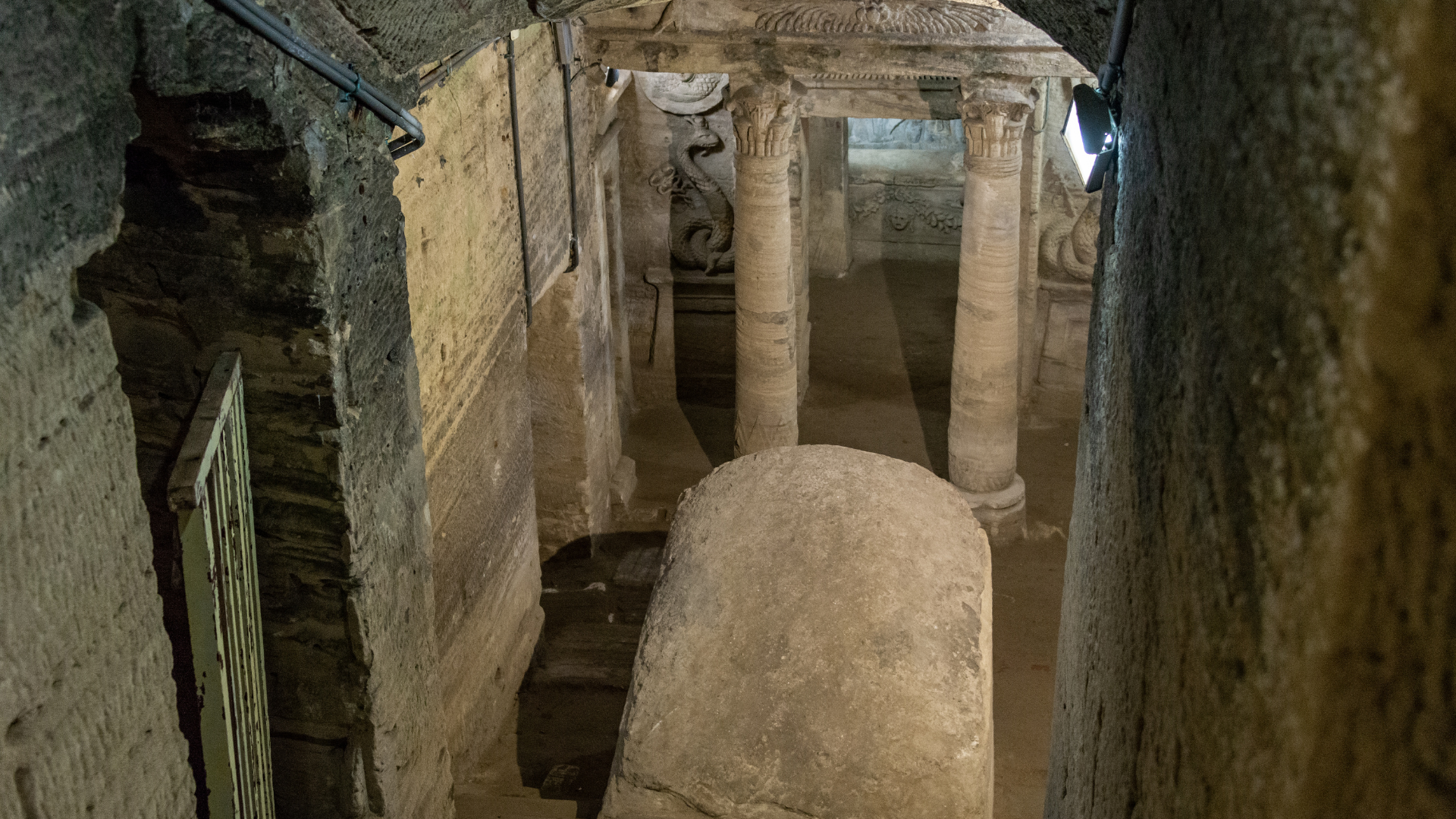
The Catacombs of Kom el-Shoqafa in Alexandria are the largest known Roman funerary complex in Egypt and one of the Seven Wonders of the Middle Ages, carved into the bedrock of the Karmouz hill in the western part of the city. Dating to the 2nd century CE and in use through the 4th century, they were accidentally rediscovered in 1900 when a donkey fell through the ground into the upper chamber. The catacombs descend three levels below street level via a spiral staircase and contain a remarkable synthesis of Egyptian, Greek, and Roman funerary art and architectural decoration — the most elaborate example of Alexandrian cultural fusion surviving in any archaeological context.
The complex consists of a triclinium (dining hall for funeral banquets), an antechamber, and the main tomb chamber on the second level, alongside a series of loculi (burial niches) carved into the surrounding rock. The decoration of the main tomb chamber is the highlight: the entrance facade combines Egyptian architectural elements — a winged solar disc, uraeus cobras, and lotus columns — with Roman architectural framing and Greek mythological figures, all carved in a single unified program that treats the three traditions as interchangeable visual vocabularies. The interior contains painted reliefs of Egyptian gods rendered in Roman artistic style, and Roman-style sarcophagi carved to appear Egyptian in form.
A flooded lower third level — visible through a shaft but currently inaccessible — suggests the catacombs may extend further than the currently explored sections. The site represents the ultimate expression of Alexandria’s defining characteristic: a city where Greek, Roman, and Egyptian traditions were not merely coexistent but genuinely fused into something new.
The Catacombs of Kom el-Shoqafa were constructed during the height of Roman Alexandria, most likely in the 2nd century CE during the reign of Hadrian or the Antonine emperors. The complex was built for a wealthy Alexandrian family and later expanded to accommodate additional burials from the surrounding community — the loculi niches in the upper levels suggest communal use alongside the grand private family tomb on the second level.
The name ‘Kom el-Shoqafa’ means ‘Mound of Shards’ in Arabic, referring to the broken terracotta pottery found at the site — the remnants of the food and drink vessels brought by mourners to the funeral banquets held in the triclinium and then smashed after use, as was the Roman custom. The dining room and its broken pottery are a direct record of the social ritual that accompanied elite Alexandrian burial.
The catacombs were forgotten and buried after the end of the Roman period. Their rediscovery in 1900 — when a donkey and cart fell through the ground — was followed by excavation that revealed the complex in the condition it remains today. A medieval section (‘Hall of Caracalla’) was later identified adjacent to the main complex, containing the bones of horses and humans possibly associated with a massacre attributed to the Emperor Caracalla in 215 CE.
The entrance to the principal burial chamber combining Egyptian winged solar disc, Roman pilasters, and Greek friezes in a single unified decorative program — the defining image of Alexandrian cultural fusion.
Interior painted reliefs of Anubis, Thoth, and other Egyptian gods rendered in Roman artistic technique — wearing Roman armor and depicted in classical postures while maintaining Egyptian iconographic identity.
The banquet room where mourners dined with the deceased — stone benches lining three walls, with the central table space still legible — one of the best-preserved Roman funerary dining rooms in any ancient site.
The original spiral staircase descending through three rock-cut levels, with a central shaft that allowed food and goods to be lowered to the underground spaces — an extraordinary piece of ancient engineering.
An adjacent section containing animal and human bones possibly associated with Emperor Caracalla's 215 CE massacre — a grim historical footnote attached to the complex.
These packages visit this site as part of the itinerary.


Start From

Start From


Start From


Start From


See what our happy travelers say about us



