

Testimonials
Our Clients Reviews
See what our happy travelers say about us

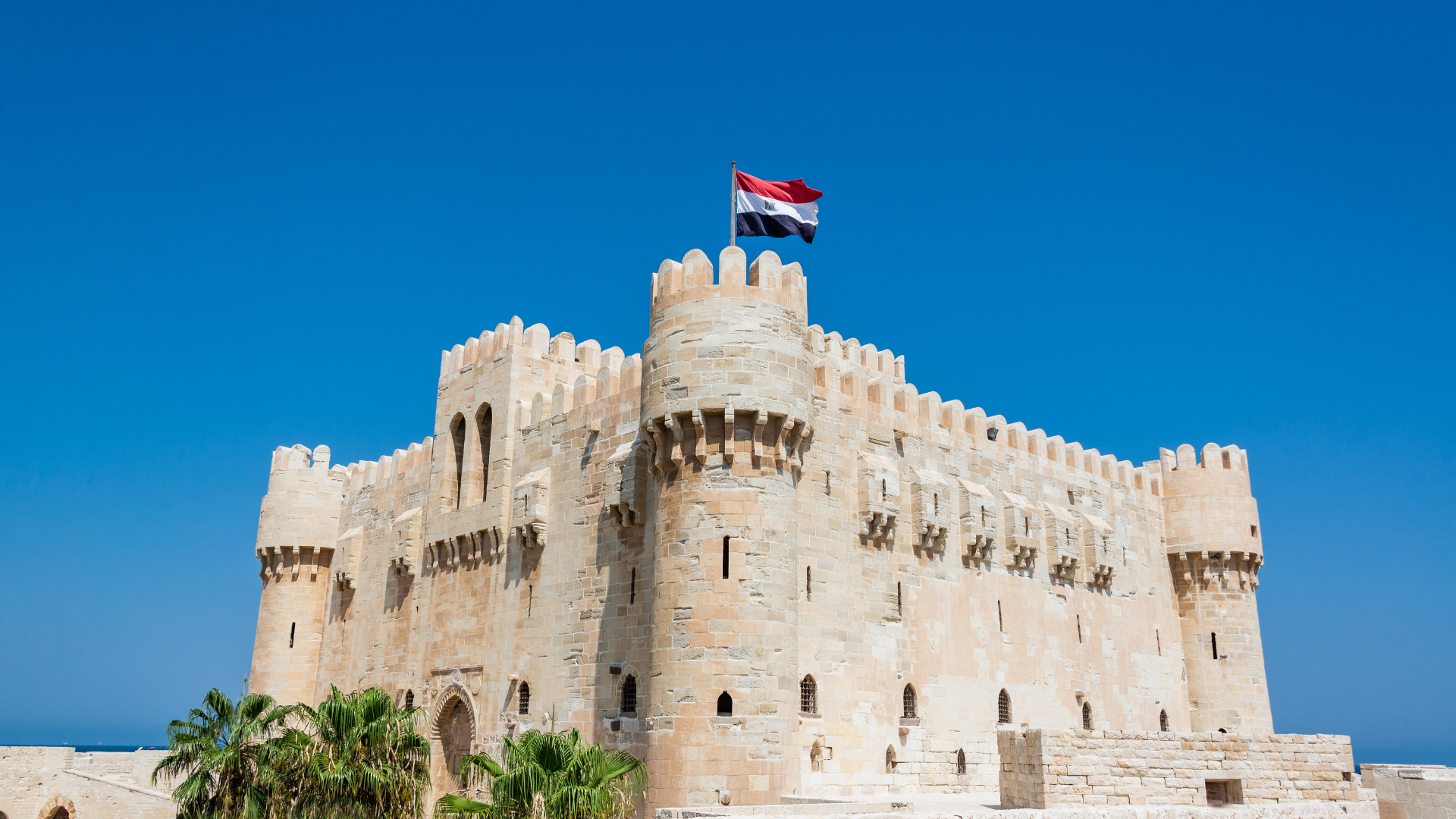
Fort Qaitbay is a 15th-century Mamluk fortress on the tip of the Pharos peninsula in the Eastern Harbour of Alexandria, built by Sultan al-Ashraf Qaitbay between 1477 and 1480 CE directly on the site — and incorporating the stones — of the ancient Pharos of Alexandria, the legendary lighthouse that was one of the Seven Wonders of the Ancient World. The fort is one of the most photogenic landmarks in Egypt: a compact, well-preserved medieval fortress with crenellated towers, a central keep, and stone walls rising directly from the sea on three sides, with the Mediterranean harbor spreading behind it in every direction.
The fortress was built as a defensive installation to protect Alexandria’s harbor from Ottoman naval incursions, using stone blocks from the Pharos lighthouse that had been toppled by a series of earthquakes between the 10th and 14th centuries. Archaeological evidence from the harbor floor, surveyed by underwater excavations since the 1990s, has confirmed that massive stone blocks — some with carved hieroglyphs identifying them as Egyptian obelisks and statuary reused in the lighthouse’s construction — lie scattered on the seabed adjacent to the fort.
The interior of the fort contains a small naval museum and several rooms preserving aspects of the original Mamluk construction, including the mosque in the central keep. The rooftop of the keep gives a 360-degree panorama of Alexandria’s Eastern Harbour, the Mediterranean, and the city’s western harbor and Anfushi peninsula — arguably the finest elevated view available in Alexandria. The surrounding plaza and harbor promenade are among the most animated public spaces in the city, particularly in the late afternoon and evening.
The Pharos of Alexandria was built under Ptolemy II Philadelphus around 280 BCE on the island of Pharos, at the entrance to Alexandria’s harbor. Ancient sources describe it as standing between 100 and 140 meters tall — making it among the tallest structures in the ancient world — and its light, reflected by mirrors or an open fire, was visible to ships at sea up to 50 km away. The word ‘pharos’ entered most European languages as the common word for ‘lighthouse.’
A series of earthquakes progressively damaged and eventually toppled the Pharos between the 10th and 14th centuries CE. The Arab traveler Ibn Battuta described a partially ruined structure in 1326 CE that was already dangerous; by 1480 CE, when Sultan Qaitbay began construction of the fort, the lighthouse had been completely destroyed. Qaitbay’s engineers incorporated the Pharos’s fallen stone — including massive granite blocks from the lighthouse’s shaft — into the fortress walls, explaining the enormous scale of individual stone blocks visible in the lower courses of the fort.
The fort was captured by Napoleon’s forces in 1798, used as a military installation through the British occupation period, and transferred to Egyptian civilian administration after independence. A major restoration project in the late 20th century stabilized the structure and opened the interior to visitors. The underwater survey of the harbor floor by French archaeologist Jean-Yves Empereur beginning in 1994 identified over 2,000 ancient stone blocks scattered on the seabed within 500 meters of the fort — including obelisks, columns, and statue fragments from the Pharos and earlier monuments.
The compact crenellated fortress rising from the sea on three sides — the most photographed view in Alexandria, best seen from the harbor promenade with the Mediterranean behind the towers.
The keep rooftop gives a 360-degree view of Alexandria's Eastern Harbour, the Mediterranean, the city's western harbor, and the Anfushi peninsula — the finest elevated viewpoint in Alexandria.
The lower courses of the fort walls contain massive ancient stone blocks from the destroyed Pharos lighthouse — some blocks bear carved hieroglyphs, confirming their ancient Egyptian origin.
The small mosque in the central keep, still used for prayer, with its original Mamluk mihrab — one of the most intact elements of the fort's 1480 CE construction.
The modest museum inside the fort displays anchors, naval equipment, and models relating to Alexandria's maritime history from the Pharos era to the modern period.
These packages visit this site as part of the itinerary.


Start From

Start From


Start From


Start From


Start From

See what our happy travelers say about us



