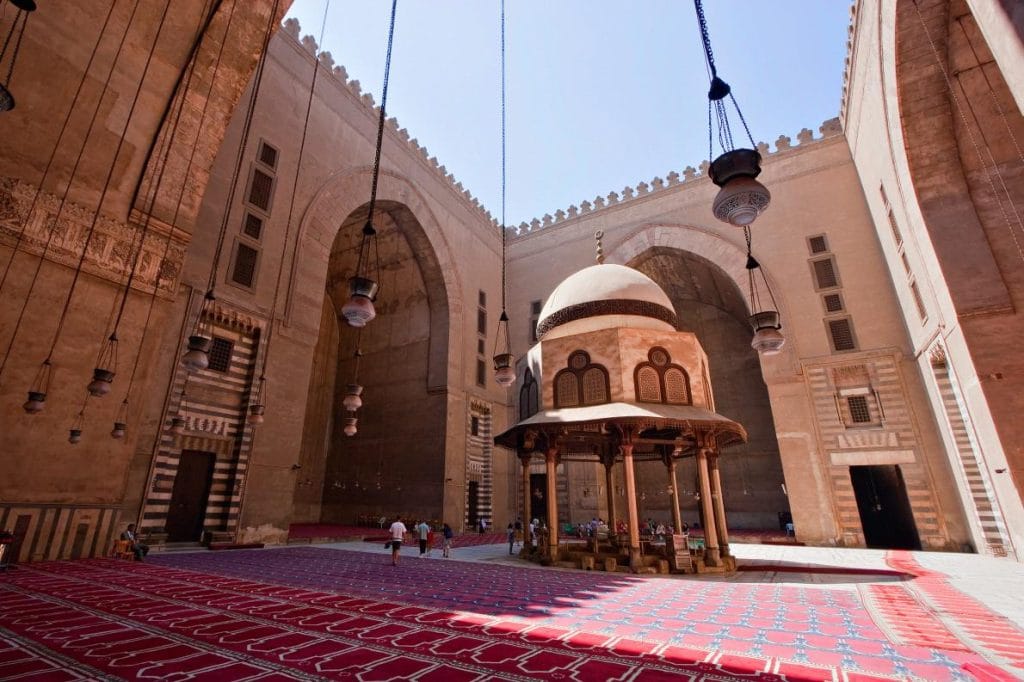
Summary
Mamluk Cairo is the medieval city built by the Mamluk sultans, who ruled Egypt from 1250 to 1517. Most of the great monuments of Islamic Cairo are theirs: the domes, minarets and madrasas along Al-Muizz Street, the huge Mosque-Madrasa of Sultan Hassan below the Citadel, and the domed tombs of the Northern Cemetery. The best way to see it is on foot, in one long morning from the Citadel to Al-Muizz Street and Khan el-Khalili.
Who Were the Mamluks?
The Mamluks were soldiers bought as boys, mostly from the steppes north of the Black Sea and the Caucasus, and trained as an elite cavalry for the Ayyubid sultans. In 1250 they took power themselves. They defeated the Mongols at Ain Jalut in 1260 and pushed the last Crusaders out of the Levant. For more than 250 years they ruled Egypt and Syria from the Citadel of Cairo, until the Ottomans conquered Egypt in 1517.
Power rarely passed from father to son, so each sultan and emir built his own mosque, madrasa and tomb to be remembered. That is why Cairo has more medieval monuments than almost any city in the Islamic world.
The Monuments to See
| Monument | Built | Why go |
|---|---|---|
| Qalawun complex, Al-Muizz Street | 1284–1285 | A hospital, madrasa and one of the most beautiful mausoleums in Cairo |
| Mosque of al-Nasir Muhammad, Citadel | 1318–1335 | The royal mosque of the Citadel, with tiled minarets |
| Mosque-Madrasa of Sultan Hassan | 1356–1363 | The largest and boldest Mamluk building, with four huge iwans |
| Madrasa and Khanqah of Barquq, Al-Muizz Street | 1384–1386 | A fine courtyard and painted ceilings |
| Mosque of al-Mu’ayyad, by Bab Zuwayla | 1415–1422 | Its two minarets stand on top of the old city gate; climb them for the view |
| Funerary complex of Qaitbay, Northern Cemetery | 1472–1474 | Often called the finest carved stone dome in Cairo |
| Al-Ghuri complex | 1503–1505 | The last great Mamluk building, by the spice market |
Khan el-Khalili itself began as a Mamluk caravanserai in the 14th century. More sights in places to visit in Islamic Cairo.
What Makes Mamluk Architecture Different
- Stone domes carved with zigzags, stars and leaves; Qaitbay’s is the best example.
- Tall minarets in stages, square at the base, then octagonal, then round.
- Striped stone in red and white (ablaq), and doorways crowned with stone “stalactites” (muqarnas).
- Several buildings in one: a mosque, a school, a fountain with a Quran school above it (sabil-kuttab) and the founder’s tomb, side by side on the street.
Egypt Honeymoon Escape: Cairo & Red Sea
Want to see this for yourself? This trip covers it.
View This TripA Walking Route Through Mamluk Cairo
- Start at the Citadel and the Muhammad Ali Mosque.
- Walk down to Sultan Hassan and the Al-Rifa’i Mosque; the second is much later, but built to match.
- Take a taxi to Bab Zuwayla and climb the minarets of al-Mu’ayyad.
- Walk north along Al-Muizz Street, past al-Ghuri, to the Qalawun and Barquq complexes.
- Finish at Khan el-Khalili and the Al-Azhar Mosque.
Allow four to five hours. Our Old Cairo tour, from $65 per person, covers the Citadel and Khan el-Khalili; ask us to add Sultan Hassan and Al-Muizz Street. See also our Cairo travel guide.
Visiting Tips
- Dress modestly, covering shoulders and knees; women should bring a scarf for the mosques.
- Take off your shoes at the entrance to prayer halls.
- Mosques close to visitors during prayer times, especially at Friday noon prayers.
- Al-Muizz Street is mostly pedestrian and is lovely in the late afternoon and early evening.
Mamluk Cairo: FAQ
Who were the Mamluks of Egypt?
Slave soldiers who became rulers. They governed Egypt and Syria from 1250 until the Ottoman conquest in 1517.
What is the most famous Mamluk building in Cairo?
The Mosque-Madrasa of Sultan Hassan, below the Citadel, finished in 1363.
Where is Mamluk Cairo?
In historic Cairo, mainly along Al-Muizz Street, around the Citadel, and in the Northern Cemetery.
How long do you need for Mamluk Cairo?
Half a day on foot covers the Citadel, Sultan Hassan and Al-Muizz Street. Allow a full day if you add the Northern Cemetery.