Summary
For several centuries the Library of Alexandria was the greatest centre of learning in the ancient world. Scholars there measured the Earth, edited Homer and studied the human body. Nothing of the building survives, and the story of its end is full of legends. This guide explains what we know, what we do not, and where you can feel its spirit in Alexandria today.
A Library for a New Capital

Alexander the Great founded Alexandria in 331 BC, and after his death his general Ptolemy became king of Egypt. Ptolemy I and his son Ptolemy II wanted their capital to lead the Greek world in learning as well as trade. Around the early 3rd century BC they founded the Mouseion, a “house of the Muses” where scholars lived, worked and were paid by the king. The Library was part of it, in the royal quarter near the harbour. Ancient writers link its planning to Demetrius of Phalerum, a scholar from Athens.
How It Collected Books
The aim was to gather every book worth reading. Agents bought scrolls across the Mediterranean, and according to a later story, ships that called at Alexandria had their books taken and copied, with the copies returned to the owners. Texts were written on papyrus scrolls, made in Egypt. How many scrolls the Library held is unknown: ancient writers give figures from tens of thousands to several hundred thousand. A second, smaller library was kept in the temple of Serapis, the Serapeum, in another part of the city.
The Scholars of Alexandria
The Library is remembered for its people. Euclid wrote his geometry in Alexandria. Eratosthenes, one of the chief librarians, worked out the size of the Earth with surprising accuracy by comparing shadows at Aswan and Alexandria. Callimachus made a huge catalogue of authors and works, an early ancestor of library catalogues. Editors such as Aristarchus produced careful texts of Homer, and doctors such as Herophilus studied anatomy. Tradition also says the Hebrew Bible was translated into Greek here, the version known as the Septuagint.
A Greek Library in Egypt
Most books in the Library were in Greek, but it stood in a country with three thousand years of written history. Around the same time an Egyptian priest, Manetho, wrote a history of Egypt in Greek, and his division of the kings into dynasties is still used today. Egyptian knowledge also fed into Greek science, as our guides to ancient Egyptian medicine and scribes in ancient Egypt explain. The last Ptolemaic ruler, Cleopatra, was said to be a learned queen who spoke many languages.
10 Days Cairo, Alexandria and Beach Vacation
Want to see this for yourself? This trip covers it.
View This TripHow Was the Library Lost?
There was no single dramatic end. In 48 BC, during Julius Caesar’s war in Alexandria, a fire spread from the harbour and burned some books, though how many is disputed. Royal funding faded under Roman rule, scholars left, and in the 270s AD fighting under the emperor Aurelian ruined the palace quarter. The Serapeum was destroyed in AD 391. A famous story blames the Arab conquest of 642, but most historians think it is a later legend, since by then the great Library had probably long been gone.
Visiting Alexandria Today
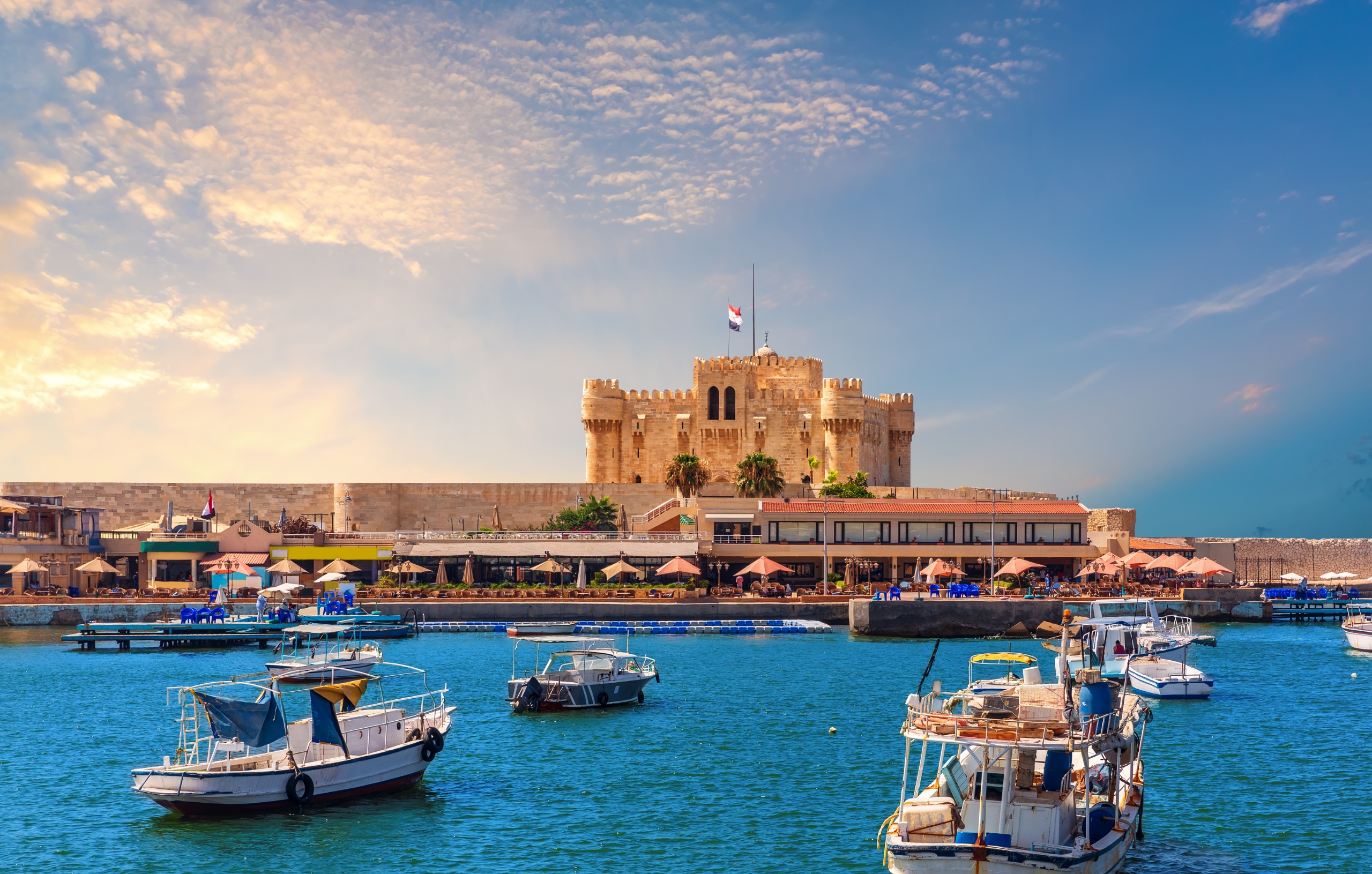
No one knows exactly where the Library stood. In 2002 Egypt opened the Bibliotheca Alexandrina on the seafront near the old royal quarter: a huge tilted disc, its wall carved with letters from scripts around the world, with reading rooms, museums and a planetarium. Nearby you can visit Qaitbay Citadel on the site of the Lighthouse of Alexandria, Pompey’s Pillar beside the ruins of the Serapeum, and the Catacombs of Kom el-Shoqafa. See them on our day tour to Alexandria from Cairo, or stay longer on our 6-day Cairo and Alexandria tour.
Library of Alexandria: FAQ
Who built the Library of Alexandria?
It was founded under the first Ptolemaic kings, Ptolemy I and Ptolemy II, in the early 3rd century BC, as part of the Mouseion research centre in their capital.
How many books did the Library of Alexandria have?
No one knows. Ancient sources give numbers from tens of thousands to several hundred thousand papyrus scrolls.
Who destroyed the Library of Alexandria?
No single person. It declined over centuries, with damage in Caesar’s war of 48 BC, the fighting of the 270s AD and the destruction of the Serapeum in AD 391. The story that the Arabs burned it in 642 is usually treated as a legend.
Can you visit the Library of Alexandria today?
The ancient building is gone, but you can visit the modern Bibliotheca Alexandrina, opened in 2002 near the old royal quarter.