
 Package
 Attraction
 Attraction
 Attraction
 Attraction
Testimonials
Our Clients Reviews
See what our happy travelers say about us
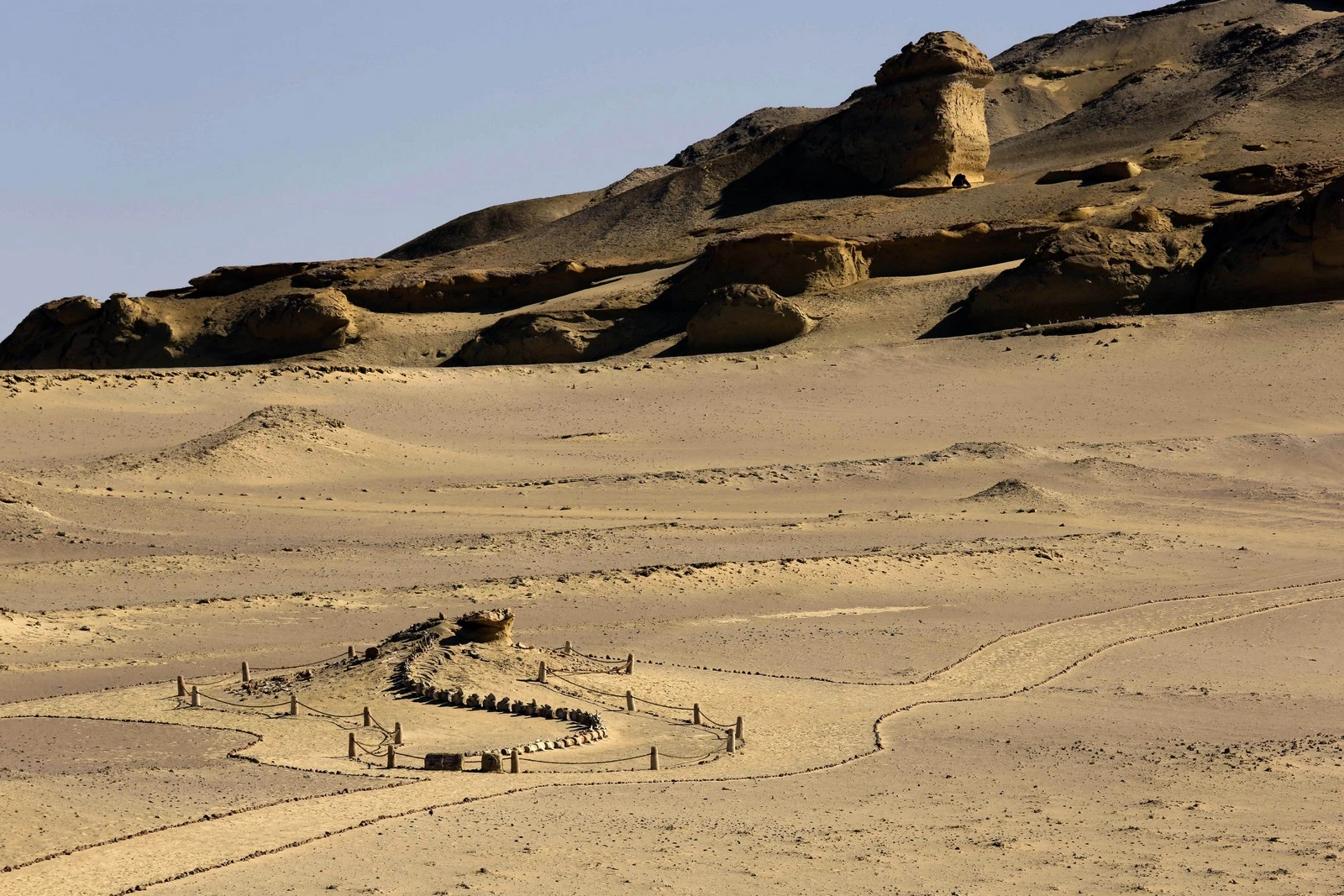
Wadi al-Hitan — the Valley of the Whales — is a UNESCO World Heritage Site in the Faiyum Desert approximately 150 km southwest of Cairo, containing the world’s most important fossil site for understanding the evolution of whales from land-dwelling mammals to fully aquatic creatures. The valley floor preserves the skeletons of hundreds of Basilosaurus and Dorudon — early whale ancestors that lived approximately 37–40 million years ago when the area was covered by the shallow waters of the ancient Tethys Sea — including specimens still possessing vestigial hind legs, the definitive anatomical evidence of whales’ terrestrial ancestry.
The site stretches across a wide desert plain of eroded pale limestone and shale, where the fossil skeletons are exposed at the surface by ongoing wind erosion — some individual specimens measuring over 18 meters in length, their vertebrae, skulls, and flipper bones lying in natural articulation exactly as the animals died and were buried millions of years ago. A walking trail of approximately 4 km winds between the most significant exposed fossil specimens, with interpretive panels at each skeleton explaining the evolutionary significance of the specific anatomical features visible.
The combination of the fossil site’s scientific significance — it provided the definitive evidence for one of evolutionary biology’s most important transitions — and its accessibility as an open desert walk through an extraordinary landscape makes Wadi al-Hitan one of Egypt’s most unusual and scientifically important visitor destinations. An on-site museum provides fossil context before the outdoor walk.
Wadi al-Hitan was an arm of the ancient Tethys Sea 37–40 million years ago, when the area was a warm shallow tropical ocean. The early whale ancestors whose fossils are preserved here — Basilosaurus and Dorudon — were contemporaries of each other: Basilosaurus was a large serpentine predator reaching 18–21 meters in length, while Dorudon was a smaller dolphin-sized species. Both were fully aquatic but retained vestigial hind limbs — reduced rear legs that no longer functioned for locomotion but were anatomically present as evidence of their land-dwelling ancestors.
The fossils were first scientifically documented in 1902 by Hugh Beadnell of the Egyptian Geological Survey. Extensive excavation by Egyptian and American paleontologists beginning in the 1980s gradually revealed the scale and scientific importance of the deposit. The discovery of a complete Basilosaurus specimen with hind legs was one of the most significant paleontological finds of the 20th century, providing physical confirmation of the evolutionary transition from land to sea that had previously been inferred from comparative anatomy.
The site was inscribed as a UNESCO World Heritage Site in 2005, recognized as an outstanding fossil record of a critical phase in the history of life on Earth. The Egyptian Environmental Affairs Agency manages the site with a visitor infrastructure that includes an open-air fossil trail, a small museum, and a visitor center.
A 4 km marked trail between the most significant exposed whale fossil specimens — skulls, vertebrae, and flipper bones in natural articulation on the desert floor, with interpretive panels at each skeleton.
Complete or near-complete skeletons of Basilosaurus — the 18–21 meter serpentine early whale — visible in the desert floor, some including the vestigial hind leg bones that prove their land-animal ancestry.
Smaller dolphin-sized early whale skeletons of Dorudon scattered across the valley floor — some preserved with mother-and-calf pairs in proximity, suggesting pod behavior 38 million years ago.
The on-site museum provides scientific context for the evolutionary significance of the fossils before the outdoor walk — including reconstructed skeletons showing the hind limb anatomy.
The eroded pale limestone and shale valley floor with fossil bones emerging from the sediment is a completely unique landscape — a desert that was once a tropical ocean, made legible in stone.
These packages visit this site as part of the itinerary.

Start From

See what our happy travelers say about us



