


 Package
 Package
 Package
 Attraction
 Attraction
 Attraction
 Attraction
 Attraction
 Attraction
Testimonials
Our Clients Reviews
See what our happy travelers say about us

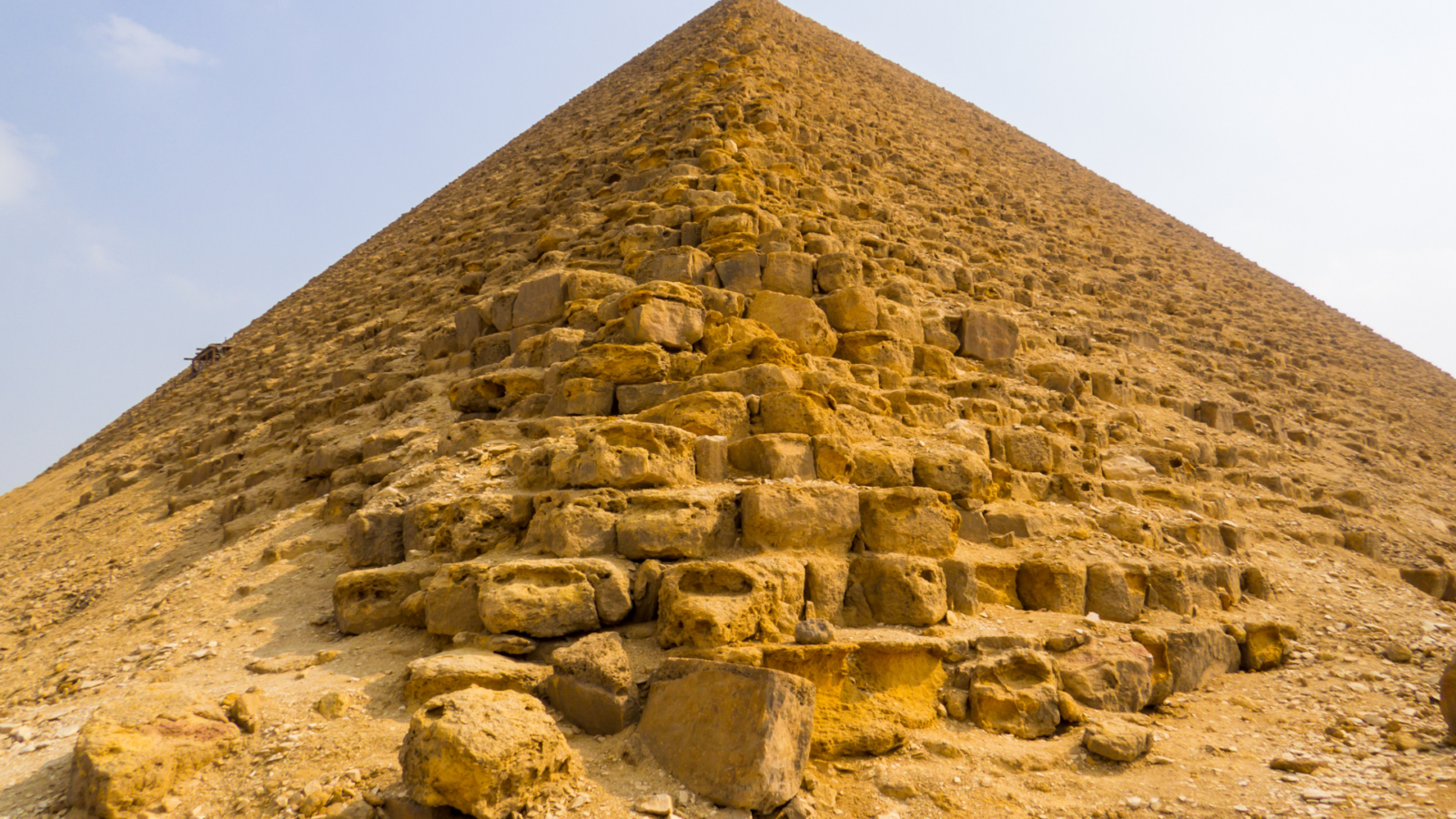
The Red Pyramid at Dahshur is the first geometrically true smooth-sided pyramid ever built and the third largest pyramid in Egypt after Khufu and Khafre at Giza. Constructed by Pharaoh Sneferu around 2590 BCE, it was the king’s successful solution to the structural problems encountered during the construction of the earlier Bent Pyramid, also at Dahshur. The pyramid gets its modern name from the reddish hue of its exposed Tura limestone core, which turns a warm terracotta color in low light.
The Red Pyramid stands 104 meters tall with a base of 220 meters per side and a slope angle of 43 degrees — the same shallow angle used for the upper section of the Bent Pyramid. Its interior is among the most accessible of any major pyramid in Egypt: a 62-meter descending passage leads to three consecutive corbelled chambers, the last two of which rise over 15 meters in height. The corbelled ceiling construction technique used here reaches its most impressive scale in these chambers and was directly inherited by the designers of Khufu’s pyramid.
Dahshur as a whole receives far fewer visitors than Giza, and the Red Pyramid in particular often has minimal crowds — making it one of the few sites in Egypt where visitors can enter a major pyramid interior with no queuing and spend time alone in the ancient chambers.
The Red Pyramid was Sneferu’s third and final pyramid, built after the Meidum pyramid and the Bent Pyramid. By solving the engineering problems of angle and load distribution that had plagued the Bent Pyramid’s construction, Sneferu established the template for the true pyramid form that his son Khufu would use on a larger scale at Giza. The successful completion of the Red Pyramid represents one of the most important developments in the entire history of Egyptian architecture.
Excavations at the pyramid by Rainer Stadelmann and the German Archaeological Institute in the 1980s and 1990s recovered fragments of the original casing stones, which confirmed the outer surface was polished white Tura limestone rather than the reddish core stone now visible. A pyramidion (capstone) in white limestone was recovered from the site and is now displayed near the pyramid.
Human skeletal remains were found in the burial chamber during the same excavations, though whether they belong to Sneferu or are a later intrusion is unresolved. The pyramid was never opened in a formally documented fashion prior to modern archaeology — no Arab-era accounts of entry exist, in contrast to the Giza pyramids.
Three consecutive vaulted chambers with corbelled ceilings rising over 15 meters — the most impressive accessible pyramid interior in Egypt after Khufu's Grand Gallery.
A 62-meter steep corridor (27-degree slope) with wooden handrails descends from the north face to the first chamber, passing through the full limestone core of the pyramid.
The reassembled white limestone capstone, displayed near the pyramid's base, gives a concrete sense of the monuments' intended appearance when complete.
The elevated Dahshur plateau gives unobstructed views across the pyramid fields to the north (Saqqara) and south, with no fences or barriers between the monuments.
These packages visit this site as part of the itinerary.


Start From


Start From

See what our happy travelers say about us



