





 Day Tour
 Nile Cruise
Testimonials
Our Clients Reviews
See what our happy travelers say about us


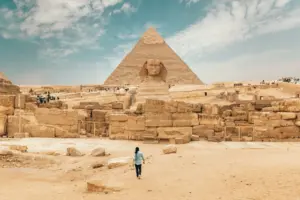
The Giza Pyramid Complex is the most complete surviving royal necropolis of ancient Egypt’s Old Kingdom, built on a desert plateau on the west bank of the Nile approximately 13 km southwest of central Cairo. The site encompasses three main pyramid complexes — those of Khufu, Khafre, and Menkaure — each with associated mortuary temples, causeways, subsidiary pyramids, and mastaba tombs. The Great Sphinx, carved from the natural limestone bedrock, stands guard over the eastern approach to Khafre’s complex.
The three pyramids were built over roughly 85 years during the 4th Dynasty (c. 2589–2503 BCE). At the time of construction they would have been encased in smooth white Tura limestone, reflecting sunlight across the Nile Valley. Today the outer casing is largely gone, stripped during medieval times to build Cairo, but Khafre’s pyramid still retains a cap of casing at its summit.
The site is a UNESCO World Heritage Site and the only one of the Seven Wonders of the Ancient World still standing. Beyond the three pyramids and the Sphinx, the complex includes the Valley Temple of Khafre — one of the best-preserved Old Kingdom temples — and the Solar Boat Museum, which houses the fully reconstructed 43-meter cedarwood boat buried alongside Khufu’s pyramid.
Giza is Egypt’s most visited site and can be crowded, particularly from mid-morning onward. Arriving before 8:00 AM gives substantially more space and better photography conditions.
Construction at Giza began under Pharaoh Khufu of the 4th Dynasty around 2589 BCE. His pyramid — the Great Pyramid — remained the tallest man-made structure on earth for over 3,800 years. His son Khafre built the second pyramid along with the causeway system and the Great Sphinx. Khafre’s son Menkaure completed the third, smaller pyramid around 2510 BCE. Together the three complexes represent the apex of Egyptian pyramid-building in terms of scale and precision.
The workforce that built the Giza pyramids was not enslaved, as was long assumed. Archaeological evidence from the workers’ village south of the plateau — excavated since the 1990s — shows well-fed, medically treated laborers buried with honor, suggesting a skilled permanent workforce and rotating conscripted labor force rather than slaves.
Giza has been a subject of scholarly and popular fascination for millennia. Greek historian Herodotus visited in the 5th century BCE and described the pyramids in detail. Napoleon’s Egyptian campaign of 1798 brought European scientific attention to the site, triggering the modern discipline of Egyptology. The complex was inscribed as a UNESCO World Heritage Site in 1979.
The largest of the three and the only surviving ancient Wonder of the World; interior access to the Grand Gallery and burial chamber is available for an extra fee.
The world's largest monolithic statue, 73 meters long and carved from a single outcrop of limestone, facing due east toward the rising sun.
Appears taller than Khufu's from most angles due to its higher base elevation; still retains its original Tura limestone casing at the apex.
One of the best-preserved Old Kingdom temples, built from massive granite and alabaster blocks and originally connected to the Sphinx by a causeway.
Houses a fully reassembled 43-meter cedarwood boat buried in a pit beside Khufu's pyramid, likely used in his funeral procession.
A ridge at the southwest corner of the plateau gives the classic view of all three pyramids aligned together — best in the early morning.
These packages visit this site as part of the itinerary.


Start From


Start From

See what our happy travelers say about us



