


 Day Tour
Testimonials
Our Clients Reviews
See what our happy travelers say about us

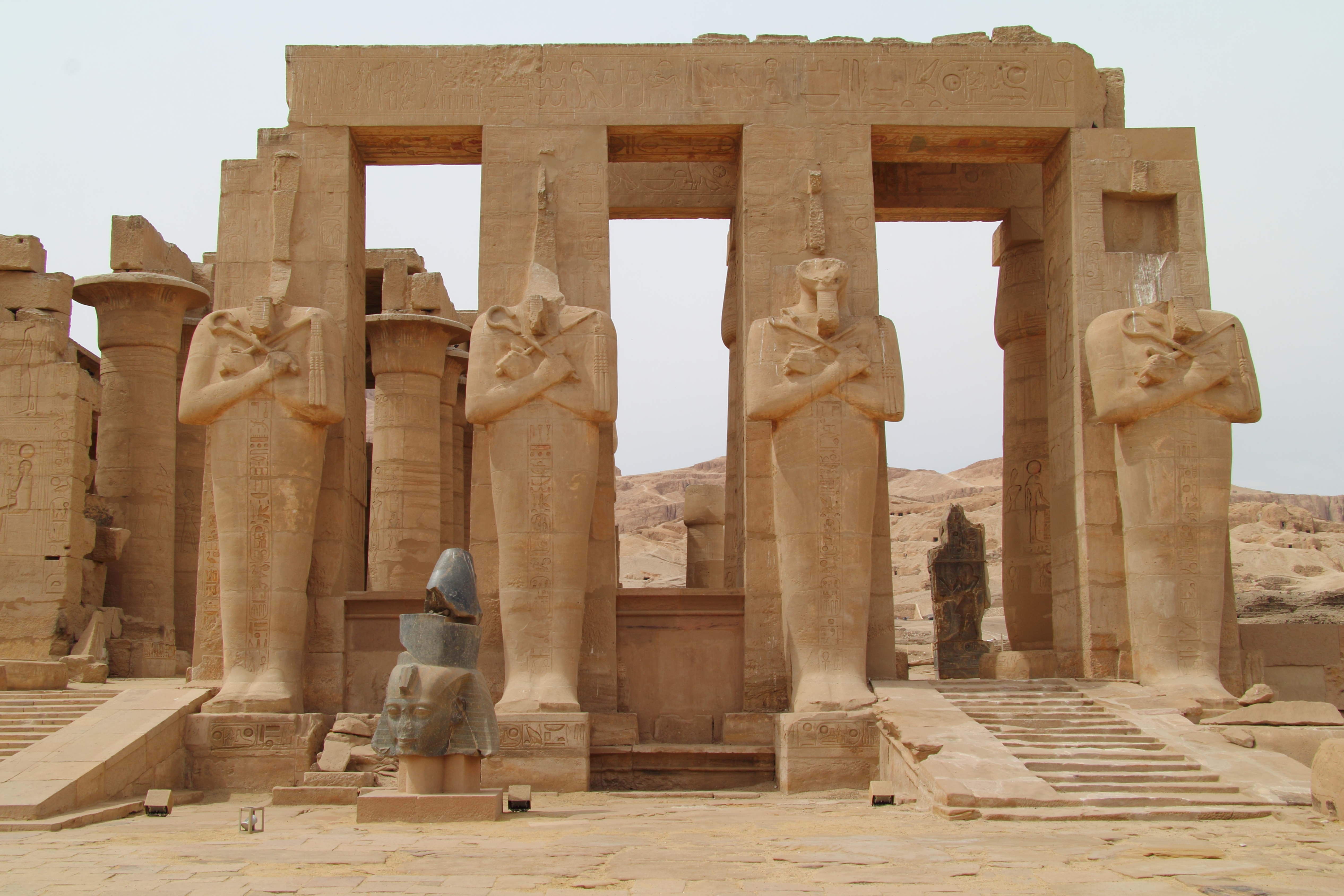
The Ramesseum is the mortuary temple of Pharaoh Ramesses II on the west bank of Luxor, built to receive offerings sustaining the king’s eternal spirit and to celebrate his divine kingship. Though substantially ruined today — only one of the original two pylon towers stands partially intact — it remains one of the most evocative ancient sites on the Theban west bank, partly because of its romantic atmosphere and partly because of the famous fallen colossus that inspired Percy Bysshe Shelley to write ‘Ozymandias.’
The temple’s complex originally included two pylons, two hypostyle halls, a sanctuary, treasury, and a mudbrick storage complex. Ruins of this administrative infrastructure are still partially visible, giving a sense of the temple’s operational scale as both a religious institution and an economic center. Excavations have found evidence of bakeries and granaries.
The temple walls carry reliefs of Ramesses II’s military campaigns, including a version of the Battle of Kadesh. The astronomical ceiling of the second hypostyle hall preserves one of the more complete surviving ancient Egyptian star calendars.
Ramesses II (c. 1279–1213 BCE) built the Ramesseum near the processional way connecting the Nile with the Valley of the Kings. The design follows the standard New Kingdom mortuary temple template established by his father Seti I.
The colossal fallen statue — originally standing over 17 meters — is known as the Younger Memnon. The upper section lies in the first court while the lower section was taken to the British Museum in 1821 by Giovanni Belzoni. The sight of the massive granite torso lying in the dust inspired Percy Shelley’s 1818 sonnet ‘Ozymandias.’
Excavations in the 1980s and 1990s by a French archaeological mission revealed barrel-vaulted storerooms holding grain, oil, and linen in quantities sufficient to serve both the temple cult and the wider population of Thebes during festivals.
The massive granite torso that inspired Shelley's 'Ozymandias' lies in the first court — at 17 meters original height and 1,000 tonnes, one of the largest ancient monoliths ever made.
The second hypostyle hall ceiling retains a painted star calendar and decan chart — one of the better-preserved astronomical ceilings accessible in an ancient Egyptian temple.
Barrel-vaulted mudbrick storerooms surrounding the stone temple give a tangible impression of the temple's economic function as a grain bank and supply center.
The first hypostyle hall walls carry scenes of Ramesses II at the Battle of Kadesh, part of the propaganda campaign depicted across New Kingdom monuments.
These packages visit this site as part of the itinerary.

See what our happy travelers say about us



