




 Package
 Package
 Package
 Package
 Package
 Package
 Attraction
 Attraction
 Attraction
 Attraction
 Attraction
 Attraction
Testimonials
Our Clients Reviews
See what our happy travelers say about us


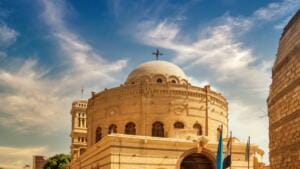
The Saints Sergius and Bacchus Church — known in Arabic as Abu Serga — is the oldest surviving church in Cairo and one of the oldest Christian pilgrimage sites in Egypt, built in the 4th or 5th century CE on a site traditionally venerated as the place where the Holy Family rested during their flight into Egypt. According to Coptic tradition, the Virgin Mary, Joseph, and the infant Jesus sheltered in a cave beneath this church after entering Egypt to escape King Herod — a tradition that makes Abu Serga the focal point of the Flight into Egypt pilgrimage route that brings thousands of Coptic Christians to Old Cairo each year.
The church is a basilica-plan structure with two rows of columns dividing the nave from the side aisles — twelve granite columns representing the twelve apostles. The interior is relatively austere compared to the decorative richness of the adjacent Church of Saint Barbara, but the antiquity of the space is palpable: sections of the original 4th-century building survive in the lower courses of the nave walls, and the crypt beneath the main altar — the traditional cave of the Holy Family’s shelter — is accessible by descending a few steps into a partially flooded underground chamber.
The cave-crypt of Abu Serga is the most sacred space in the Coptic Quarter for pilgrims following the Flight into Egypt route. An annual liturgy is celebrated here on the 24th of Bashans (the Coptic calendar month corresponding to late May or early June), drawing large crowds. The flooding of the crypt, caused by the high water table beneath Old Cairo, ironically preserves the atmosphere of a place that has remained essentially unchanged for sixteen centuries.
The Church of Saints Sergius and Bacchus was built in honor of two Roman soldier-martyrs executed for their Christian faith around 303 CE during the Diocletian persecution. The dedication to these military saints was common in the early Christian period, particularly in regions with significant Roman military presence — the Babylon fortress nearby maintained a garrison that presumably included Christian soldiers.
The tradition linking the site to the Holy Family’s Flight into Egypt is ancient — it appears in Coptic hagiographic texts from the 5th century CE onward and was well-established by the medieval period. Medieval Arab geographers and travelers including al-Maqrizi documented the church’s significance as a pilgrimage destination. The Coptic Pope traveled annually to celebrate the liturgy in the crypt.
The church underwent significant restoration in the Fatimid period and again during the 19th century, when extensive work was undertaken to stabilize the structure against the rising water table. Despite these interventions, substantial original fabric from the early centuries of the building’s existence remains visible, particularly in the lower sections of the walls and in the granite column capitals.
The partially flooded underground crypt beneath the main altar — traditionally the cave where the Holy Family sheltered during their Flight into Egypt — the most sacred space in Coptic Cairo for pilgrims.
Twelve granite columns with carved capitals dividing the nave from the side aisles — representing the apostles and forming the structural spine of the 4th-century basilica.
Sections of the lower nave walls and column bases dating to the original building — one of the oldest legible Christian architectural structures in Egypt.
These packages visit this site as part of the itinerary.


Start From

Start From


Start From


Start From

Start From

See what our happy travelers say about us



