
 Attraction
 Attraction
 Attraction
 Attraction
 Attraction
Testimonials
Our Clients Reviews
See what our happy travelers say about us

It’s the peak in the southern Sinai Peninsula traditionally identified as the mountain where Moses received the Ten Commandments from God, one of the most significant sites in the Abrahamic religious traditions shared by Judaism, Christianity, and Islam. At 2,285 meters above sea level, it rises above the surrounding granite massif in a landscape of extraordinary austerity and grandeur, with views from the summit at sunrise extending across the Sinai mountains, the Red Sea, and — on clear days — the mountains of Saudi Arabia and Jordan.
The mountain is climbed by thousands of visitors each year, primarily in the pre-dawn hours to reach the summit for sunrise — an experience of extraordinary atmospheric power as the desert mountains emerge from darkness and the sky transitions through deep blue, violet, pink, and gold. Two routes ascend from the base at St. Catherine’s Monastery: the longer Camel Path (approximately 7 km), which can be covered by camel for much of the distance; and the steeper Steps of Repentance (3,750 stone steps cut by a monk into the mountain), which is more arduous but more dramatically direct.
At the summit stands a small Greek Orthodox chapel and a mosque, both closed to general visitors, along with the views that have drawn pilgrims, travelers, and seekers for centuries. The descent in full daylight reveals the mountain’s extraordinary geological character — ancient Precambrian granite in shades of pink, red, and grey, carved by billions of years of weathering into forms of severe grandeur.
Mount Sinai, known locally as Jebel Musa, rises to 2,285 metres in the high mountains of South Sinai, directly above St Catherine’s Monastery. The town of St Catherine is about 220 km by road from Sharm El Sheikh, roughly three hours’ drive, which is why most visitors set off from the coast late in the evening, climb through the night and reach the summit for sunrise.
Mount Sinai’s identification as the biblical Horeb/Sinai has been accepted by the Christian church since at least the 4th century CE, when the Byzantine Empress Helena (mother of Constantine) established a chapel at the summit and another at the Burning Bush at the mountain’s base — the latter developing into what is now St. Catherine’s Monastery. The tradition is accepted by the Coptic, Greek Orthodox, Catholic, and Protestant churches, though some scholars propose alternative locations for the biblical Sinai.
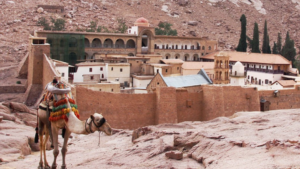
The Monastery of St. Catherine, established at the mountain’s base by Emperor Justinian in 548–565 CE, has maintained a continuous monastic community for over 1,400 years and manages access to the mountain. The Steps of Repentance were cut by a single monk — Father Prokopios — in the 6th century CE, and represent one of the most remarkable individual construction achievements in the history of monasticism.
Mount Sinai’s significance across three religions — as the site of Moses’ reception of the Torah for Jews and Christians, and as a site revered in the Islamic tradition as a place of divine revelation — has made it one of the most universally sacred mountains in the world.
The sky transitioning from deep blue through violet, pink, and gold as the sun rises over the Sinai mountains — the definitive Mount Sinai experience and one of Egypt's most atmospheric natural spectacles.
3,750 stone steps cut by a single monk in the 6th century CE leading directly to the summit — the more arduous and more dramatically direct of the two ascent routes.
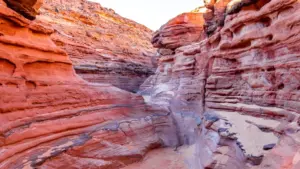
The ancient pink and red granite of the Sinai massif — some of the oldest exposed rock in Egypt — visible in all its austere grandeur from the summit and throughout the descent.
The world's oldest continuously inhabited Christian monastery at the mountain's base — a natural pairing with the summit ascent for a complete Sinai experience.
We do not run a scheduled tour to Sinai yet, but our team can build a private trip that includes Mount Sinai, with a guide, transport and hotels arranged for you.
Plan a tailor-made trip
See what our happy travelers say about us



