





 Package
 Package
 Package
 Package
 Package
 Package
 Attraction
 Attraction
 Attraction
 Attraction
 Attraction
 Attraction
Testimonials
Our Clients Reviews
See what our happy travelers say about us


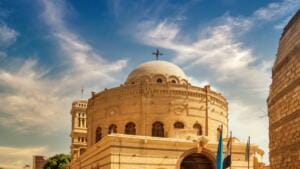
The Hanging Church (al-Mu’allaqa — ‘the suspended’) is the most celebrated Coptic church in Egypt and one of the oldest in the world, built in the late 7th century CE over the southern gatehouse of the Roman fortress of Babylon in Old Cairo. Its name derives from its unusual position — the nave is literally suspended over the fortress gateway’s two ancient Roman towers, giving the church its elevated and historically layered setting. With its magnificent carved wooden ceiling, ivory-inlaid iconostases, and collection of early Coptic icons, the Hanging Church is the finest example of medieval Coptic ecclesiastical art and architecture accessible to visitors.
The church’s interior is extraordinarily rich. The nave ceiling is divided into 29 panels, each framing a carved wooden arch and decorated with geometric and cross patterns in ebony, cedar, and ivory — one of the most elaborate wooden ceilings in any Egyptian church. Three iconostases of carved wood decorated with ebony and ivory inlay separate the nave from the three sanctuaries. The icons, dating from the 8th century CE through the 18th century, represent the full chronological development of Coptic devotional painting — from hieratic Byzantine-influenced early works to the more dynamically composed later icons attributed to Ibrahim al-Nasikh.
A marble pulpit supported on thirteen slender columns — representing Christ and the twelve apostles, with one column intentionally slightly darker than the rest to represent Judas — stands in the nave. The church has served as the patriarchal seat of the Coptic Pope on several occasions in its history and retains an atmosphere of spiritual significance that makes it the most visited Coptic site in Egypt.
The site of the Hanging Church was occupied by a Christian place of worship as early as the 3rd century CE, making it among the earliest Christian cult sites in Cairo. The current structure was built primarily in the late 7th century CE, following the Arab conquest of Egypt in 641 CE, with significant additions and restorations in the 9th, 11th, and 13th centuries. The patriarchal throne of the Coptic Pope was located here for several periods in the medieval era, and numerous Coptic Popes were installed and buried in the church.
The church’s extraordinary wooden iconostases and ceiling decorations date primarily from the Fatimid period (10th–12th centuries CE), when the Coptic community under the relatively tolerant Fatimid Ismaili rulers undertook a major program of church beautification and decoration. This period produced the finest Coptic woodworking surviving anywhere in Egypt, and the Hanging Church’s interiors represent its peak achievement.
The church has been continuously used for Coptic worship since its founding — a period of over 1,300 years. It appears in the accounts of medieval Arab geographers, was visited by Napoleon’s scientific expedition in 1798, and has been the subject of scholarly study since the 19th century. A comprehensive restoration project in the late 20th century stabilized the structure and cleaned the wooden decorative elements, revealing the full quality of the carving beneath centuries of candle smoke.
The nave ceiling divided into 29 panels of carved cedar, ebony, and ivory in geometric and cross patterns — the finest Coptic wooden ceiling in Egypt, dating primarily to the Fatimid period.
Carved wooden screens separating the nave from the three sanctuary altars, decorated with ebony and ivory inlay in elaborate patterns — Fatimid-period craftsmanship at its finest.
The marble pulpit on thirteen columns representing Christ and the apostles — with one column slightly darker than the rest representing Judas — a deliberate symbolic element of the church's liturgical furnishing.
Sections of the church floor have glass panels through which the Roman fortress towers below are visible — a direct encounter with the 2,000-year layering of history beneath the church.
Early Coptic icons spanning the 8th–18th centuries CE, including works attributed to Ibrahim al-Nasikh — a chronological survey of Coptic devotional painting in its original church setting.
These packages visit this site as part of the itinerary.


Start From

Start From


Start From


Start From

Start From

See what our happy travelers say about us



