
Testimonials
Our Clients Reviews
See what our happy travelers say about us
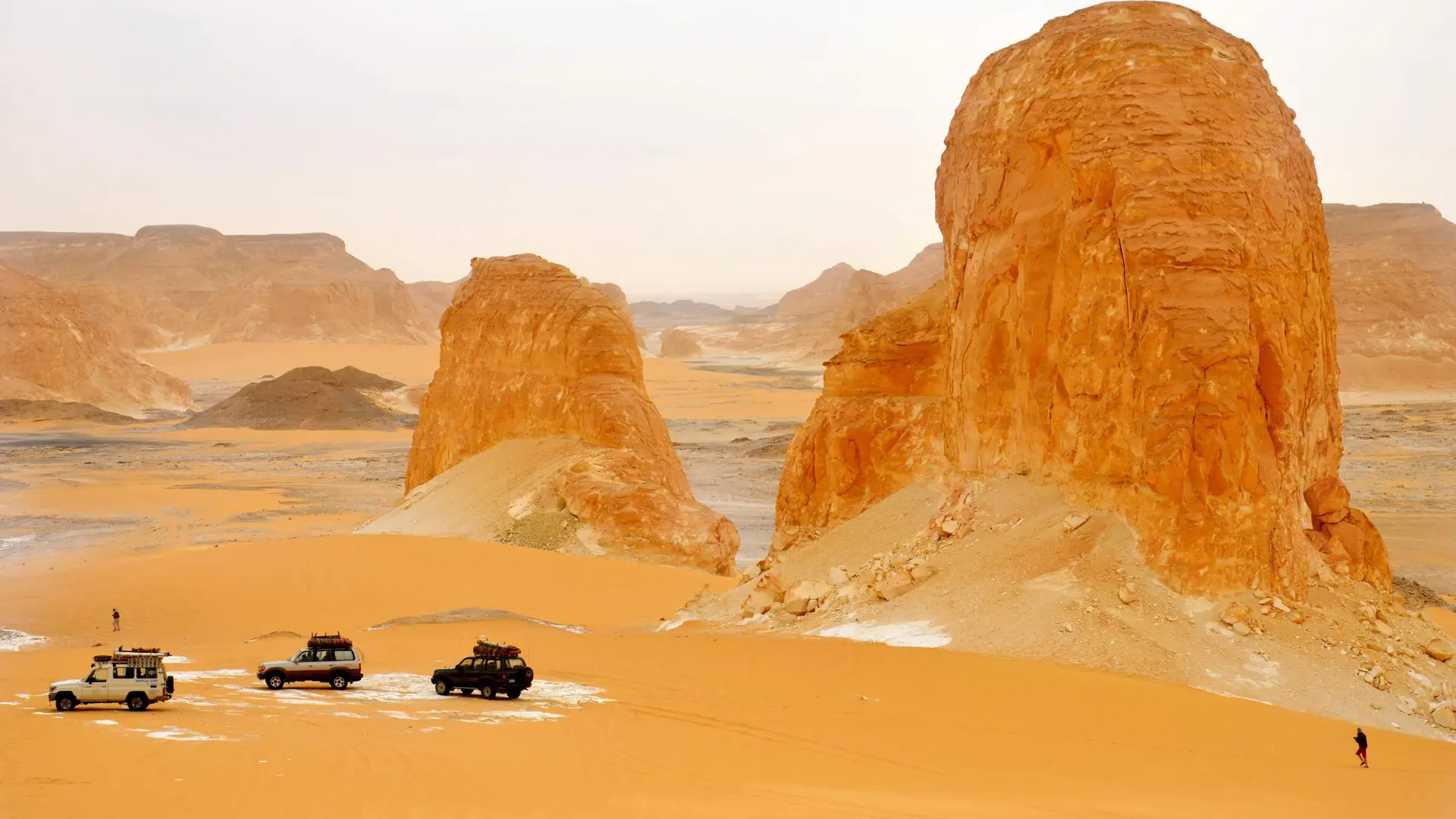

Farafra Oasis is the smallest and most isolated of Egypt’s five major Western Desert oases, located approximately 600 km southwest of Cairo between Bahariya to the north and Dakhla to the south. The oasis depression supports a small population — historically the least-populated of the five oases — centered on the village of Qasr Farafra, with palm groves, hot springs, and scattered ancient ruins. What Farafra lacks in population and archaeological density it more than compensates for in landscape: it serves as the northern gateway to the White Desert, one of the most remarkable natural formations in Africa.
The White Desert (Sahara el-Beyda) lies approximately 45 km north of Qasr Farafra, where millennia of wind erosion have carved the white chalk and limestone bedrock into extraordinary formations — towering mushroom-shaped pillars, arched spans, reclining animal shapes, and abstract white sculptures rising from a cream and ochre plain. The formations glow blue-white under moonlight and golden-orange at sunset, creating an other-worldly landscape that has become one of the most photographed natural environments in the Middle East. Camping overnight in the White Desert — watching the formations shift color from sunset through moonrise to dawn — is considered one of Egypt’s essential travel experiences.
Qasr Farafra itself is a small traditional mud-brick village with a local museum displaying the folk art of Badr Abd el-Moghny, a self-taught local artist whose paintings and sculptures document Farafra’s traditional Bedouin culture and are displayed in the museum he built in the oasis.
Farafra was known in ancient Egypt as ‘Land of the Cow’ and was administered as part of the oasis system supplying wine and agricultural produce to the Nile Valley. Unlike the other oases, Farafra has relatively few ancient monuments — the small population meant less pharaonic investment, and no major temple complexes were built here. The main ancient site is the ruins of Qasr Farafra, the old fortified town, and some rock-cut tombs.
The isolation of Farafra made it both vulnerable to raids and culturally conservative — the oasis maintained its Bedouin character into the modern period more fully than the larger oases. The paved road connecting Farafra to Bahariya and Dakhla was not completed until the 1970s, ending centuries of near-complete isolation.
The White Desert’s geological formations were created over millions of years as the Tethys Sea deposited thick chalk and limestone layers that were later uplifted above sea level. Wind erosion over the past 70 million years progressively sculpted the softer chalk into the formations visible today — a process still ongoing. The mushroom shapes result from faster erosion of the softer lower layers compared to the harder capstone layers above.
Chalk formations in mushroom shapes, arches, and abstract organic forms spread across a cream plain — glowing gold at sunset and blue-white at night, one of Africa's most visually extraordinary natural landscapes.
Camping among the White Desert formations under the stars — the formations transform in color through sunset, moonrise, and dawn in a sequence that defines the Western Desert experience for most visitors.
A folk art museum built by self-taught local artist Badr Abd el-Moghny, displaying his paintings and sculptures documenting Farafran Bedouin culture — one of the most personal and distinctive cultural institutions in the Egyptian desert.
A 35°C natural hot spring pool in the desert — freely accessible, open-air, and in the dry desert landscape of Farafra a genuinely memorable bathing experience.

See what our happy travelers say about us



