
Testimonials
Our Clients Reviews
See what our happy travelers say about us
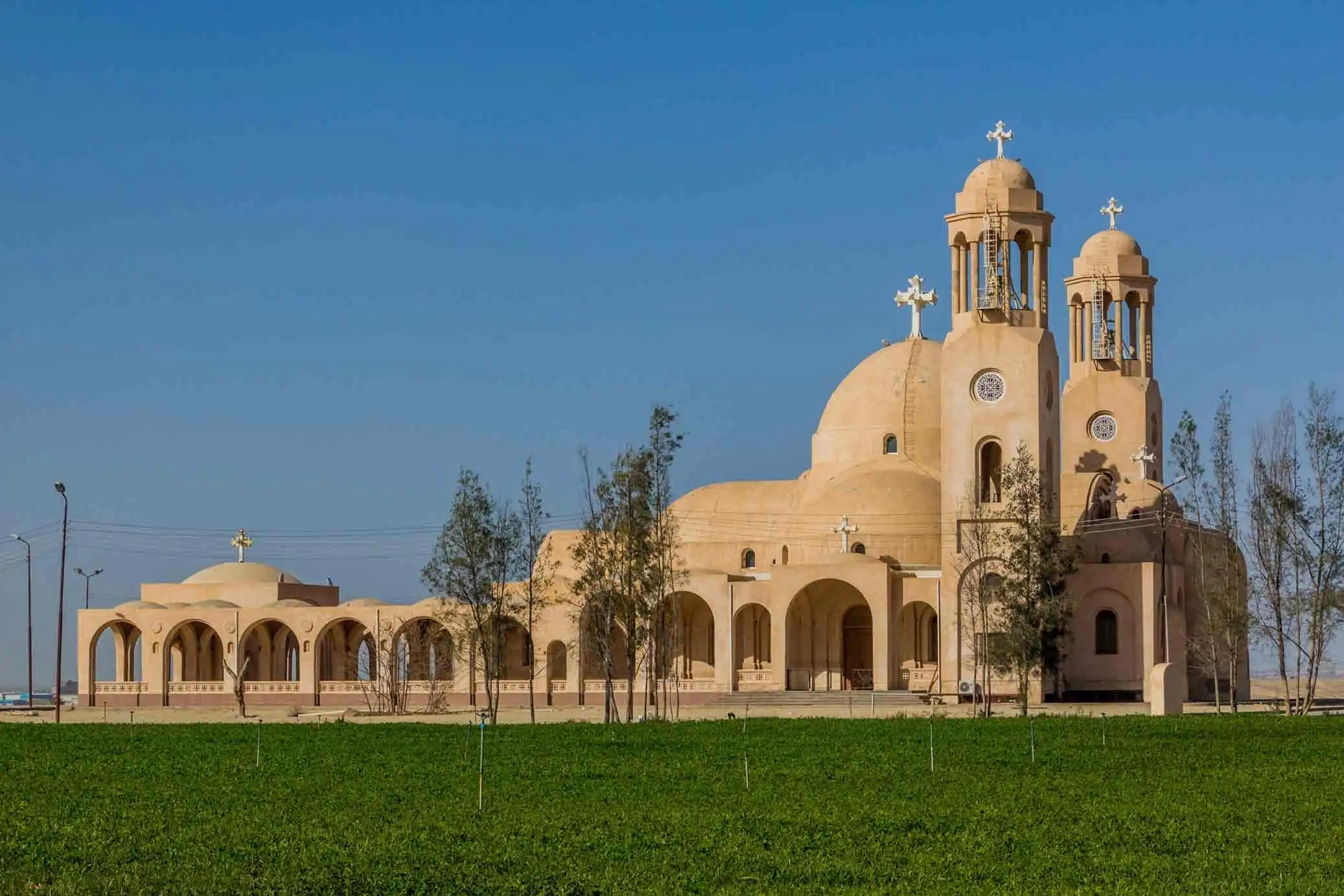
The Wadi Natrun valley, located in the Western Desert approximately 100 km northwest of Cairo along the Cairo-Alexandria desert road, contains four Coptic Orthodox monasteries that are among the oldest surviving Christian monastic communities in the world. The monasteries of Deir Anba Bishoi, Deir Abu Makar (Saint Macarius), Deir al-Baramus, and Deir al-Suryan together represent the direct continuation of the desert monastic tradition established by the early Christian hermits who fled to the Egyptian desert in the 3rd and 4th centuries CE — the same movement that produced Saint Anthony, Saint Pachomius, and the principles of communal monasticism that influenced all subsequent Christian monastic life worldwide.
Each of the four monasteries is a self-contained fortified compound with high stone walls, ancient churches, libraries, and residential cells for the monks. The fortified design reflects centuries of Bedouin raids and political instability that the communities survived. Inside the walls, the monastery churches contain early Christian art — Coptic paintings, carved wooden iconostases, and manuscript collections — that represent some of the oldest surviving examples of Coptic religious culture in any institutional setting.
Wadi Natrun is not merely a historical site — the monasteries are fully functioning communities with active monastic populations that have grown significantly since the 1960s. The revival of Coptic monasticism under Pope Cyril VI and Pope Shenouda III brought thousands of new monks to the desert communities, and today the four monasteries collectively house several hundred monks who maintain the liturgical and agricultural life of their communities. Visitors are welcome but should treat the monasteries as the living religious institutions they are rather than heritage attractions.
The Wadi Natrun valley, known in antiquity as Scetis, became one of the most significant centers of early Christian monasticism in the 4th century CE. Following the legalization of Christianity by Emperor Constantine in 313 CE, many devout Christians who had previously sought holiness through martyrdom turned to the desert as an alternative form of radical religious commitment. The Egyptian desert attracted hermits and later communal monastics who established the vocabulary of Christian contemplative life — regular prayer, manual labor, communal life, and spiritual direction — that was transmitted to Europe through Saint John Cassian and formed the basis of the Benedictine and later monastic traditions.
The founding figures associated with Wadi Natrun include Saint Macarius the Great (c. 300–391 CE), who established the first monastic settlement in the valley, and the thousands of desert fathers and mothers whose sayings were collected in the Apophthegmata Patrum (Sayings of the Desert Fathers) — the foundational text of Christian monasticism. At its peak in the 4th and 5th centuries, Scetis may have housed thousands of monks across multiple communities.
The valley’s name comes from natron — the natural sodium carbonate salt used in ancient Egyptian mummification and occurring naturally in the alkaline lakes of the depression. The ancient Egyptians extracted natron here for ritual and industrial purposes, and the monastery of Deir Abu Makar was built on the site of an ancient Egyptian natron works.
The most accessible and most visited of the four monasteries, containing the relics of Saint Bishoi and a church with early Coptic paintings and iconostases — the former exile residence of Pope Shenouda III.
The oldest of the four monasteries, associated with Saint Macarius the Great who founded the first community at Scetis — its library holds important manuscript collections and its keep tower is a well-preserved example of medieval Coptic military architecture.
Contains some of the most important early Christian artwork in Egypt — Coptic paintings in the haykal (sanctuary) dome dating to the 10th century CE and a renowned library of Syriac manuscripts.
The most remote of the four monasteries — a quieter, less-visited community with an ancient church containing early Coptic paintings and a serene desert setting.
The alkaline lakes and flat desert horizon of Wadi Natrun provide the ecological and spiritual landscape that attracted the first Christian hermits — the view from any monastery wall toward the open desert is unchanged from the 4th century.
We do not run a scheduled tour to Wadi El Natrun yet, but our team can build a private trip that includes Wadi Natrun Monasteries, with a guide, transport and hotels arranged for you.
Plan a tailor-made trip
See what our happy travelers say about us



