




 Day Tour
Testimonials
Our Clients Reviews
See what our happy travelers say about us

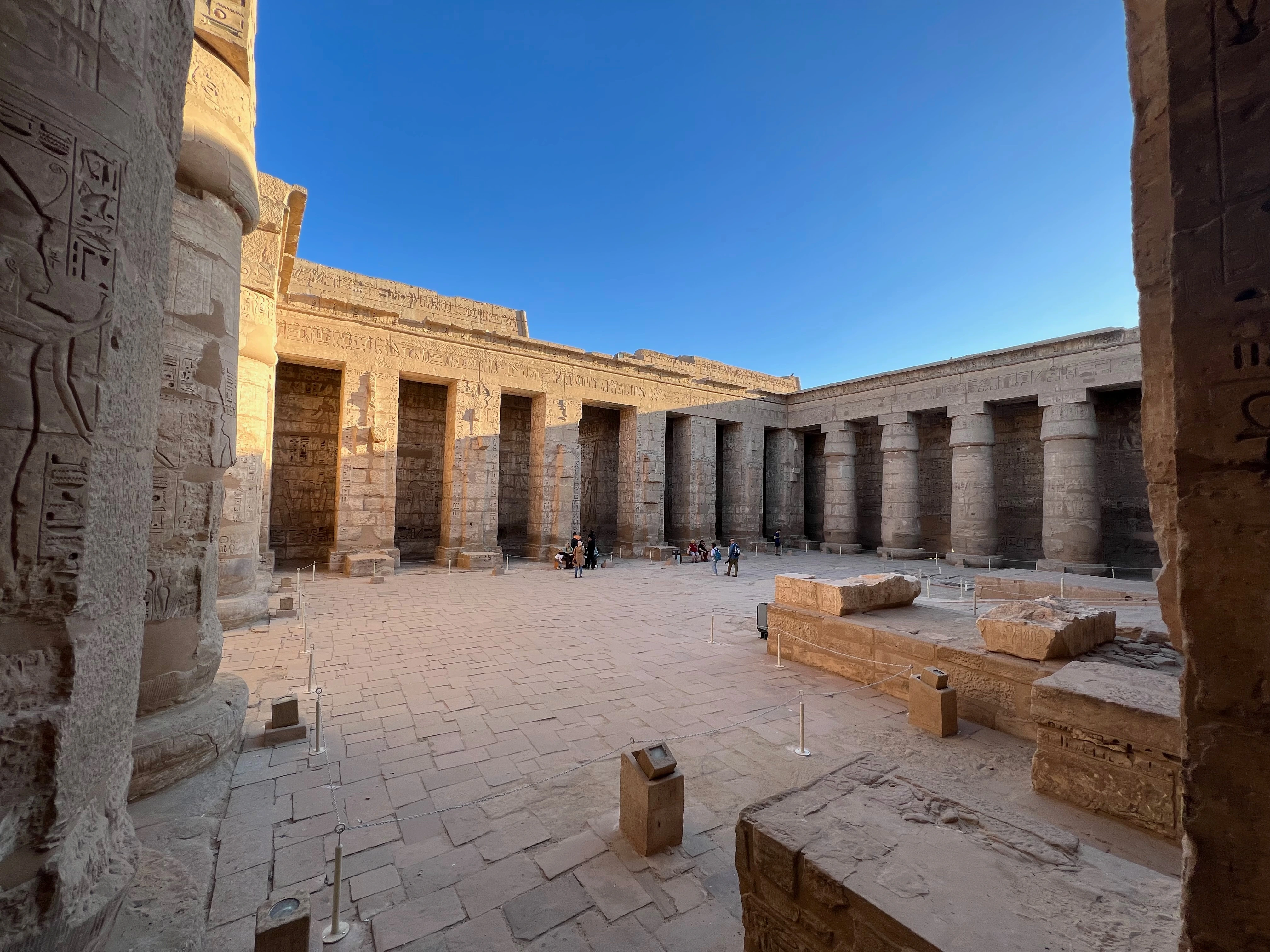
The mortuary temple of Ramesses III at Medinet Habu is the best-preserved New Kingdom mortuary temple on Luxor’s west bank and one of the most extensive ancient Egyptian temple complexes still standing. Larger than the Ramesseum and in substantially better condition, Medinet Habu is the primary record of Ramesses III’s military campaigns against the Sea Peoples, Libyans, and other foreign threats — the last successful military actions of the Egyptian New Kingdom. The external walls carry some of the largest and most detailed military reliefs in ancient Egyptian art.
The complex is entered through an unusual fortified gateway called the Migdol — a towered structure modeled on Syrian military architecture, used by Ramesses III as a personal leisure residence. Beyond the Migdol, successive pylons and courts lead to the mortuary temple proper. The first pylon carries carved reliefs of the king’s campaigns against the Sea Peoples, including the battle of the Nile Delta — the first known naval battle in recorded history.
Medinet Habu served as a significant administrative and population center in the late New Kingdom. The site also contains an 18th Dynasty chapel to Amun built by Hatshepsut and Thutmose III inside the enclosure — one of the oldest structures on Luxor’s west bank.
Ramesses III was the second pharaoh of the 20th Dynasty (c. 1186–1155 BCE) and the last ruler of the New Kingdom to exercise strong centralized control. His reign faced three major military crises: two Libyan invasions (years 5 and 11) and an invasion by the Sea Peoples (year 8) — the migration of displaced Mediterranean peoples that destroyed the Bronze Age palace civilization of the Levant. Ramesses III repelled all three, but the economic cost weakened Egypt irreversibly.
Ramesses III was ultimately assassinated in a conspiracy organized by members of his harem — the Harem Conspiracy, documented in papyri now in Turin. His mummy shows evidence of a fatal throat wound confirming the ancient textual record.
The temple served as a refuge for the local population when central authority broke down following his death. Traces of mudbrick domestic architecture from this later occupation period are still visible inside the enclosure.
The outer temple walls carry the most detailed ancient Egyptian military narrative ever recorded — depicting land and sea battles against the Sea Peoples in year 8 of Ramesses III's reign.
A Syrian-style fortified gate with two towered chambers that Ramesses III used as a personal retreat — the inner chambers retain painted ceiling decoration and royal scenes.
The first hypostyle hall retains some of the best-preserved original painted color of any New Kingdom temple — ochre, blue, and red pigments vivid on the column shafts.
The small 18th Dynasty Amun chapel of Hatshepsut and Thutmose III inside the enclosure is one of the oldest structures on Luxor's west bank with detailed painted reliefs.
Walking the perimeter inside the enclosure wall reveals the full scale of the complex and the mudbrick remains of the settlement that grew within the precinct after the New Kingdom.
These packages visit this site as part of the itinerary.


Start From

See what our happy travelers say about us



