





 Day Tour
 Day Tour
 Nile Cruise
 Nile Cruise
Testimonials
Our Clients Reviews
See what our happy travelers say about us

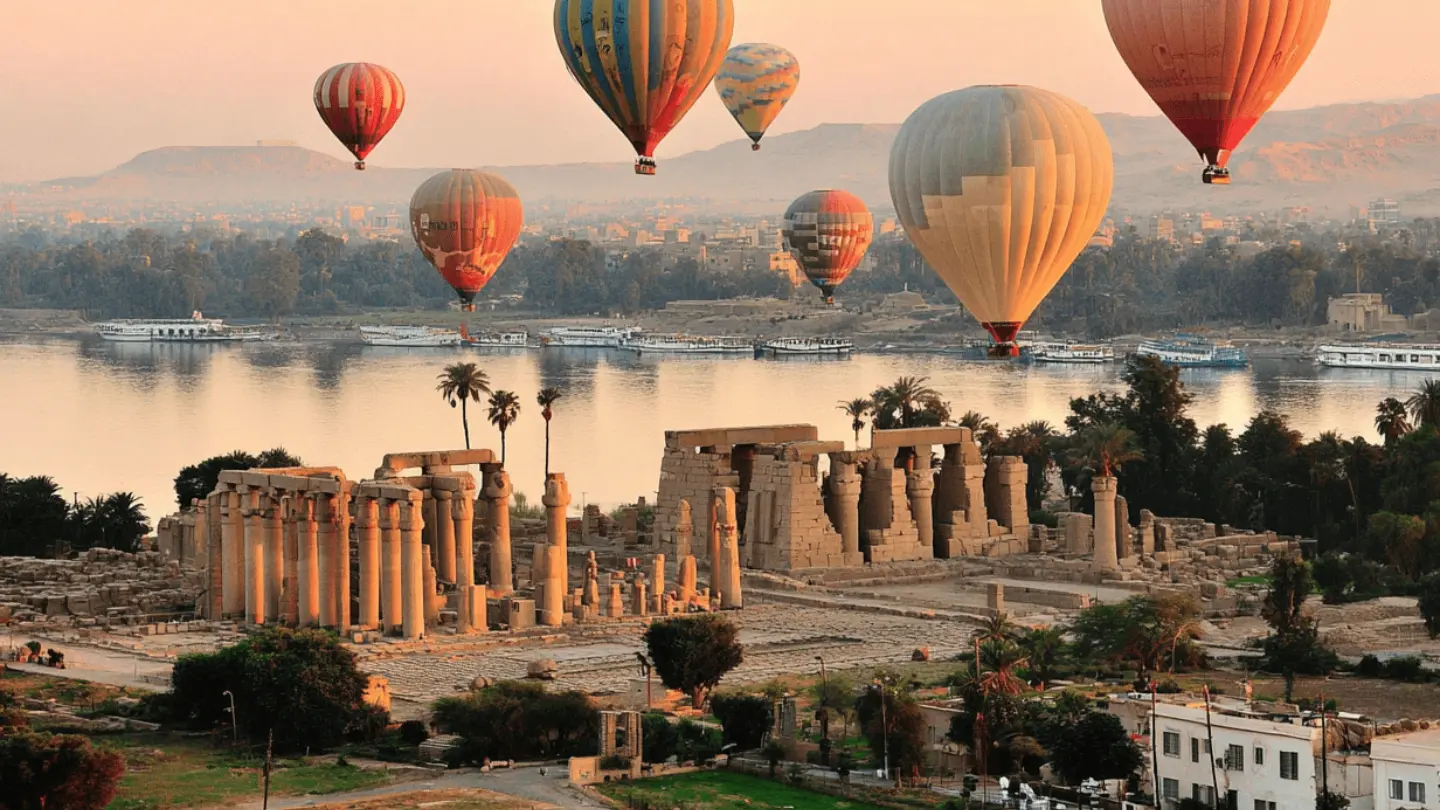
Luxor Temple stands on the east bank of the Nile in the heart of modern Luxor city, its ancient pylons and columns rising directly from the surrounding urban fabric. Built primarily by Amenhotep III and extended by Ramesses II, the temple served as the destination of the annual Opet Festival — a two-to-four-week celebration in which the statues of Amun, Mut, and Khonsu were carried in procession from Karnak to Luxor. The full 2.7-km Avenue of Sphinxes connecting the two temples was reopened in 2021 after 70 years of excavation.
The entrance is dominated by Ramesses II’s massive pylon — 65 meters wide and originally flanked by six colossal statues and two obelisks. One obelisk remains in place; the other was given to France in 1836 and now stands in the Place de la Concorde in Paris. Unlike most Egyptian temples, Luxor contains a significant Roman presence: the inner sanctuary was converted into a chapel for the imperial cult, with red-painted Roman frescoes surviving in some areas.
The Abu el-Haggag Mosque, built over the temple in the medieval period, still functions as an active place of worship and sits directly within the temple precincts — a visible reminder of the temple’s 3,400-year span of continuous use. The temple is floodlit after dark and open until 10 PM, making it one of the most accessible evening attractions in Luxor.
The core of Luxor Temple was built by Amenhotep III (c. 1390–1352 BCE) as a sanctuary for Amun in his ithyphallic manifestation as Amun-Min, associated with fertility and royal rejuvenation. Ramesses II later added a large court and pylon, incorporating an earlier peristyle court of Amenhotep III.
Alexander the Great visited in 332 BCE and added a granite shrine to the inner sanctuary, depicted in traditional pharaonic style making offerings to Amun — one of the earliest examples of a Macedonian ruler adopting full Egyptian royal iconography.
The Abu el-Haggag Mosque was constructed in the 12th century CE over accumulated silt that had buried the temple to colonnade level. Gaston Maspero began clearing the temple in 1884; the mosque was already an active place of worship and could not be removed, and it remains in use today floating above the original ancient floor level.
The entrance pylon flanked by seated and standing colossal statues, with the single remaining obelisk rising 25 meters above the forecourt.
A procession avenue of 14 towering papyrus-bundle columns, each 19 meters tall, leads to the inner temple — originally used for the Opet Festival barque procession.
A granite sanctuary added by Alexander depicting him as a pharaoh making offerings — one of the best-preserved Macedonian-era additions to any Egyptian temple.
A functioning 12th-century mosque perched on top of the ancient colonnade, its minaret rising above the temple walls — a vivid symbol of Egypt's layered religious history.
The temple is floodlit after dark and open until 10 PM; the illuminated columns and pylon create one of the most atmospheric nighttime experiences in Egypt.
These packages visit this site as part of the itinerary.

Start From


Start From


Start From

See what our happy travelers say about us



