
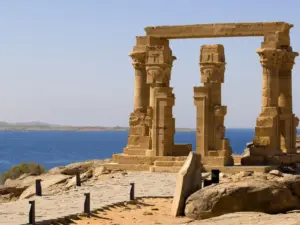
 Nile Cruise
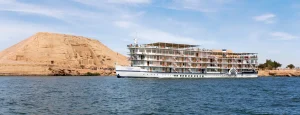 Cruise Ship
Testimonials
Our Clients Reviews
See what our happy travelers say about us


The Temple of Amada is the oldest surviving Egyptian temple in Nubia and one of the finest examples of New Kingdom wall painting still intact anywhere in Egypt. Built on the west bank of what is now Lake Nasser, it was constructed during the reigns of Thutmose III and Amenhotep II of the 18th Dynasty, with later additions by Thutmose IV. Despite its modest dimensions, the temple’s interior reliefs and painted decoration are exceptionally well preserved — color pigments remain vivid after more than 3,400 years.
The temple is dedicated jointly to Amun-Ra and Ra-Horakhty. Its walls carry two historically significant inscriptions: a stele recording Amenhotep II’s military campaign into Canaan and his impalement of seven Canaanite princes, and a second inscription of Merenptah documenting his repulsion of a Libyan invasion in the 13th century BCE. Together these texts make Amada a primary historical source for New Kingdom events.
During the UNESCO Nubian salvage campaign of the 1960s, Amada was too fragile to be cut into blocks. Instead, it was moved intact on a hydraulic platform and rail system, relocated 2.6 km to higher ground — an engineering feat as remarkable in its own way as the dismantling of Abu Simbel.
Construction at Amada began under Thutmose III (c. 1479–1425 BCE), who established the temple as a cult center in Egypt’s Nubian territories. His son Amenhotep II completed the inner sanctuary and added the historically important campaign stelae. Thutmose IV later added a pronaos (entrance hall).
During the Amarna Period, Akhenaten’s agents defaced the name and image of Amun throughout the temple. Following the Amarna Period, Seti I had the defaced images carefully restored using plaster infill — preserving the original composition while covering the damage. This restoration is clearly visible in raking light.
The relocation of Amada in 1975 was undertaken by a French team who built a reinforced concrete jacket around the entire temple, then transported it on a specially built hydraulic rail trolley at roughly 20 meters per hour over 65 days. The operation remains unique in the history of monument conservation.
The interior walls retain painted carvings in red, yellow, blue, and green with a clarity unmatched by most New Kingdom temples — the dry Nubian air preserved them uniquely well.
Two inscribed stelae recording Amenhotep II's Canaanite campaign and Merenptah's Libyan victory make Amada a primary text source for New Kingdom military history.
Areas of deliberate defacement from Akhenaten's reign were patched with plaster by Seti I — visible as lighter-colored sections preserving the original cartouches beneath.

See what our happy travelers say about us



