


 Day Tour
Testimonials
Our Clients Reviews
See what our happy travelers say about us

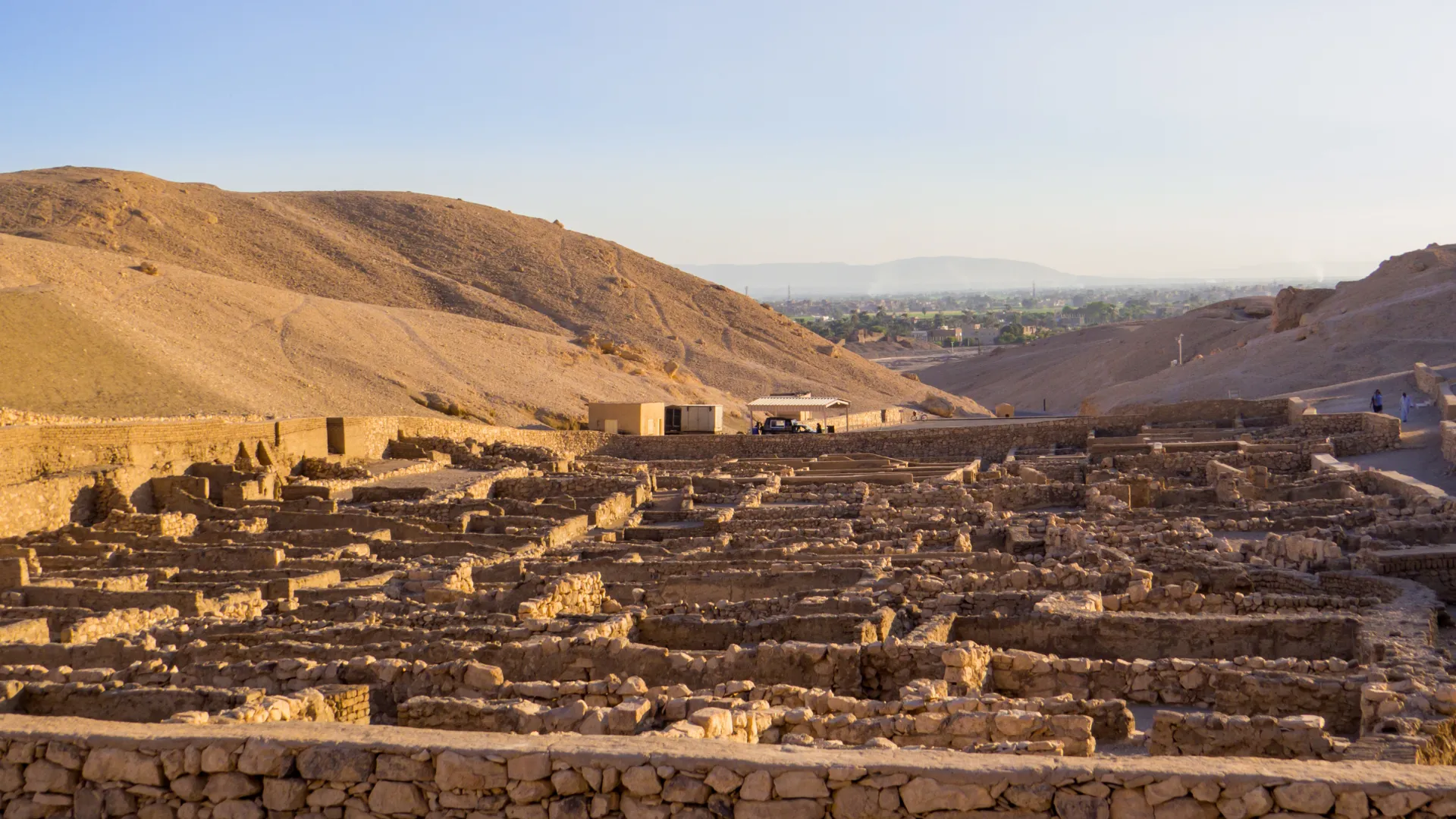
Deir el-Medina is the best-preserved ancient Egyptian workers’ village ever excavated, inhabited from approximately 1550 to 1070 BCE by the craftsmen and artisans who carved and decorated the royal tombs in the nearby Valley of the Kings and Valley of the Queens. The village sits in a narrow desert valley on Luxor’s west bank, tucked between the Theban hills and entirely isolated from the agricultural land of the Nile floodplain — a deliberately controlled environment designed to maintain the secrecy of the royal tomb locations.
The village contains the mudbrick remains of approximately 68 houses, a small Ptolemaic temple dedicated to Hathor and Maat, and a necropolis of workers’ tombs that are among the most colorfully painted private tombs in Egypt. The painted decoration in the tombs — particularly those of Sennedjem, Pashedu, and Inherkhau — is exceptionally well preserved, featuring vivid depictions of the Field of Reeds (the Egyptian paradise) and underworld scenes from the Book of the Dead rendered in a palette of warm yellows, deep blues, and crisp white.
Deir el-Medina also yielded the largest collection of ancient Egyptian administrative and personal documents ever found at a single site. Written on ostraca (pottery shards and limestone flakes), these texts record work rosters, legal disputes, love letters, medical prescriptions, and the world’s first documented labor strike — when the workers stopped work in the 29th year of Ramesses III’s reign because their grain rations had not been delivered.
The village was founded at the beginning of the New Kingdom, most likely under Thutmose I (c. 1506–1493 BCE), when the first royal tombs were being cut in the Valley of the Kings. At its height the village housed approximately 60–120 working families, along with a larger supporting population of servants, water carriers, and administrative personnel. The workforce was organized into two gangs — the right side and the left side — each responsible for one wall of the royal tomb being excavated at any given time.
The workers of Deir el-Medina were among the most literate members of ancient Egyptian society. The volume of written texts they left behind — over 10,000 ostraca recovered from the site — has given scholars an unparalleled window into daily life, interpersonal relationships, legal proceedings, and popular religious practice in the New Kingdom. The ostraca record not only professional matters but also personal letters, erotic poetry, and satirical animal fables in which mice besiege a city defended by cats.
The village was abandoned around 1070 BCE, at the end of the New Kingdom, as political instability and increased tomb robbery made the isolated location untenable. The inhabitants left in an orderly fashion, and the mudbrick houses were gradually buried under windblown sand — a process that preserved their contents and structure better than almost any other ancient Egyptian settlement.
The best-preserved and most colorful worker's tomb at the site — the painted chamber depicting the Field of Reeds is one of the most vibrant ancient Egyptian interiors accessible to visitors.
A beautifully painted tomb showing Pashedu kneeling at a palm tree beside a pool — a devotional image of remarkable elegance from the 19th Dynasty.
Mudbrick walls of approximately 68 houses survive to varying heights, giving a direct impression of the spatial organization and domestic scale of the working community.
A small but well-preserved temple built over an earlier New Kingdom shrine, with carved and painted reliefs; one of the most complete small temples on the Theban west bank.
The necropolis above the village contains dozens of decorated tombs with small mudbrick pyramid superstructures — giving the site a distinctive skyline unlike any other Theban cemetery.
These packages visit this site as part of the itinerary.

See what our happy travelers say about us



