
Testimonials
Our Clients Reviews
See what our happy travelers say about us
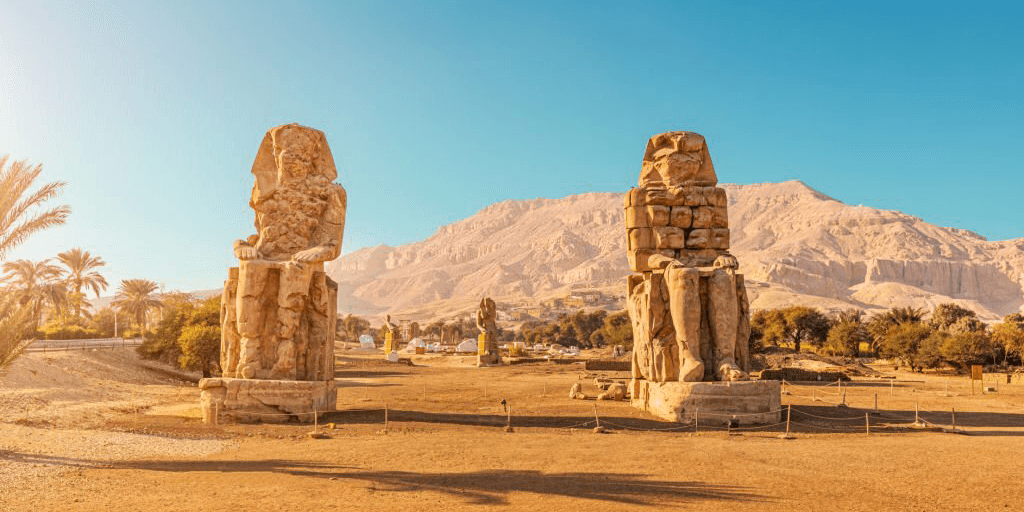
The Colossi of Memnon are two massive seated statues of Pharaoh Amenhotep III of the 18th Dynasty, standing approximately 18 meters tall and carved from single blocks of quartzite sandstone. They stand on the west bank of Luxor at the entrance to what was once the mortuary temple complex of Amenhotep III — in its time the largest temple in Egypt, larger even than Karnak, but now almost entirely destroyed, its stones robbed for later construction projects. The two statues are among the very few surviving elements of this once-enormous complex.
The statues depict Amenhotep III seated on a throne with his hands on his knees, wearing the nemes headdress and double crown. Flanking his legs are smaller figures representing his wife Tiy and his mother Mutemwiya. The thrones are carved with scenes of the god Hapy binding the heraldic plants of Upper and Lower Egypt — a symbolic depiction of the union of the two lands. Additional standing figures of the king were once positioned at the sides, though these are now largely destroyed.
In antiquity the northern statue was famous for a phenomenon known as the ‘singing of Memnon’: after an earthquake in 27 BCE cracked the statue, it began to produce a whistling or singing sound at dawn, caused by the expansion of the damaged stone as it warmed in the morning sun. Greek and Roman tourists traveled specifically to hear this sound, and over 90 ancient graffiti inscriptions recording visits survive on the statue’s legs. When the Roman emperor Septimius Severus restored the statue around 199 CE, the sound ceased — the repairs apparently sealed the crack responsible for the acoustic phenomenon.
Amenhotep III (c. 1390–1352 BCE) was one of the wealthiest and most prolific builders of the New Kingdom. His mortuary temple on the west bank, of which the Colossi are the surviving gateway, was the largest religious building in ancient Egypt at the time of its construction, covering an area of approximately 350,000 square meters. The temple was dedicated to Amenhotep III’s mortuary cult and to the god Amun.
The destruction of the temple began as early as the reign of Merenptah (c. 1213–1203 BCE), who dismantled portions of it to build his own mortuary temple nearby. Subsequent pharaohs continued to reuse the stone, and by the late New Kingdom the temple had largely disappeared. Archaeological excavations since the 1990s by the Colossi of Memnon and Amenhotep III Temple Conservation Project have recovered thousands of statue fragments and architectural elements from the site, revealing the former scale of the complex.
The statues’ Greek name ‘Memnon’ was applied by Greek travelers who identified the statue with the mythological Ethiopian hero Memnon, son of the dawn goddess Eos, who fought at Troy. This identification was prompted by the singing phenomenon and the statue’s position facing east toward the rising sun.
Two 18-meter quartzite seated statues facing east across the Nile floodplain — the most immediately recognizable ancient monuments on Luxor's west bank.
Over 90 Greek and Latin inscriptions carved into the statue legs by Roman-era tourists record visits spanning two centuries, creating one of the oldest documented ancient tourism traditions.
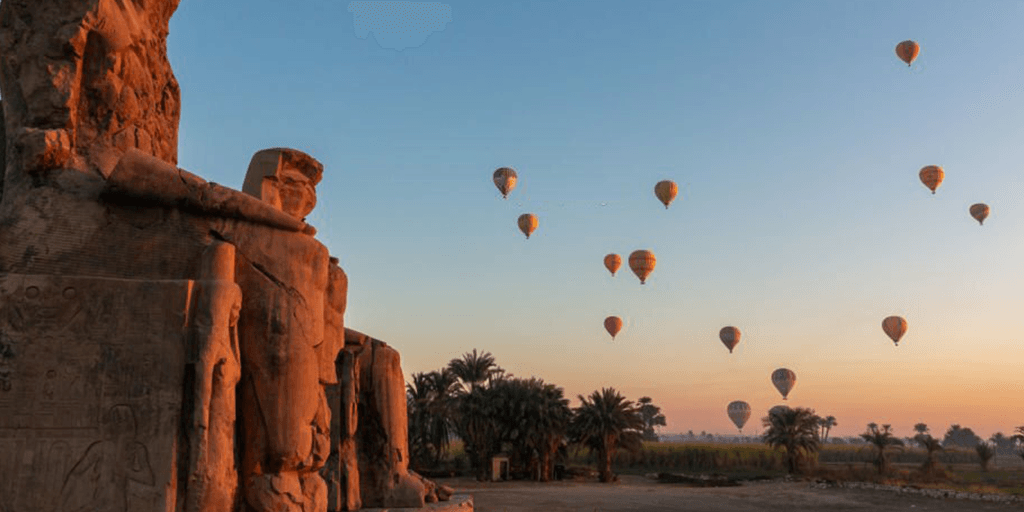
The throne sides carry carved reliefs of the god Hapy binding the heraldic plants of Upper and Lower Egypt — the symbolic depiction of national unity in stone.
A third, standing statue of Amenhotep III has been partially reconstructed from excavated fragments and stands near the original pair — visible during the current ongoing excavation project.
The statues face east; at sunrise the low orange light strikes the quartzite facades directly and the surrounding fields are quiet — the most atmospheric time to visit.

See what our happy travelers say about us
