


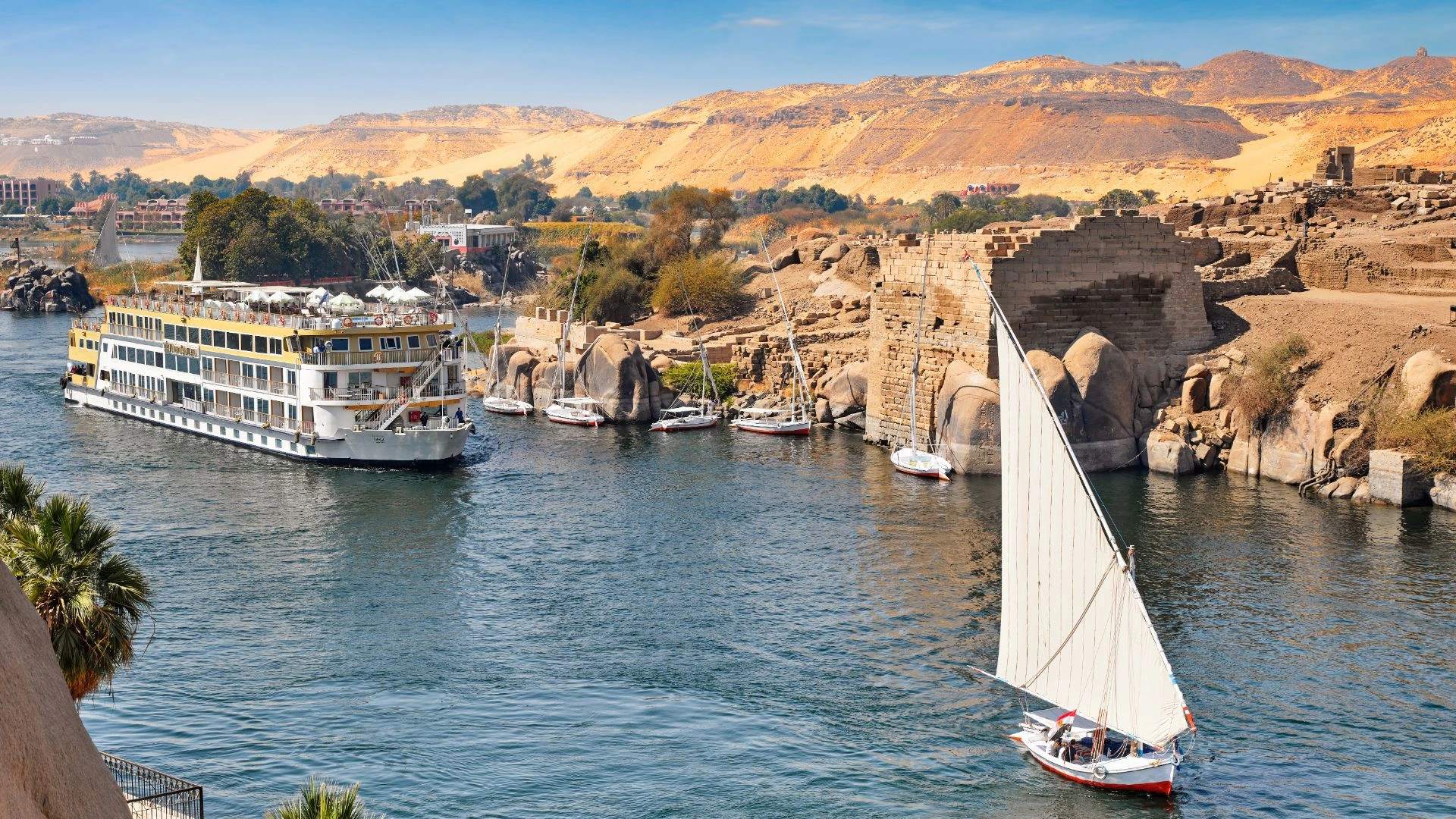


 Nile Cruise
 Nile Cruise
 Nile Cruise
Testimonials
Our Clients Reviews
See what our happy travelers say about us


Abu Simbel Temples is a pair of rock-cut temples on the west bank of Lake Nasser in Egypt’s southernmost governorate, approximately 280 km south of Aswan. The larger temple was built by Pharaoh Ramesses II of the 19th Dynasty as both a monument to his own glory and a statement of Egyptian power to the Nubian peoples to the south. The smaller temple was dedicated to the goddess Hathor and to Ramesses II’s chief wife, Nefertari — one of only a handful of temples in Egyptian history dedicated to a queen.
The Great Temple’s facade is dominated by four colossal seated statues of Ramesses II, each approximately 20 meters tall, flanking the entrance. Inside, the hypostyle hall is lined with eight Osirid statues of the king and painted reliefs of his military campaigns, most famously the Battle of Kadesh against the Hittites. At the temple’s innermost sanctuary, four statues receive a remarkable solar phenomenon twice a year: on February 22 and October 22, sunlight penetrates 65 meters through the entire temple to illuminate the faces of three of the four statues — Ptah, god of darkness, remains in shadow.
The temples would have been submerged permanently by Lake Nasser following construction of the Aswan High Dam. In one of the most ambitious archaeological rescue operations in history, UNESCO coordinated the dismantling and relocation of both temples between 1964 and 1968, cutting them into over 1,000 blocks and reassembling them on an artificial hill 65 meters higher and 200 meters back from the original site.
Ramesses II began construction of the Abu Simbel temples around 1264 BCE and completed them roughly 20 years later. The site was chosen at the border of Nubian territories that Egypt had controlled since the New Kingdom, and the temples served a dual function: religious sanctuary and political monument asserting Egyptian sovereignty. Inscriptions record Ramesses II’s victories at Kadesh and his subsequent peace treaty with the Hittite king Hattusili III — the earliest known international peace treaty in recorded history.
The temples fell out of use following the decline of Egyptian power in Nubia and were gradually buried under drifting sand. They were largely unknown to European scholars until the Swiss explorer Johann Ludwig Burckhardt rediscovered them in 1813, with Giovanni Belzoni clearing the entrance four years later.
The UNESCO salvage campaign of 1964–1968 involved 51 nations and cost approximately $80 million USD. The temples were cut into 1,036 precisely numbered sandstone blocks, each weighing up to 30 tonnes, and reassembled inside a concrete dome structure. The project directly led to the creation of the UNESCO World Heritage Convention in 1972.
Four 20-meter seated statues of Ramesses II guard the Great Temple entrance; the second from the left has been damaged since antiquity, likely by an earthquake shortly after construction.
Twice yearly on February 22 and October 22, dawn sunlight reaches 65 meters to illuminate the inner sanctuary statues — an event crowds travel specifically to witness.
The hypostyle hall walls carry detailed carved reliefs of Ramesses II's chariot charge at Kadesh — the largest military narrative in ancient Egyptian art.
The smaller temple is dedicated to both the goddess Hathor and Queen Nefertari, whose facade statues stand equal in height to those of the king — a deliberate statement of royal esteem.
The deepest chamber contains four statues of Ramesses II with Amun, Ra-Horakhty, and Ptah — Ptah alone is never illuminated by the solar event, as he was god of darkness.
These packages visit this site as part of the itinerary.

Start From

See what our happy travelers say about us



